Braille Monitor
May 2008
(back) (contents)
(next)
More Than You Might Have Imagined
A Survey of Secondary LCB Programs
by Daniel B. Frye and Barbara Pierce
If the comprehensive adult rehabilitation program and the activities of the
Professional Development and Research Institute on Blindness at Louisiana Tech
University were the only initiatives that the Louisiana Center for the Blind
(LCB) administered, most people would agree that they constituted a full array
of service delivery options for any single agency to manage. These, however,
do not represent the LCB�s sole offerings. In addition to its core services,
the LCB runs several seasonal, periodic, and ad hoc specialty programs for infants
and toddlers, youth, those seeking employment, and seniors.
Recognizing that healthy and fundamentally sound attitudes about
blindness are best formed early�well in advance of the inevitable influences
of negative public opinion and low expectations about limited vision�the LCB
established its Early Steps Infant and Toddlers Program. Staffed by consultants
who espouse the progressive philosophy about blindness promoted at the LCB and
who possess expert knowledge about early childhood development and pediatric
orientation and mobility (O&M), this cadre of outreach specialists helps
parents cope with their children�s vision impairments and helps them learn that
blindness does not have to limit opportunities. Through basic education about
blindness, early O&M instruction, and facilitated interaction with parents
of other blind children and blind adults at state and national seminars and
meetings, the LCB Early Steps consultants work to remove the initial mystery,
misconception, and misery that parents often feel when they first learn that
their child is blind. They are also available to make presentations on blindness
to organizations and government entities throughout Louisiana.
The LCB consultants--Sandy Dunnam, vision consultant, and Roxann
Buller, O&M instructor in the school systems of several Louisiana parishes--have
capitalized on their significant professional experience and cultivated positive
working relationships with the state�s public schools over the years. Their
early intervention in the lives of families with blind children�from the rural
depths of Louisiana to the urban inner cities of New Orleans and other metropolitan
areas�allow Louisiana�s blind children to begin school and growing up generally
as well-adjusted blind people.
Eric Guillory, a young blind leader in Louisiana whose résumé
includes a professional background in Braille literacy, adaptive technology,
and special education advocacy stemming from his recent successful work as a
high-profile statewide consultant with the Louisiana School for the Blind, now
directs youth programs for the LCB. These include free consulting services on
Braille, adaptive technology, and special education law to public schools throughout
Louisiana; advocacy support to parents of blind children; and the Buddy Program
and the Summer Training and Employment Project (STEP) summer program for blind
youth.
Capitalizing on his network of public school contacts throughout
the state, Guillory introduced the full scope of the LCB school consulting program
in the following letter:
As some of you know, I became employed as director of Youth Services with the
Louisiana Center for the Blind in May 2007. I am happy to report that in this
capacity I stand ready to assist your agency or school district with a variety
of issues and challenges including instruction in the implementation and utilization
of assistive technology, Braille literacy concerns, activities of daily living,
transition planning, and in-servicing or training in other skills of blindness
areas. We offer training both on-site (in your locale) and on the LCB campus
in Ruston.
 The
Louisiana Center for the Blind�s Youth Services Department is committed to providing
outreach, training, and advocacy assistance for students, their families, and
the professionals who serve them. Please do not hesitate to contact me should
you have any questions or wish me to provide training or technical assistance
to your school or agency. I look forward to working collaboratively with you
to ensure that a high degree of quality services is made available to Louisiana�s
blind students and their families.
The
Louisiana Center for the Blind�s Youth Services Department is committed to providing
outreach, training, and advocacy assistance for students, their families, and
the professionals who serve them. Please do not hesitate to contact me should
you have any questions or wish me to provide training or technical assistance
to your school or agency. I look forward to working collaboratively with you
to ensure that a high degree of quality services is made available to Louisiana�s
blind students and their families.
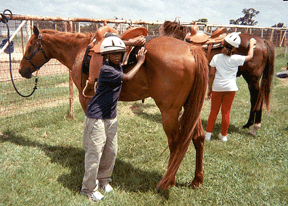
Since 1989 the LCB�s Buddy Program has combined hard work and
challenging recreational activities to provide blind students in grades four
through eight a rewarding four-week summer experience that participants long
cherish. In addition to learning the alternative techniques of blindness, students
enjoy activities like waterskiing, camping, bowling, roller-skating, and horseback
riding.
Because of a lack of positive role models and society�s negative
stereotypes about blindness, many blind children have misconceptions about themselves.
Unlike other summer programs for blind children, the Buddy Program is directed
and staffed by competent blind adults. Cane travel classes instill independence
and self-confidence. Mastering Braille enables the blind child to compete equally
with sighted peers in the classroom and provides a solid background in spelling
and other grammatical skills. Computer literacy classes expose a blind child
to available adaptive equipment. Classes in daily living skills promote equal
participation by summer participants in age-appropriate household duties such
as cooking, shopping, and cleaning. In short, involvement in the Buddy Program
helps blind children realize that not blindness but the negative attitudes and
misconceptions about blindness can prevent their reaching their potential.
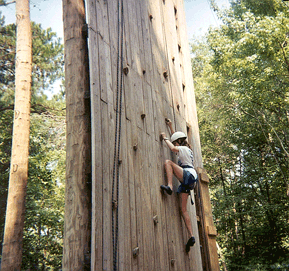 Since
1990 the STEP program has introduced blind teenagers to positive blind role
models and provided participants with summer work experience. Students learn
alternative techniques in blindness and then work fifteen to twenty hours a
week at a local business earning minimum wage. This eight-week summer program
is open to high school students seeking to build their blindness skills and
enhance their résumés through work. In addition to taking classes
in Braille, adaptive technology, cane travel, and independent living skills,
program participants attend seminars on job-readiness, interviewing skills,
and résumé writing. STEP participants also get to attend the annual
NFB national convention, exposing them to a week-long conference where adult
blind role models grapple with contemporary issues of blindness. The combination
of work experience, intensive instruction in blindness skills, and fun-filled
activities such as swimming and adventuresome field trips fosters self-confidence
and increased independence in these blind teenagers.
Since
1990 the STEP program has introduced blind teenagers to positive blind role
models and provided participants with summer work experience. Students learn
alternative techniques in blindness and then work fifteen to twenty hours a
week at a local business earning minimum wage. This eight-week summer program
is open to high school students seeking to build their blindness skills and
enhance their résumés through work. In addition to taking classes
in Braille, adaptive technology, cane travel, and independent living skills,
program participants attend seminars on job-readiness, interviewing skills,
and résumé writing. STEP participants also get to attend the annual
NFB national convention, exposing them to a week-long conference where adult
blind role models grapple with contemporary issues of blindness. The combination
of work experience, intensive instruction in blindness skills, and fun-filled
activities such as swimming and adventuresome field trips fosters self-confidence
and increased independence in these blind teenagers.
LCB�s Career Center reflects the center�s commitment to helping
graduates of its comprehensive adult training course identify and find personally
rewarding employment consistent with their skills and abilities. The Career
Services staff believe that blind people should not be relegated to jobs generally
thought to be especially well suited for blind people.
In order to achieve this goal, the Career Center program enables
graduates of the six-to-nine month comprehensive adult rehabilitation program
to return to the LCB for concentrated instruction in one or more classes in
which additional training will enable them to retain or secure a particular
job. For example, graduates of the LCB rehabilitation program from the late
eighties and early nineties have recently returned to get updated adaptive technology
instruction since Windows-based programs did not exist during their original
training. In addition to a customized blindness skills program, participants
in the Career Center program may also receive career counseling, including one-on-one
instruction in résumé writing, job interviewing, and principles
of general job-readiness. While not regularly used or needed by center alumni,
the LCB Career Center program does provide for flexible training solutions to
support the long-term interests of those who do require additional training
to find or keep a job.
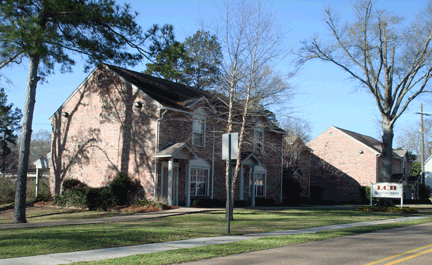 The
Techniques for Living Confidently (TLC) seniors program at the LCB is an initiative
especially targeting legally blind people age fifty-five and above. Aware that
age-related blindness affects the lives of a growing number of seniors, the
LCB has created a program to help newly blind seniors fully participate in the
social and spiritual lives of their communities by teaching them the alternative
techniques of blindness that allow them to resume normal life. Wendy Ortego,
TLC coordinator, along with several other TLC consultants and LCB faculty as
needed, host concentrated week-long senior retreats three or four times a year,
in which participating seniors are taught to cope with vision loss, master basic
skills of independent living, and learn introductory techniques of cane travel.
Recently spouses, adult children, or close friends have been invited to attend
these retreats with the blind senior to observe what is being taught and to
learn how to be supportive and constructive once they return home. TLC participants
also undergo a low-vision assessment to determine what other simple techniques
or technologies might help them live comfortably and adjust to their blindness.
The NFB philosophy shared during these busy training sessions powerfully resonates
with the participating seniors, enabling them to return to their homes and communities
full of optimism and prepared to live confidently and more independently.
The
Techniques for Living Confidently (TLC) seniors program at the LCB is an initiative
especially targeting legally blind people age fifty-five and above. Aware that
age-related blindness affects the lives of a growing number of seniors, the
LCB has created a program to help newly blind seniors fully participate in the
social and spiritual lives of their communities by teaching them the alternative
techniques of blindness that allow them to resume normal life. Wendy Ortego,
TLC coordinator, along with several other TLC consultants and LCB faculty as
needed, host concentrated week-long senior retreats three or four times a year,
in which participating seniors are taught to cope with vision loss, master basic
skills of independent living, and learn introductory techniques of cane travel.
Recently spouses, adult children, or close friends have been invited to attend
these retreats with the blind senior to observe what is being taught and to
learn how to be supportive and constructive once they return home. TLC participants
also undergo a low-vision assessment to determine what other simple techniques
or technologies might help them live comfortably and adjust to their blindness.
The NFB philosophy shared during these busy training sessions powerfully resonates
with the participating seniors, enabling them to return to their homes and communities
full of optimism and prepared to live confidently and more independently.
The programs described here appeal to one degree or another to
blind people at every stage in life. The common element that they share is the
simple but profound philosophy about blindness that characterizes and animates
every undertaking at the LCB. From children to adults to seniors, the can-do
message of the LCB�as articulated through the fifty-eight-year history of the
NFB�shines through. For further information about any LCB program, visit its
Website at <www.lcb-ruston.com> or call (800) 234-4166.