_______________________________________________________________________________
Braille Monitor
Vol. 51, No. 2 February
2008
Barbara Pierce, editor
Published in inkprint, in Braille, and on cassette by
The National Federation of the Blind
Marc Maurer, president
National Office
1800 Johnson Street
Baltimore, Maryland 21230
telephone: (410) 659-9314
email address: [email protected]
Website address: http://www.nfb.org
NFBnet.org: http://www.nfbnet.org
NFB-NEWSLINE® information: (866) 504-7300
Letters to the president, address changes,
subscription requests, and orders for NFB literature
should be sent to the National Office.
Articles for the Monitor and letters to the editor may also
be sent to the National Office or may be emailed to [email protected].
Monitor
subscriptions cost the Federation about twenty-five dollars per year.
Members are invited, and nonmembers are requested, to cover
the subscription cost. Donations should be made payable to
National Federation of the Blind and sent to:
National Federation of the Blind
1800 Johnson Street
Baltimore, Maryland 21230-4998
THE NATIONAL FEDERATION OF THE BLIND IS NOT AN ORGANIZATION
SPEAKING FOR THE BLIND--IT IS THE BLIND SPEAKING FOR THEMSELVES
ISSN 0006-8829
____________________________________________________________________
Contents
Vol. 51, No. 2 February
2008
Dallas Site of 2008 NFB Convention
Lead Photos
Introduction to the Dare to Be Remarkable Conference
by Daniel B. Frye
Diplomacy, Reality, and the Organized Blind Movement
The Elements of Rehabilitation
by Marc Maurer
Independence and Expectations
by Fredric K. Schroeder
Leading and Managing Change in Public Vocational Rehabilitation
by Deana Graham
Making Things Pono in Hawaii: Changes at Ho`opono
by Lea Grupen
Structured Discovery in the Classroom
by Edward Bell
A Governing Philosophy
Strategies for Implementing a Progressive Approach in a
Center-Based Environment
by Shawn Mayo, Pam Allen, and Julie Deden
My Path: My Perspective
by Rosy Carranza
A Summary of Essential Blindness Philosophy in Residential Rehabilitation Training
by James H. Omvig and Joanne Wilson
The 70 Percent Solution
Employment Preparation in a Center Environment
by Dick Davis
Medical Issues and Special Populations
Providing Training to Students with Mental Health Issues
by Mary Ann Goodwyn
Understanding Brain Injury
by Duncan Larsen
Innovative Employment Outcomes
The Real Results of Effective Residential Rehabilitation
by Stacy Cervenka and Nicolas Crisosto
Messages to Take Away: Final Reflections on Residential Rehabilitation
by Allen C. Harris
Recipes
Monitor Miniatures
Copyright 2008 National Federation of the Blind
Dallas Site of 2008 NFB Convention
The 2008 convention of the National Federation of the Blind will take place
in Dallas, Texas, June 29-July 5, at the Hilton Anatole Hotel at 2201 Stemmons
Freeway, Dallas, Texas 75207. Make your room reservation as soon as possible
with the Hilton Anatole staff only. Call (214) 761-7500.
The 2008 room rates are singles, doubles, and twins $61 and triples and quads
$66 a night, plus a 15 percent sales tax. The hotel is accepting reservations
now. A $60-per-room deposit is required to make a reservation. Fifty percent
of the deposit will be refunded if notice is given to the hotel of a reservation
cancellation before June 1, 2008. The other 50 percent is not refundable.
Rooms will be available on a first-come, first-served basis. Reservations may
be made before June 1, 2008, assuming that rooms are still available. After
that time the hotel will not hold our block of rooms for the convention. In
other words, you should get your reservation in soon.
Guestroom amenities include cable television, coffee pot, iron and ironing
board, hair dryer, and for a charge high-speed Internet access. The Hilton Anatole
has six excellent restaurants, twenty-four-hour-a-day room service, first-rate
meeting space, and other top-notch facilities. It is in downtown Dallas with
shuttle service to both the Dallas/Ft. Worth Airport and Love Field.
The schedule for the 2008 convention will depart from what many think of as
our usual schedule:
Sunday, June 29 Seminar Day
Monday, June 30 Registration Day
Tuesday, July 1 Board Meeting and Division Day
Wednesday, July 2 March for Independence and Opening Session
Thursday, July 3 Tour Day
Friday, July 4 Banquet Day
Saturday, July 5 Business Session
The �Dare to Be Remarkable� residential rehabilitation conference was held
at the National Center for the Blind from Wednesday, December 5, to Friday,
December 7, 2007. Over one hundred and fifty professionals gathered to discuss
a wide range of issues involved in operating residential rehabilitation centers
for the blind, but the conference was not all work. Luncheons and a reception
were also part of the program.
1. The NFB of Utah auditorium in the Jernigan Institute was filled to capacity
when Joanne Wilson, executive director of affiliate action, called the Dare
to Be Remarkable conference to order.
2. Conference delegates are pictured here assembled for the Thursday luncheon.
Festive holiday decorations can be seen.
3. Chad Allen, one of the luncheon speakers and a Federation leader from California,
performs magic tricks with a wooden box at the illusions reception on Wednesday
evening.
Conference participants socialize at the Illusions reception on Wednesday evening.
Pictured left to right are Pat Byrnes, Lorinda Riddle, Richard Davis, Shawn
Mayo, Jeffrey Thompson, and Zacharia Ellingson.
Note from the President: I have asked Dan Frye to do much of the editing
for this issue of the Monitor under the direction of Barbara Pierce.
During the past few months Dan has written a number of pieces for the Monitor
and edited others. Most of the time he serves as a manager of programs in the
affiliate action department, where he played a significant role in planning
the conference reported about in this issue. He is an effective writer, and
he likes to express interesting concepts involving the Federation. I will undoubtedly
call upon him from time to time to do further writing for the Monitor.
Because he has been responsible for much of the editorial work in this issue,
his name appears frequently.
Introduction to the Dare to Be Remarkable Conference
by Daniel B. Frye
�Dare to Be Remarkable� was the title and theme of the national conference for
residential rehabilitation training centers for the blind held at the National
Center for the Blind from Wednesday, December 5, to Friday, December 7, 2007.
Jointly sponsored by the National Federation of the Blind and the National Council
of State Agencies for the Blind (NCSAB), this training event featured two and
a half days of instruction in a wide array of topics in both plenary sessions
and interactive, concurrent workshops of particular interest to administrators
and teachers working at residential rehabilitation training centers for the
blind across the country.
Over one hundred and fifty professionals working in the field of blindness
rehabilitation and education from thirty-two states attended the conference.
They represented twenty state rehabilitation agencies, ten private rehabilitation
organizations, five residential schools for the blind, and one university.
The idea of holding a training conference catering to the unique programmatic
needs of staff members in residential rehabilitation centers for the blind was
first conceived in 2002 under the leadership of then Rehabilitation Services
Administration (RSA) Commissioner Joanne Wilson. Two such conferences were subsequently
held in Albuquerque, New Mexico, and Nashville, Tennessee, in 2002 and 2004.
Since then, however, the commitment of influential RSA leaders has waned. They
have abandoned even the most modest pretense of supporting the quality delivery
of categorical rehabilitation services to blind recipients, as manifested by
RSA�s decision to close all ten of its regional offices; dismantle the Office
for the Blind; abdicate its ethical (if not statutory) obligation to preserve
and promote the priority of the Randolph-Sheppard vending program for the blind
in military dining and general program maintenance; and wage an unofficial war
of morale and opportunity against existing and would-be agency employees�particularly
blind professionals�who understand, appreciate, and champion the value of targeted
disability-specific rehabilitation services. In light of the inhospitable climate
currently prevailing at the RSA for blindness-specific rehabilitation initiatives,
NFB and NCSAB leaders determined to convene a third national training conference
for staff of residential rehabilitation centers for the blind. By all accounts
this third national conference compared favorably with its predecessors in size,
program, and participation.
During the three plenary conference sessions, participants heard from sixteen
presenters. Notable among these presentations were addresses by NFB President
Marc Maurer; Dr. Fredric Schroeder, research professor at San Diego State University
and former RSA commissioner; Ed Kunz, Dr. Deana Graham, and Lea Grupen, managers
at the Criss Cole Rehabilitation Center in Austin, Texas, and Ho`opono Services
for the Blind in Honolulu, Hawaii; the executive directors of the NFB-operated
residential training centers for the blind in Louisiana, Colorado, and Minnesota;
Dr. Edward Bell, director of the Professional Development and Research Institute
on Blindness at Louisiana Tech University; five graduates of state and privately
administered residential rehabilitation centers for the blind; and Allen Harris,
executive director of the Iowa Department for the Blind.
An innovative programming feature of this conference was the facilitation of
seven different discipline-specific breakout meetings for managers and administrators
of residential rehabilitation centers and for teachers of Braille, adaptive
technology, orientation and mobility, home management and independent living,
industrial arts, and employment and career counseling. During these discipline-specific
sessions, those working in common professions were able to share ideas and strategies
for enhancing their teaching or management duties. The concurrent afternoon
sessions addressed employment preparation in a center-based environment, legal
affairs and consumer empowerment, blindness philosophy, research issues, transition
and follow-up matters, teaching strategies, challenge activities and self-confidence
discussions, personnel development and training, special populations and medical
issues, and approaches to operating summer programs for blind youth. Finally,
the Dare to Be Remarkable conference included two formal luncheons with keynote
speakers and an evening reception encouraging informal networking among participants.
This edition of the Braille Monitor reprints the principal addresses
delivered during the plenary sessions of the conference and highlights selected
breakout session topics of special interest. Space limitations prohibit our
including every presentation offered during the conference, but what follows
will give Braille Monitor readers a sense of the spirit and flavor
of this early December assembly.
It is significant that the National Federation of the Blind, the nation�s oldest
and largest consumer organization of the blind, and leaders of the National
Council of State Agencies for the Blind, the recognized organization of rehabilitation
professionals specially committed to serving blind people, have over the last
decade or so forged a partnership. This shift in the historical pattern of professional
and consumer relationship promises to be of tremendous benefit to all blind
people in America and may in time revolutionize opportunities for our community.
It is heartening to observe the dawning of a day when both consumers and professionals
are coming to realize that our mutual efforts may yield untapped hope and levels
of independence for blind people everywhere. Focusing, then, on the development
of this partnership in general and the topic of rehabilitation in particular,
in this special edition of the Braille Monitor seems appropriate and
timely.
Diplomacy, Reality, and the Organized Blind Movement
The Elements of Rehabilitation
by Marc Maurer
From Dan Frye: President Maurer delivered the opening address at the
Dare to Be Remarkable residential rehabilitation conference held at the National
Center for the Blind from December 5 to 7, 2007. In addition to providing a
historical context for the development of the rehabilitation system in America,
his remarks offered a succinct perspective on the Federation�s views about the
essential elements of effective residential rehabilitation for blind consumers.
President Maurer proposed commonsense solutions and gave candid advice to the
assembled professionals. The text of his speech follows:
Sometimes, when I think of rehabilitation, my attitude becomes whimsical.
With this in mind, consider the following:
Rehab is our business;
Rehab is what we sell.
Rehab is our business,
The system we know so well.
All the students learn from us
Everything they should know,
How to get an education,
How to travel where they want to go.
The complications of legal rights,
The mysteries of different schools,
The federal/state rehab scheme,
The regulations and the rules.
How to compose resumés,
Create the documents to find work,
Teaching an integrated lifestyle,
Before your clients become berserk.
Rehab is our business;
Rehab is what we sell.
If rehabilitation is noncomplicated�simple and easy to perform�why is there
not uniformity of result throughout the nation? Why does the system seem to
work better in some places than in others? Are the clients different from locality
to locality? If the clients are much the same, the rehabilitation programs must
be different.
According to the dictionary, rehabilitation was known in the English language
as early as 1533. The rehabilitation of that time denominated an act of the
king or the pope to restore legal or ecclesiastical rights to a person who had
lost them. The restoration of an individual to a previous condition of value,
of prominence, or of authority was contemplated by the term. In this sense rehabilitation
is a concept still used in the law today.
Rehabilitation of the kind we are discussing today, finding a method of training
or instruction adequate to permit individuals to employ their talents despite
a severe disability, is a much more modern concept. The story is related that
those who were injured and disabled during the Civil War were known as "the
invalids." During World War I many, many soldiers were severely wounded
and disabled. Something had to be done for them. The first United States Rehabilitation
Act was adopted in 1920. The Smith-Fess Act, otherwise known as the Civilian
Vocational Rehabilitation Act, was the first federal law to authorize rehabilitation
efforts.
Blindness programs were first specified in rehabilitation law in 1943. Some
of the writers on rehabilitation have stated that the early rehabilitation act
did not emphasize blindness because it was thought that this disability was
too severe for rehabilitation to take place. It was not possible to restore
blind people to productivity, they thought. However, in a great many states,
agencies for the blind had been created. These agencies attempted to perform
rehabilitation. The Bardon-LaFollette Act of 1943 first authorized federal support
for separate programs for the blind. Schools for the blind had been established
beginning in the late 1820s, but often the students who graduated from them
were unable to pursue higher education or to find employment. Furthermore, a
number of people became blind after their school-age years. During the 1920s
and 1930s the American Foundation for the Blind, founded in 1921, made a concerted
effort to encourage states to adopt legislation establishing service programs
for adult blind people.
In 1951 Dr. Jacobus tenBroek, then president of the National Federation of
the Blind, worked with others in California to create the California Orientation
Center for the Blind. Dr. Kenneth Jernigan, who became president of the National
Federation of the Blind in 1968, joined the faculty of this center in 1953.
It was the first program to attempt comprehensive orientation training that
incorporated faculty members from the National Federation of the Blind and the
principles of independence espoused by the Federation. The Carroll Center for
the Blind in Massachusetts was creating a training program that taught mobility
for the blind at about the same time, and it expanded services to include other
orientation classes during the 1950s.
In 1955 Dr. tenBroek delivered an address to the American Association of Workers
for the Blind in which he outlined theories behind the approach of the National
Federation of the Blind to rehabilitation training. He expressed the view that
rehabilitation training is based upon the constitutional right of freedom of
expression, which necessarily implies freedom of movement. Dr. tenBroek's speech,
entitled "The Pros and Cons of Preferential Treatment," outlines the
thinking of the Federation with respect to the necessity for orientation training
and the requirements to be expected of rehabilitation programs in providing
it.
In 1958 Dr. Kenneth Jernigan, who had served his apprenticeship in the California
Orientation Program from 1953 until that year, became the director of the Iowa
Commission for the Blind. He quickly established an orientation program which
became the most powerful of its kind. By 1968 Dr. Jernigan had received an award
from United States President Lyndon Johnson for the excellence of his efforts
in the state of Iowa.
I participated as a student in this program from June of 1969 until my departure
for college at the University of Notre Dame in August of 1970. My memory of
that year of training is that I learned so much so fast that it changed the
direction of my life. As I reflect upon my own experience, I sometimes feel
a bittersweet amusement at the comments of some of the blind people I have met
based on my experience with orientation training. I spent a little more than
a year in the program. I have no interest in doing it again. Some of the blind
people I have met have told me that the rehabilitation programs in which they
participated were excellent. They enjoyed them each of the several times they
went through the classes. One blind person I met said that she had been rehabilitated
seven times. I wondered when she would be finished. At the time I spoke with
her, she was in her early forties.
To delineate the elements of residential rehabilitation training for the blind
is fairly straightforward. To implement them satisfactorily is enormously difficult.
Rehabilitation training for the blind requires a fundamental belief that blind
people have ability�as much ability as anybody else. When rehabilitation personnel
believe that the people they are teaching can achieve enormous potential, the
expectations for blind clients go up, the effort poured into the program by
the trainers increases, and the results improve.
The rehabilitation program will instill a demanding work ethic in the clients.
It will teach the essentials for performing tasks using blindness techniques
that would be performed with sight if the clients had it. It will train the
clients to understand the nature of blindness�what the limitations of the condition
are, what society expects of blind people, what is reasonable for blind people
to achieve, what misunderstandings exist about blindness, and the way to address
the social aspects of the subject. It will expect the clients to come to be
able to manage their own lives�determining what kind of education they want,
deciding what kind of livelihood they will seek, choosing the lifestyle that
they want, and making other decisions for themselves. It will assist the clients
to achieve the objectives chosen by the clients. It will recognize the necessity
for the blind to offer something to society. Making a contribution to the society
in which a person lives is a necessary part of achieving integration within
it. It will help the clients to come to understand that they may not expect
a livelihood without having something to trade for it�in other words, productivity
is essential. It will take all other necessary steps to assist in creating a
climate conducive to the integration of the blind on the basis of equality.
This is the task of the rehabilitation program.
In my own case the teachers in the rehabilitation program that I attended expected
me to begin each day at 5:30 a.m. with gym class that lasted an hour. Many blind
people are encouraged to believe that gym class is not for them. I encountered
this argument at the University of Notre Dame when I matriculated there. At
the university my gym class commenced at 8:00 a.m. A strong temptation crossed
my mind to accept the argument that blind students should be exempted. However,
with proper rehabilitation I knew this argument to be an attempt to duck my
responsibilities. If I wanted all the benefits the university could offer, I
must be prepared to accept the responsibility for performing the duties demanded
of all other students. Gym class was a requirement; I went.
When my gym class in the rehabilitation program had concluded at 6:30, I was
free to clean up and dress for the day. I purchased breakfast from a blind vendor.
By 8:00 a.m. I was expected to be ready to learn to travel with a cane. This
class lasted until 10:00 a.m., when the period for wood and metal shop began.
At noon I was free for lunch. Home economics commenced at 12:30; Braille began
at 2:30; typing began at 3:30. At 4:30 we had a business or philosophy class.
At 5:30 in the afternoon we were free to look for dinner or to engage in other
activities. Sometimes evening activities occurred. In other words, the schedule
was demanding�not to say intense. The blind vendor who sold breakfast and lunch
had a vending facility in the rehabilitation agency. However, no facility was
open for dinner. The objective (we were told) was to get us out of the building.
We were expected to seek our supper at a restaurant in town not too far from
the rehabilitation agency. By necessity we learned to travel the streets of
the town with our canes because we were quite interested in getting something
to eat.
During my period of rehabilitation I asked the shop instructor to teach me
how to overhaul an automobile engine. Although this activity had not previously
been a part of the program, he agreed. I was expected to provide the automobile.
I had asked to overhaul the engine because I had heard the teachers saying that
blind people could do almost anything that sighted people could do. I wondered
if the teachers really meant it. I thought overhauling an automobile engine
would be a challenge for them. They challenged me right back by demanding that
I figure out a way to get an automobile. Though I did not know where to obtain
one, I promised that I would get it.
Within a few days the shop teacher took me to a hardware store, where we bought
thousands of dollars worth of tools that could be used to overhaul an engine.
When they said they would help me, they meant it. I got the car, and they taught
me how to rebuild its engine. It worked very well when I was finished. I was
impressed by the experience because I loved automobiles. I was more impressed
by the experience because I had asked the program to do a difficult thing, and
it responded. From this I learned that the wishes of blind people are sometimes
granted, and the desires of blind people to build interesting lives can have
substance and meaning. In other words, this program taught me that my life mattered.
Our philosophy class, the one that began at 4:30 in the afternoon, concentrated
on the subject of blindness. I remember the day that one of the teachers told
me I should learn about this subject. I was seventeen at the time, and I had
been blind all of my life. I thought to myself, "What in the world is there
to know? I have dealt with this topic every single day for years." However,
I had not dealt with it in an informed way.
This class was conducted by a senior staff member who had become acquainted
with a broad range of literature regarding blindness. Questions considered included
what blindness means, what blindness does not mean, what limitations are inherent
in blindness itself, what the misunderstanding of blindness can do to the thought
processes of a blind person, what might be expected from a blind person, what
misconceptions exist within society about blindness, how these misconceptions
can be managed, and how independence is created. All people are frightened by
blindness�some more than others. All people misunderstand blindness at least
to some extent�even those who have lived with it for extensive periods and have
studied it. All people sell blind people short at least part of the time, regardless
of their training or experience. I realize that these global statements may
seem to overstate the case, but my experience tells me that they don't.
The skills portion of rehabilitation programs is important, but the blindness
study gives the skills segment of training meaning and depth. If it were possible
to teach either the skills necessary for independent cane travel or the understanding
of independent travel without the skills, it would be more desirable to teach
the second than the first. It is enormously difficult to teach either without
teaching both.
As I said earlier, the rehabilitation program I attended scheduled activities
for me from 5:30 in the morning until 5:30 in the evening, and sometimes evening
activities occurred. The reason for the extensive day of exercise and study
is that this schedule demonstrated in a tangible way the notion that hard work
is an element of rehabilitation and independence. Unless the teachers are willing
to demonstrate this characteristic, most students will not believe that it is
essential. Therefore teachers must expect long hours and hard work.
Then there are the elements of faith and love. Unless the teachers in a rehabilitation
program become invested in the lives of their students, they will not easily
be able to impart the necessary emotional and spiritual support that are required
to instill a belief in the minds of the students that they have the capacity
to face the world and to handle the problems that come up. Students need to
know that their teachers believe in them and care about them. Blind people are
routinely told that they have no ability and that their lives are without value.
Most of the time these things are said with kindness, but they hurt no less
for all that. The teachers represent a change of mind and a change of heart
for the students. Unless the teachers believe and care enough to share that
belief, the students' minds and hearts will remain unaltered and rehabilitation
cannot occur.
During the course of rehabilitation the teachers will be a primary point of
contact with the students. However, greater depth of understanding becomes possible
when members of the organized blind movement, the National Federation of the
Blind, are also incorporated into the classes. Furthermore, long-term support
is available from the Federation, and the organization has thousands of role
models from whom to gain experience and advice, and the Federation conducts
hundreds of activities to inspire blind students. This is a major factor for
the outstanding success of the training facilities operated by the National
Federation of the Blind. The spirit of the Federation breeds success.
Some administrators have said that they cannot work closely with the Federation
because they must remain neutral. This argument is a dismal cop-out. Neutrality
in rehabilitation has never been required, and it has almost never been practiced.
Rehabilitation officials should go wherever they can get the best support for
their clients. My opinion is that the Federation is that place. We are prepared
to work with you and build alongside you. We believe that fairness to all clients
is necessary. No client should be penalized for membership in any organization.
However, neutrality means that you believe membership organizations are unimportant.
This is shortsighted.
One final observation must be made. Many believe that the world should be fair
but that for the blind it is not. This leads a number of blind people to seek
a way to get even or to look for opportunities to demand retribution or to soak
the sighted. The thought is, "I'm blind, and you owe me." This thought
process�soaking the sighted and retribution�is an expression of bitterness.
It is destructive, and it hurts those who employ it. The blind must come to
know that with proper training and opportunity blind people have the capacity
to compete with others and to succeed. Blind people are not victims; nobody
owes us anything. We must earn our way just as anybody else must. Rehabilitation
shows us that we can, and it gives us the tools to do precisely that. It has
enormous potential. Properly conducted, it is among the most honorable professions
that exist anywhere in the world. It is an honor for me to talk with you about
the remarkable capacity of rehabilitation in the twenty-first century.
Independence and Expectations
by Fredric K. Schroeder
From Dan Frye: Dr. Fredric Schroeder, commissioner of the Rehabilitation
Services Administration during the Clinton administration, recognized professional
in the fields of blindness education and rehabilitation, and first vice president
of the National Federation of the Blind, delivered a powerful address to the
participants attending the �Dare to Be Remarkable� conference during the first
plenary session of the gathering on December 5, 2007. Resurrecting the often-discussed
themes of independence and expectations with fresh and fascinating insights,
he said the following:
I suppose we should begin at the beginning. Where did the structured discovery
model of orientation center training come from? As Dr. Maurer indicated, it
began in California in the early 1950s and was brought to maturity a decade
later under the leadership of Dr. Kenneth Jernigan during his tenure as director
of the Iowa Commission for the Blind.
Of course other programs were providing blindness skills training. So what
was different? What was distinctive in the training Dr. Jernigan developed?
What made it so much more dramatically effective? In a word, it was expectations,
or, said another way, it was the National Federation of the Blind. For at its
core the National Federation of the Blind is blind people asserting their right
and ability to live normal, productive lives--as Dr. Jernigan so often said,
the belief that, given proper training and opportunity, blind people can compete
on terms of equality with their sighted peers.
The Iowa program stood alone. It was not just better than other programs; it
eclipsed them in its impact on the lives of blind people. It set an entirely
new standard, so different from conventional training that the two could not
be compared, as different from one another as the infinite and the finite. But
why was this so? What made the Iowa program extraordinary? What was the quintessential
difference?
Was it the quality of the skills instruction? Was it the rigor of the program?
Of course, but it was more than technical competence and a demanding curriculum.
Dr. Jernigan understood that the isolation of the blind--the lack of opportunity--was
the outgrowth of societal misconceptions about blindness or, said another way,
prejudice based on myth and misunderstanding.
The Iowa program was rooted in a recognition that the condition of the blind
was not the consequence of limited ability but prejudice. It affirmatively set
out to help blind people free themselves from their marginalized status by changing
their own attitudes about blindness. It worked to instill in them an understanding
that society's low expectations did not reflect the truth about blindness but
only the view of the majority, people who could not imagine the blind living
and working alongside the sighted.
To combat a lifetime of conditioning, the Iowa program pushed its students
beyond anything they could have imagined. It showed them through words and deeds
that blind people are limited mostly by stereotypic thinking and low expectations,
not by blindness itself. This is what made the program vital and effective,
but Dr. Jernigan did not stop there.
Every day, every month, every year the program became better still--more challenging,
more rigorous, and as a result more effective and more successful. There was
no sense of defensiveness, no sense that to do better today must mean that we
did poorly yesterday or that to do better tomorrow must mean that today's efforts
are wanting. Instead staff and students alike recognized that low expectations
are in us all and that there is no shame in acknowledging that fact. They took
pride in a shared sense of restlessness, a sense that the limits had not and
would never be reached. But the value of doing better presumes that we are building
on a strong foundation, building on a shared sense of purpose and on a clear
vision of where we are going.
Unfortunately, conventional programs have used the idea of doing better, making
progress, as an excuse for failing to challenge their students, as a shield
for low expectations. For all of their history conventional programs have used
the doing-better standard to justify and defend uninspired and uninspiring programs.
As rehabilitation professionals we believe in the inherent worth of all people
regardless of their ability to achieve according to external measures. We acknowledge
and respect individual differences, individual strengths and abilities. But
our own humanity is turned against us, used to justify low expectations. We
are told that, if a person is doing better, making progress, who are we to devalue
the person's achievements just because those achievements fall short of our
elitist expectations? We are told that, if a person only learns to pour a cup
of coffee, that should be respected every bit as much as the achievement of
a blind person who graduates from Yale Law School. But there is no accountability
in such a view. If the person taught to pour a cup of coffee had the ability
to do more, the potential to attend Yale Law School, but was denied the opportunity,
the person has not been helped but damaged. And we can and must denounce that
damage even when done with caring, kind words and sincere sentiment. Without
a sound foundation, without a shared vision of where we are going, the doing-better
standard serves only to relegate the oppressed to continued oppression.
I respect the illiterate, but I do not celebrate the lack of opportunity that
inevitably results. I respect the unemployed, but I do not celebrate the 80
percent unemployment rate among the blind. As Tevye in Fiddler on the Roof so
eloquently put it, "There's no shame in being poor, but it's no great honor
either.� I respect differences, but I do not celebrate the consequences of low
expectations. I respect the victims of oppression and prejudice, but I do not
respect prejudice and oppression. Doing better is not enough, not enough if
it means helping blind people move from despair to lesser despair, from hopelessness
to lesser hopelessness, from poverty to lesser poverty, when something more
is within reach.
This week we will share ideas, analyze our successes, and discuss the challenges
that remain. We know the fundamentals. We know the principles that make the
Iowa experience the model. But how do we know if we are doing well, doing enough?
How do we know if our programs are good, very good, excellent, or poor? We know
we must continually strive to do better, to make progress from day to day, month
to month, year to year. But does making progress mean we are doing enough, doing
all we should; or has it become an excuse for complacency, justifying mediocrity
by saying, "We're doing better than we were, and we're doing better all
the time"?
Doing better is not enough in and of itself and cannot be the sole measure.
If a racehorse is running at half the speed of others, it can be argued that
it is making progress while still falling farther and farther behind. I am reminded
of the story of the haberdasher who sells a suit for one hundred dollars even
though he paid a hundred and twenty dollars for it himself. When asked how he
can afford to take such a loss, he says "I'll make it up on volume."
Doing better is not enough; it only works if we begin with a sound foundation
and if we have a clear idea of where we are going.
I believe the greatest challenge that confronts us is not external. It is not
the challenge of finding the money to support our programs, even though it may
feel like that from day to day. It is not the challenge of recruiting more students.
It is not the challenge of working with a changing demographic--more and more
older blind individuals, more and more people with additional disabilities--or
even the challenge of finding new activities, new experiences to keep our programs
vital. I believe our greatest challenge is not external, but lies within ourselves,
within each of us individually and within all of us collectively. It is the
challenge of resisting false pride, the idea that there is nothing more for
us to learn. It is the challenge of resisting complacency, resisting falling
into comfortable patterns, putting off the hard things. It is the challenge
of facing our own beliefs about blindness, facing our own fears and uncertainty.
It is the challenge of resisting the paralysis of doubt.
Our responsibility is not to perpetuate comfort, create an illusion of success,
a facade concealing our own conditioning and low expectations. We cannot allow
doing better to replace doing well, nor should we try.
Can a blind person do anything a sighted person can do? The answer is no. I
cannot be an NFL quarterback in spite of my obvious physical prowess. I cannot
be a brain surgeon in spite of my Einsteinesque intelligence. The problem is
not in identifying the impossible. Blind people can do most things with a greater
or lesser degree of adaptation. The difficulty is in knowing when the amount
of adaptation is so great, so disproportionate as to make it impractical if
not impossible for a blind person to do. I believe some things cannot be efficiently
done without sight, but where I draw that line--the line between the impossible
and the impractical--has been determined by my own beliefs about blindness,
and consequently, I suspect, it has been set too low. I need you to help me.
I need you to push and challenge me, not as an inquisitor or bully, but as a
friend and colleague, as someone who shares a deeply held belief in the ability
of blind people and who wants our programs to be a part of helping blind people
break free from the bonds of stereotype and tradition. I need you to help me,
and you need me to help you. By helping each other, will we be able to replace
doing better with doing well, replace progress with real success? Who knows?
But without it failure is certain.
Dr. Jernigan's assertion that with proper training and opportunity blind people
can compete on terms of equality was not just a slogan, not just a dream or
far off hope, not simply hortatory words to lift our spirits, cheer our otherwise
empty lives. The assertion of equality for the blind was meant deeply and literally.
It was a remarkable declaration made by a remarkable man on behalf of a class
of people for whom equality had never before been imagined. It was remarkable
in the 1960s and continues to be remarkable today. Not remarkable because of
a deficiency in the will and ability of blind people to compete, but remarkable
because of the oppression and associated lack of opportunity that blind people
continue to face.
We should celebrate the work we have done, the difference we have made in the
lives of our students, but we should view our success with a skeptical eye--always
questioning, always wondering if we could have done more. The truth is that,
if we are to learn from the Iowa experience, learn from Dr. Jernigan's example,
we will acknowledge and accept that we could have and should have done more.
I do not say this out of harshness or to demean or belittle our past efforts.
I say it because I believe that understanding our own attitudes about blindness
and their impact on our work is fundamental to our success.
What held us back, what kept us from that greater effort, that greater push,
was not laziness or lack of imagination. What we did yesterday and what we do
today and what we will do tomorrow are driven by what we believe about blindness.
Changing society's attitudes about blindness is a long and painstaking process.
Changing our students' attitudes--raising their confidence and expectations--is
equally long and painstaking, but neither is longer or more painstaking and
painful than changing our own attitudes and elevating our own expectations.
Our challenge--our responsibility--is to face our own prejudices, our own misconceptions
about blindness. Face them honestly, not with a wink and a nod, not with an
unspoken smugness that, while we have a vestige of societal conditioning, others
are consumed by it. There is no place for arrogance, no place for false pride
or, for that matter, false humility. The work we do is too important to allow
ourselves to drift into complacency, too important to allow ourselves to become
comfortable and self-satisfied. To achieve this goal, I need your help and you
need mine. We need each other, and we need the collective dreams and aspirations
of blind people, blind people who have joined together to encourage and support
one another, to expand opportunities in education and employment and to change
society's low expectations for the blind. We need the National Federation of
the Blind. We cannot do it alone, and, more to the point, we the professionals
cannot take the lead. The drive, the perspective, the push for equality must
come from blind people themselves. That is the lesson of the Iowa experience.
That is what made the difference. It was true in the 1960s, and it is true today.
Doing better is not enough. Doing better is effective only if we begin with
a strong foundation, the foundation that is the blind themselves, the foundation
that is the National Federation of the Blind.
Leading and Managing Change in Public Vocational Rehabilitation
by Deana Graham
From Dan Frye: Dr. Deana Graham, program manager at the Criss Cole
Rehabilitation Center, Division of Blind Services, Texas Department of Assistive
and Rehabilitative Services, was the lead presenter on a panel that addressed
the topic of effecting change in a center-based environment during the first
plenary session of the Dare to Be Remarkable conference on Wednesday, December
5, 2007. She has distinguished herself as an expert on management change theory,
and she took the opportunity to share her perspective and research on this critical
issue with conference participants. The essence of the message that Dr. Graham
delivered during the gathering is reflected in chapter five of the thirty-first
Institute on Rehabilitation Issues (IRI), a chapter she authored which
provides clear formulas and strategies for introducing change in public vocational
rehabilitation programs. Dr. Graham�s reflections promise to be of considerable
help to rehabilitation-center administrators and blind consumers who are interested
in causing meaningful change to occur in local programs around the nation. No
substantive amendments to Dr. Graham�s work have been made here; only changes
to bring the writing and format into compliance with Braille Monitor standards
have been made. Bibliographic references have been omitted. These may be obtained
by acquiring a copy of the official publication. Finally, readers particularly
interested in this topic may wish to read the entire IRI for broader context.
Occasionally references are made in this excerpt that might be better appreciated
with this additional information, but the main messages about change shine through
nevertheless. We print below Dr. Graham�s chapter on change theory found in
IRI XXXI:
Defining the Change Framework
As a leader you are often faced with change that is major in scope and designates
a fundamental reorientation in the way your organization operates. This radical
or transformational change requires a fast shift in mindset. Relationships change,
both internally and externally, and systems change as the transformation process
moves forward. Quick, significant outcomes are expected, and implementation
of the new order is rapid, jolting, and often fatiguing.
The bad news is that making your organization what it should be and positioning
it to create positive change in your community (not to mention changing the
world) will probably involve transformational change. The good news is you already
know where to start.
Transformational change begins with you. Renee Hanson, in Organizational
Change: How to Survive and Thrive, states, �What organizational change
ultimately requires is that people develop not just new skills and knowledge,
but a whole new way of looking at things.� In the preceding exercises you envisioned
a better future for yourself, your organization, your community, and your world.
You have a whole new way of looking at things. Now you can take action to share
that vision with others and work together toward making it a reality. As a Three-Dimensional
Leader, you can begin building a framework for change.
Five basic elements are important to consider, regardless of the scope of the
change. Successful change is dependent on how well you
- develop and communicate a powerful call to action,
- carefully assess the attitudes of those involved in the change,
- build strong and dependable coalitions of pro-change activists,
- empower people at all levels of the process to begin implementing the changes,
- assure that the new way is mastered and normalized.
Step One: Call to Action. Before you can even begin to deal
with or lead major change, you must stop to ask and answer some tough questions.
For example:
- What is the true essence of this change?
- How does it relate to the underlying principles of vocational rehabilitation
(VR)?
- If I am initiating this change, is it worth the risk to me as the leader,
to the organization, to the local community, and to the larger disability
community?
- Is this a change that is coming whether I like it or not? How can I be
proactive, not just reactive?
- How can I best deal with the implications personally and in all three dimensions
of my leadership responsibilities?
- Why is this change important? Why now?
For the most part life is not made easier for leaders by major change. When
radical, transformational change that is looming on the horizon has already
begun as a result of outside forces or both internal and external factors are
at work, the �why� questions are important ones to answer honestly and candidly.
Change occurs on multiple levels and is driven by multiple perspectives. The
answers to the �why� questions are different based on perspective. The call
to action must be designed to take into consideration as many perspectives as
possible. It is important for you to understand your own perspective before
you can effectively influence others to act.
As a leader at the top you must view change from a wide variety of perspectives,
including its impact on the organization you lead. You may need to consider
issues related to rapidly changing technology; national and state politics;
funding; disability advocates; and changing local, state, and national regulations.
You must always be cognizant of how to position your organization and use your
influence to develop and sustain a positive, powerful vision for the future.
As a middle-management leader your issues relate to the internal operating
systems of the organization, the partnership needed with your service community,
and the impact you can have on the rights of people with disabilities. Your
concerns may relate more directly to the quality of consumer services, meeting
performance goals, communication challenges, and collaboration with internal
customers and local external resources.
As a nonmanagement leader your questions may relate to yourself and your colleagues.
How will the changes impact your ability to do your job and serve your consumers?
How will the changes impact your status and influence? How will you work together
with others in new relationships?
Regardless of the organizational level from which you lead, or which of the
three dimensions you seek to influence, the call to action is a critical element
in any framework for change. You must:
- Have a clear picture of what you want to accomplish and communicate your
vision strongly, passionately, and repeatedly.
- Create a sense of urgency related to the change in order for people to
take the difficult actions required for the process to begin. Change for its
own sake is seldom a good idea.
- Build trust and credibility among all those involved if people are to be
willing to move outside their comfort zone and support any change.
Step Two: Assess Attitudes. As the vision for change emerges,
it is important to assess just where individuals are in their willingness to
embrace the new ways of thinking, communicating, and behaving.
In order to move forward and proactively deal with the challenges of radical,
transformational change, you must facilitate a confrontation with the undiscussables.
These are issues that are critical to opening communications and building trust
but have been too threatening to discuss in open dialogue. These issues become
the proverbial elephant in the living room. Failure to deal with the undiscussables
can make change at both the collective and personal level impossible.
How are the people impacted by the change reacting to the call to action? As
a leader it is up to you to accurately determine who supports the change and
at what level. In order to do that, you need to determine whether those impacted
by the change are true believers, forced believers, or nonbelievers.
True believers, who are enrolled (fully behind the change) or committed (willing
to actively enroll others), truly want the new reality promised by the vision.
The committed person brings energy, passion, and excitement to the process.
The committed person doesn�t play by the rules of the game. She is responsible
for the game. If the rules of the game stand in the way of achieving the vision,
she will find ways to change the rules.
Forced believers make up the majority of individuals impacted when radical,
transformational changes begin to occur. These are folks who are riding the
fence. They are not sure that the changes are positive on any level, but they
are willing to reserve judgment, at least temporarily. Some forced believers
exercise grudging compliance. They tend to dislike the changes and mistrust
the true believers, but they are minimally cooperative in implementing changes,
generally out of fear of retribution or job loss.
Another category of forced believers is the formally compliant group. They
remain reasonably neutral about the new vision and changes but are always careful
to obey the letter of the transformations, if not the spirit. They want to be
perceived to be on board. They generally have a surface-level understanding
of what is happening, but their heart is not yet in the new game.
Finally, the forced-believer category includes those who are doing their best
to genuinely comply. They have some level of understanding and even agreement
with the new state and are struggling to add passion and excitement to their
belief. They are the best candidates to become true believers early in the process.
Nonbelievers are an inevitable part of all change processes. Individuals who
take a stand in this category are either apathetic or noncompliant. Those who
are apathetic were probably not very productive in the old order of things and
will likely present similar problems in the new order. Their issue is less about
change than job performance. Noncompliant members of the organization are those
who have strongly held disagreements with the new direction of things. They
may have been satisfied with the way things were done and remain firmly unconvinced
that changes need to be made.
Every participant in the change process requires your support and encouragement.
As a change leader you must manage the white space. The white space is the gap
between what people do and say and what they think and feel. The larger the
gap between action and belief, the more dysfunction the individual, and ultimately
the process, are likely to experience. The goal at this juncture in the change
process must be to provide forced and nonbelievers with as much information,
support, and guidance regarding nonnegotiable aspects as needed to transition
them to the ranks of the true believers. Ultimately individuals who are unable
to embrace at least forced-believer status will leave the organization, voluntarily
or otherwise.
True believers require significant amounts of encouragement and support as
well, especially from the leader whose vision they embrace and whose call to
action they support. As the new environment emerges, they are in the minority
and outside the mainstream of standard systems. These are the transformational
leaders who are willing to die for the cause and provide the energy and persistence
all change processes require to be successful.
You Are Not Alone
Change is a process that relies heavily on overcoming inertia. As a change leader,
once you have successfully negotiated steps one and two above, the good news
is that you are well on your way to facilitating radical, transformational change.
The other part of the good news is that you are not alone.
Step 3: Form a Powerful Coalition. As the change process
gets underway, you need to identify the true believers. This is called �diagonal
slicing.� Those who strongly support the changes embodied in the vision will
be found at all levels impacted by the change process. They will have diverse
work responsibilities, levels of power, informal authority, and motivations.
They will communicate within their work groups their thoughts and support for
the new ideas and changes. At some point they will become a critical mass. There
will be enough true believers to begin implementation of significant changes,
provide training to other participants, and explain the changes to external
constituents. Experimentation will occur and insight will be gained which will
continue to improve services and create success. Nothing breeds success like
success.
While true believers become a driving force for change, very powerful coalitions
may be formed with others who share commitment to similar long-term outcomes.
There may be dissenting voices among coalition members and a healthy diversity
of perspectives. There may be opposition to some of the strategies planned to
reach the change goal. However, if the coalition is aligned toward the long-term
change, differences create opportunities for problem solving and alternatives
that may be greater than those devised by true believers alone.
Step Four: Expand Commitment and Empower Others to Act. The
change process is well underway. The entire dynamic of change is feeling and
acting a bit chaotic. Transitions are occurring at different rates and levels.
Overall productivity may be temporarily lower. Realignments are taking place,
resulting in significant communication and management challenges.
You may very well feel regretful for having taken on the challenge of change
at all. The prevailing insight tends to be, �If I had known it would be this
difficult, I never would have started.� Transformational leadership is risky
business and clearly not for the faint-hearted. This is the time to remind yourself
that change in all three dimensions is necessary to the survival of organizations,
community services, and opportunities for people with disabilities.
This is a time to expand the numbers of those who are true believers and expect
others to move from grudging compliance to at least formal compliance and so
on up the scale. You should expect true believers to spend a significant amount
of their time teaching others about the new state. Experimentation continues,
and useful insights lead to confirmation of valid ways of thinking, improved
practices, new relationships, and value-added outcomes for people with disabilities.
Empowering others to act is a key element in any successful change strategy.
Participants in the change who have the authority to make choices and the support
to take risks will provide the innovative and creative ideas needed to move
through the chaotic transition phase and into the new emerging state. Empowered
true believers develop and create new systems and models that will provide small,
successful wins, which can become the foundational building blocks for new structures
within the organization.
Encouragement and avenues for sharing success stories must become a priority.
Even small successes reinforce new ideas and behaviors and promote learning
and professional growth. Overall confidence increases, and the number of people
willing to give the new way a try grows. Participants have new experiences and
develop new ideas and concepts, which result in new perspectives. Roles are
redefined to match the new, emergent order of things. New roles encourage new
patterns of action, and the cycle of empowerment begins anew.
Step Five: Consolidation, Mastery and Normalization. Eventually
chaos subsides and life returns to a more manageable level of activity. The
new reality is better able to meet the emerging needs of the internal and external
environments. Values have shifted to encompass the current state. New technologies
and systems have been mastered, informal organizational structures have reformed
and consolidated, and all is back to a somewhat different normal.
Normalization, which is a necessary part of the cycle, can become a dead end.
For transformational change to continue, the transformational cycle must be
complete. The change process will continue when there is ongoing evaluation,
reinvention, and realignment by 3-D leaders.
As a change leader in any of the three dimensions, you must be aware of pitfalls
that often doom the best-intentioned changes: stagnation, illusion, panic, and
exhaustion.
- Stagnation: Sometimes the desire for change is stymied by an overpowering
fear of failure, and the process never even begins.
- Illusion: As organizations, systems, and even cultures struggle to define
their vision, enthusiasm sometimes moves the discussions beyond the practical
into the world of illusions. Transformational change cannot occur if the vision
is not possible to achieve, even with hard work and dedication.
- Panic: Experimentation is required to determine the best course of action
in the early stages of the change process. By definition not all experiments
are successful. The process can get sidetracked during this phase, and those
involved may retreat, panic-stricken, from the change initiative because of
one or more high-profile failures.
Making Things Pono in Hawaii: Changes at Ho`opono
by Lea Grupen
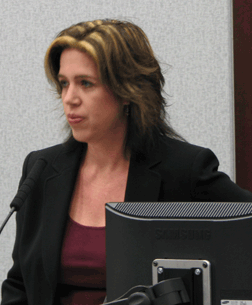 From
Dan Frye: Following the theoretical discussion of elements necessary to effect
substantial change in public rehabilitation programs, Lea Grupen, orientation
center director and field services supervisor at Ho`opono Services for the Blind,
a branch of Hawaii State Vocational Rehabilitation, spoke movingly about the
reforms that she has shepherded at the residential rehabilitation center that
she administers. Her remarks represent a model of how theory and practice can
be successfully married. Readers will marvel at the change that has occurred
in Hawaii, rejoice in the newly found promise for blind consumers of this state,
and enjoy the vicarious Hawaiian cultural experience that her address provides.
Here is what she said:
From
Dan Frye: Following the theoretical discussion of elements necessary to effect
substantial change in public rehabilitation programs, Lea Grupen, orientation
center director and field services supervisor at Ho`opono Services for the Blind,
a branch of Hawaii State Vocational Rehabilitation, spoke movingly about the
reforms that she has shepherded at the residential rehabilitation center that
she administers. Her remarks represent a model of how theory and practice can
be successfully married. Readers will marvel at the change that has occurred
in Hawaii, rejoice in the newly found promise for blind consumers of this state,
and enjoy the vicarious Hawaiian cultural experience that her address provides.
Here is what she said:
Aloha, my name is Lea Grupen, and I am the orientation center director and field
services supervisor at Ho`opono Services for the Blind, a branch of Hawaii State
Vocational Rehabilitation.
I am humbled and grateful for being invited to speak to you today about our
experiences in changing our training program. I want all of you in the audience
who are thinking about making a change to believe that it is possible. This
sounds like such a cliché, but change is not easy. It is definitely easier
to stay the same. Now I am going to throw a few Hawaiian words at you. I think
you will be able to relate. You have to make a decision. You have to want pono--justice;
you have to have ha`aha`a--humility. You must have an attitude of imua--moving
forward; malama and aloha--genuine caring for your students. Your staff, from
the administration down, must accept kuleana--responsibility; you must be wiwo`ole--courageous.
And you need to have lots of help from friends who know what they are doing.
About seven years ago we had an adjustment-to-blindness-training program that
was running under the traditional medical model. It was a day program in which
students could come in when they wanted and take the classes they wanted using
whatever vision they had, and it was run by primarily sighted staff who cared
about their students and were doing the best they could to train blind consumers
in the basic core areas of cane travel, Braille, computers, and home management.
There was also a class called �GT,� or �Give and Take,� which was a sort of
group therapy session. Many students had been coming to the center over and
over again and did not really get to know one another. Staff and students did
not interact much except in the classrooms. We ran a sheltered workshop producing
items such as brooms, mops, and pens.
In the year 2000 my boss, Dave Eveland, visited the Iowa Department for the
Blind as part of a conference and saw a very different kind of training program.
He saw students who were independent, happy, and successful. As you all probably
know, this program was founded by Dr. Kenneth Jernigan and employs a structured
discovery model. Students are given instruction under sleepshades using long
canes and problem solving, and�most important--are immersed in a positive philosophy
of blindness. There, students come to believe that, given the proper training
and opportunity, blindness can be reduced to a nuisance level, a characteristic.
Students and staff understand that the main problems facing blind people stem
from the misconceptions they face from society. Shortly after Dave�s visit,
I was hired at Ho`opono, having been a vocational rehabilitation counselor at
the general agency in Hawaii for a number of years. I was fortunate enough to
receive sleepshade training at the Iowa center. It all made sense to me. Why
couldn�t we do it in Hawaii? After all, both consumer organizations in our state
had been asking us to make a change for quite some time. We knew we needed to
do better. It was our kuleana--our responsibility.
I came home and told Dave of my experiences. We decided that there was no reason
why we couldn�t make things better for the blind of Hawaii. But where to start?
Shortly after my Iowa trip, in early 2001, I went to a management-training program
sponsored by RSA. There I met Carlos Serván, deputy director at the Nebraska
Commission for the Blind, where they have been teaching the structured discovery
method for a long time. We had long discussions about blindness and about good
training, and he helped me to believe we could make it a reality. He suggested
I call Fred Schroeder. Fred Schroeder! I thought, how can I just pick up the
phone and call this guy? Will he really take me seriously? Well I swallowed
my fear and made the call. He listened. He gave me encouragement. He suggested
I call Doug Boone to have him come and do some training with staff. Doug did
an excellent job with our staff, returning several times to work in small groups
with staff under sleepshades, doing travel and philosophy discussions.
Then I was fortunate enough to meet Allen Harris, now director of the Iowa
Department for the Blind, although at the time he was working in New York. He
was in Honolulu for an NFB state convention. I told him of our thoughts and
plans, and he gave me more encouragement, more ideas. He took me seriously.
He told me we could do it. I started to really believe we could.
In early 2002 Sandy Tigges, director of the orientation center in Iowa, agreed
to come to Hawaii to meet with Ho`opono administration and staff, and to discuss
our plans for change further. She helped us all to understand the commitment
we were about to make, and as a large group we created a mission and vision.
We were a little bit further along the path to change. We began sending all
staff to Iowa for two to three weeks at a time, so they could receive training
and also shadow teachers and counselors there. Staff came back with a slightly
better understanding of the structured discovery method, but we knew we needed
much more. Imua�we moved forward. In November 2002 we renamed ourselves as the
New Visions program. We changed our training program to one using sleepshades
and the long cane exclusively (no exceptions), taking all classes (with the
addition of woodshop), and coming every day. Classes were now taught in groups.
We were trying our best to work toward change. We had a core group of committed
staff and the support of large numbers of consumers in the community. We closed
down our sheltered workshop.
Now don�t get me wrong, we also had opposition on our staff and in the community.
Some staff thought we weren�t changing fast enough, or we weren�t doing it right.
Some staff strongly disagreed with the change. People said we were not providing
informed choice. People said we were cruel. People said we were being given
orders by the National Federation of the Blind and that the NFB has a one-size-fits-all
approach for only the superblind, the cream of the crop. It was for only haoles--white
people, and was not culturally sensitive. It went on and on. Attacks came daily,
weekly, monthly. We had countless town hall meetings, letters, and phone calls.
We even had to face legislators because of complaints. We had to hang tough.
We knew what we were doing was right. We were working for pono--justice. We
were wiso`ole--tireless. It was our kuleana, our responsibility, to do the best
we could for the consumers we served. And we definitely had malama and aloha
from friends in the National Federation of the Blind, in Hawaii and here on
the mainland.
I was the first staff member ever to become active in a consumer organization
when I joined the NFB and attended my first national convention in Philadelphia
in 2001. There I would seek out confident blind people and ask them questions:
Where did you get your training? What was it like? Now that I think about it,
I was probably a pest, but no one ever turned me away. Every single person I
talked to had graduated from a structured discovery program and was willing
to take time, to encourage, to show interest, to answer my millions of questions.
I found more support from people such as Jim and Sharon Omvig, who invited me
to their hotel room for Grape Nuts and juice and talked with me, encouraged
me, made time, and showed aloha for what Ho`opono was undertaking. Don�t give
up, they said. We are here for you, they said. Anything we can do, they said.
Ramona Walhof, Chris Boone, Ron Gardner, and countless others answered the call.
We still had staff going to the Iowa center for training. Some started going
to the Louisiana Center for the Blind as well. We kept learning. Staff were
returning with new ideas and with a renewed energy in their jobs. The naysayers
also kept on. We were wiwo`ole. We wouldn�t turn back. Some staff left us when
they realized we were heading in this direction and were not going to compromise.
We hired new people with open minds, blind and sighted. They became role models
for our students. We got rid of the GT class and changed it to BOBB�Business
of Being Blind. We no longer had a psychologist or occupational therapist on
staff.
So we had a taste of structured discovery training, but we still didn�t fully
understand how to make it work. We needed to take the next step. With the help
of Dave Eveland, Dr. Schroeder, and Dr. Eddie Bell, a contract was negotiated--and
it wasn�t cheap, but it was well worth it--to bring staff--we called them coaches--from
the Iowa department and from the Louisiana Center for the Blind to Honolulu
each and every week for a period of twelve months starting in January 2006.
A coach from each instructional area would come to work one on one with our
staff on a rotating basis, observing and modeling the way for us. They worked
with each of the orientation center staff and students. Now we were starting
to understand more. Things were starting to click. And, most of all, our students
were learning faster, exceeding our expectations. They were finishing the program,
which was now about nine months, more ready to continue to college and good
jobs. We were working harder, but also laughing and enjoying ourselves. Students
and staff were eating lunch together, going out together, and just hanging out.
However, things were not all rosy. Union grievances were filed by some staff
who either did not agree with the changes or did not like having coaches working
with them so intensively. After all, it takes a lot of ha`aha`a�humility--to
open oneself up to admit to not knowing how to teach and think in this new way.
But almost all of the staff, as time went on, came to see that the rumors were
not true: the structured discovery method, yes, is employed by NFB centers,
but the Iowa and NFB center staff are not militants or robots, advocating a
one-size-fits-all, cookie-cutter approach. They have students of all kinds,
just like we do. Blind people in Hawaii have the same needs and the same possibilities
as blind people anywhere else.
After the first coaching cycle, we started another. We were in this for the
long haul. We had come a long way, but we still needed more. We were wiwo`ole.
We wanted to get it right. And we now had a new vocational rehabilitation administrator
who really believed in what we were doing: Joe Cordova. With Joe�s unwavering
support, in January 2007 we expanded the coaching staff to include weekly visits
from instructors and directors from the Colorado Center for the Blind and BLIND,
Inc., the other two NFB centers. He gave us his commitment to find funding for
student apartments. We took recommendations from the coaches. We implemented
almost all of them because they made sense and because it was our kuleana--our
responsibility to do this thing right. The coaches were never condemning or
scolding, always patient and respectful. They were obviously dedicated to their
jobs and made us feel proud about what we were doing. And our staff were ha`aha`a,
wanted to do their best and continue to learn. They were not passive in the
process. They were fully engaged, they worked hard, and they saw that this new
way of doing things was paying off in huge dividends for our students. I am
so proud of all of them; seven of them are here today. Why don�t you guys stand
up.
Now the coaching cycles for the teachers have finished, although many continue
to stay in touch with their coaches by phone calls and emails. The administrative
coaching continues as well. I am still fortunate to be receiving enormous amounts
of support from my administrative coaches. Dr. Schroeder, Allen Harris, Pam
Allen, Shawn Mayo, Julie Deden, Sandy Tigges, Joanne Wilson, Dick Davis, and
the countless others I know I can call on any time, and they will be there.
They are wiwo`ole, they always believe, they always encourage. They are generous
with their time, always willing to listen and give advice, to tell me when I
am doing things right and to tell me when they think things could be done differently.
All of our coaches, without exception, have also told us they have learned things
from the Ho`opono staff.
Finally we are in the process of taking all that we have learned so far and
synthesizing practices and beliefs that enable us to work toward doing the best
that we can do. We are a little bit Iowa, a little Louisiana, a little Minnesota,
and a little Colorado. But we also know we are Hawaiian, and we must have our
own identity. What I know for sure is that we are a very different place than
we were seven years ago. We are now functioning at full capacity and have a
long waitlist to get in. We have students wanting to come to our center from
Guam, Saipan, Samoa, and here on the mainland. We have off-campus apartments
that are extensions of our classrooms and have built a whole other dimension
into New Visions.
Our students are traveling independently all over the state, with the majority
now using the bus rather than paratransit. They are reading the Braille code.
They are confident users of technology. They are giving back to the community
through volunteer efforts and participation in consumer groups. They are managing
their families and households independently. They are making more money per
hour now at closure than they ever have before; in fact, I believe their wages
at closure are some of the highest in the nation. Our staff are functioning
as a cohesive team. We believe deeply in what we do. We have hired a couple
of New Visions graduates as well as some from the Louisiana center and the Nebraska
center on our staff as NOMC cane travel teachers, Braille teachers, home ec
teachers, and counselors. We now have new staff go through training in our center
for up to four months before they start their jobs.
We still have rough days, but now that I look back, and with reminders from
our supporters and our students, I see that we have come further than we ever
imagined. On behalf of all the staff at Ho`opono, I want to take this opportunity
to thank all those who have believed in us from the beginning, who have given
your tireless support and encouragement, and helped us to get where we are today.
I feel great hope knowing that we will continue to have your support in the
future as well. We promise to imua, to malama, to be wiwo`ole. The wisdom you
have shared with us is priceless, and we promise to continue to do our best
with the gifts you have given us.
And again, to those of you sitting in the audience today, where I once was,
wondering if change can be realized: please believe that, if you are committed,
humble, tireless, and courageous and really care about the consumers you serve,
all you need to do is reach out to the experts. If you are serious, they will
support you every step of the way. Please find me and talk to me if I can be
of any help to you as well.
Mahalo nui and aloha.
Structured Discovery in the Classroom
by Edward Bell
From Dan Frye: Dr. Edward Bell, director of the Professional Development
and Research Institute on Blindness at Louisiana Tech University, delivered
an illuminating lecture on the definition, purposes, and practical application
of the structured discovery teaching method and general philosophical mindset
at the Dare to Be Remarkable conference during the second plenary session on
December 6, 2007. Using his personal life experience, theoretical underpinnings,
and quantifiable research to illustrate the concept of structured discovery,
Dr. Bell makes clear this often misunderstood approach and shows how it can
be put to practical use in the context of rehabilitation training of blind consumers.
His comments, while not exhaustive on the topic, will be a good primer on structured
discovery for us all to consider. This is what he said:
�Structured discovery� is the term that has been coined to define a specific
methodology used in the rehabilitation of blind people. This methodology, born
out of the collective knowledge, experiences, and beliefs of successful blind
men and women who have achieved independence, serves as the driving force behind
effective rehabilitation training today. But what is structured discovery, and
how can it be implemented in classrooms and training programs throughout the
country? The answer is simple yet allusive and intangible.
Before one can implement structured discovery in a training situation, one
must first have a fundamental understanding of this concept at both the intellectual
and intuitive levels. Structured discovery is not a set of principles or rules
that can be written down and taught in a couple of modules. It is instead a
fundamental shift in the worldview, philosophy, and scope of practice within
which a person operates. It is part and parcel of who a person is as a teacher.
Anyone who tells you that he or she teaches both conventional and structured
discovery methods has a fundamental misunderstanding of the idea�it is not possible
to pick and choose which methodology to use if you are a true structured discovery
instructor. In attempting to clarify the issue, I will use personal experiences,
theoretical foundations, and research to explain structured discovery.
Personal History
I was born in Albuquerque, New Mexico, and was raised as a hopeful, independent
sighted child. Although I grew up in poverty with no opportunity for a college
education, I was at least raised with the expectation that I would work, have
a family, and contribute to society in some way. When I was suddenly blinded
at age seventeen as a result of a gunshot wound, my entire world changed. Although
I had never met another blind person in my life, I knew in my gut that my life
would be severely limited, that my opportunities for employment were nil, and
that my expectations for a normal life were gone. This was evident to me despite
the fact that I had had no exposure to blindness prior to my own accident.
Knowing nothing about blindness, we contacted the state VR agency to learn
about our options. I learned that I had access to informed choice and had the
right to choose my own employment goal and service providers. In the age of
informed choice this would have been the expected course of action. This information
alone, however, would have been, not informed choice, but uninformed chance,
and the results would have been disastrous.
You know the choice in the old adage, give a man a fish�or teach him to fish�.
At that point in my life I did not want to fish, I did not believe that blind
people could fish, and I was not motivated to learn to fish. Had I lived in
many other states, failure to fish would have been my choice, and my case would
have been closed. I lived in New Mexico, however, where my rehabilitation counselor
knew better. She recognized that my diminished hope and lack of aspiration was
not my true goal, but rather a result of the diminished expectation of society
that I had internalized. My counselor expected that I would go to the orientation
center, expected that I would complete my GED, and expected that I would then
go to college. She did not hold another gun to my head, but rather insisted
on my success through her unending love, encouragement, and support. She was
not content to provide me with options and allow me to make a choice knowing
that I would sell myself short. This is an example of the way structured discovery
works.
At the orientation center positive blind role models (both staff and students)
surrounded me. They immediately put a cane in my hand and got me out onto the
streets. They taught me techniques, helped me to overcome my fears, and demonstrated
to me through my own success that I was going to make it. Each time I attempted
to gain sympathy from my instructors by telling them my dramatic story of being
blinded in a drive-by shooting, their response was, �I am sorry to hear that,
but what are you going to do now?� I quickly concluded that no one was feeling
sorry for me and that I should get over it. Once the pity party was over, my
only choice was to look forward and never to look back. This is the way structured
discovery works.
So I immediately jumped into college and then into my present career, right?
Wrong. I was still the uneducated kid from the ghetto who did not have a strong
academic background, had no role models from home, and had no interest in pursuing
higher education. My instructors at the center and fellow students, who today
are my dear friends, would not allow me to sell myself short. They encouraged
me, helped me to study for remedial classes, and expected that I would be successful.
They helped me to problem-solve challenges in college, picked me up when I fell
down, and reminded me that we were all in this together. This is the way structured
discovery works.
Theoretical Foundations
For some of you my story is entirely illustrative, while for others structured
discovery remains illusive. I will try to explain. While it is often characterized
by a cane and sleepshades, structured discovery is more accurately a holistic
approach to the way we work with all blind people. It is simultaneously a set
of specific skills and an overarching approach to the way we view the condition
of blindness. Too often professionals in the field view the longer white cane
and sleepshades and come to the conclusion that they have defined structured
discovery. In true behavioral psychology it is easier to describe that which
is directly observable. Structured discovery, however, borrows much more heavily
from the cognitive-psychology side of the fence, where considerably more emphasis
is placed on the changes that happen within an individual, but, which are not
directly observable by the naked eye. Far more than a philosophical approach,
over forty years of empirical research in social cognitive learning supports
the foundations of structured discovery.
True, a structured discovery program depends heavily on a long white cane,
and sleepshades are used throughout the instruction. These, however, are merely
the means to the end, but not the end in itself. Structured discovery at its
core has much more to do with the cognitive, emotive, and behavioral changes
that occur within the individual. Dr. Jernigan built this methodology by focusing
on mastery of blindness skills, building self-confidence, learning to cope with
public attitudes about blindness, and changing the way individuals think of
themselves as blind people. His foresight and knowledge are the foundation of
the methodology that has come to be known as structured discovery.
Albert Bandura, a leading cognitive psychologist, has helped us to articulate
the concept of self-efficacy and the way these processes are achieved through
structured discovery training. Bandura did not study blindness, and Dr. Jernigan
did not study Bandura, but the philosophy and research are inseparable. It is
important to note here that self-efficacy is not unique to blindness but is
fundamentally the way human beings learn. More than forty years of empirical
research has been done to explain how individuals succeed in accomplishing their
goals. These are the tenants found in structured discovery training.
Bandura stated that self-efficacy is the cornerstone of human agency and is
defined as an individual�s belief in his or her capacity to carry out actions
effectively to achieve desired goals. According to Bandura there are four primary
ways to increase self-efficacy, and it is these tenets that underlie structured
discovery training.
1. The most powerful way to increase efficacy is by succeeding at tasks one
considered difficult or impossible�success breeds success. It is not achieved
through counseling or talking about it, but by having the direct experience
for oneself in a meaningful way. Structured discovery functions to provide extensive
experiences to people in real-world situations. Through Socratic questioning
they learn to problem-solve in every situation, from how to judge the safety
of a street crossing to living independently. Each small success builds efficacy
to accomplish greater and greater goals.
2. The second most potent means to increase efficacy is through role modeling
or witnessing someone who is similar to you doing the very task you fear. This
is not trivial but a cornerstone of structured discovery learning. It is simply
not sufficient for an instructor to talk about how important nonvisual skills
are. If he cannot put his money where his mouth is, the student will lose all
confidence in him. This is why structured discovery centers hire blind instructors
and insure that sighted instructors can do their jobs nonvisually. By the same
token, if blind students see their fellow students constantly going sighted
guide, deferring to students with more vision, and depending on sighted instructors
to protect them during challenging tasks, they will come to believe that blindness
means dependency, not independence. The actions of instructors and other students
have a far greater impact on the outcomes for the student body than any amount
of rhetoric about independence.
3. The third way to increase efficacy is through persuasion, which is the encouragement,
support, and praise we give students when they succeed at their goals. Critical
to structured discovery is that instructors find ways to praise students for
their success, but only for meaningful success. When praise is given for accomplishments
that are mundane or trivial, it serves more to lessen and not strengthen efficacy.
Structured discovery centers work constantly to recognize the day-to-day accomplishments
of each student, while continuing to push them to move onto the next challenge.
Announcing bell ringers [victories worthy of celebration], sampling each other�s
creations in home ec, and debriefing after lessons are all ways that the instructor
provides encouragement and motivation for the student to try harder.
4. Finally, emotions effect efficacy in two ways--by increasing positive feelings
or pride in success, and by reducing fear and anxiety about performance. In
other words, a small amount of stress challenges the student to work harder;
however, confidence may be diminished if stress exceeds one's current ability.
In structured discovery, no matter what the student�s capacity, it is critical
to push that student continually to meet higher and higher challenges. People
tend to live up to the expectations that others hold for them, whether the expectation
is high or low. What is wrong with shooting for the moon? If you miss, you will
still be among the stars. Once you stop providing meaningful challenges to students,
you can stop the training--you can send them home because you are no longer
using the structured discovery method.
Structured discovery centers build self-efficacy in many ways. It is counterproductive
to try to come up with a list of activities or modules to teach using the structured
discovery method. In the first place, the list will quickly become outdated,
and, in the second place, attempting to do so contradicts the very nature of
structured discovery. Teaching occurs in many environments, and the learner
must be challenged on all levels. Structured discovery is about providing students
with meaningful experiences that build their skill sets while simultaneously
boosting their confidence in their ability to do more things. This is done through
experiential learning, viewing positive role models, and continually raising
the bar for one another. This is the methodology that Dr. Jernigan laid out
fifty years ago, and it is based on the same principles that have been empirically
validated for more than forty years in many realms of human learning.
Research Data
The proof is in the pudding. What has happened with all of these people who
have learned using the structured discovery method? In attempting to understand
the true nature of structured discovery and to provide the evidence that supports
its efficacy, we at the Professional Development and Research Institute on Blindness
at Louisiana Tech University have begun to study students who have received
structured discovery training. The following studies highlight the important
factors of structured discovery. Some of the participants graduated from structured
discovery centers, learned through their experiences in the NFB, or participated
in programs that used structured discovery elements.
Functional Independence: In 2004 Dr. Ram Aditya conducted
a study involving 228 blind adults who had graduated from residential training
programs across the country. The study used a measure created by Dr. Aditya
to quantify the functional independence of blind adults in their daily lives.
The scales included measures of daily living, mobility, information access,
and home management skills. The results demonstrated that individuals taught
using the structured discovery model of training had statistically higher scores
on the functional independence scale. Not only did recipients have significantly
higher reported belief in their ability to function independently, but they
had even more highly significant scores on their reported behaviors of living
independently. This means that, not only did individuals state that they were
more confident in their abilities to live independently, but they were in fact
more engaged in society and living independently. The data support the premise
that the structured discovery teaching method is more efficacious in cultivating
ability and behavior of independent functioning.
Focus Group: Just over a year ago Professor Mary Ann Goodwyn
and I conducted two focus group studies of blind adults whom we determined to
have met objective criteria of success, and we asked them to illuminate the
factors that they believed had led to their success. This qualitative study
of fourteen NFB members revealed that success, beyond economic factors, was
defined by having control over one�s life, achieving important goals, doing
the things one wanted to do, giving back to others, and having a quality life
led with integrity and good will towards others. After more than twelve hours
of focused discussion, participants reported that the factors they associated
with their success were having strong family expectations for success; finally
coming to accept blindness and identifying themselves as blind; gaining skills
for independence, especially in mobility and Braille; having access to positive
blind role models; learning problem-solving skills for work and life; involvement
in an organization which provides personal identity, social support, an opportunity
to give back, and a feeling of normalcy and commonality; and the collective
efficacy that comes from knowing that one is part of a social network of like-minded
individuals who work collectively to achieve their common goals.
Mentoring: We have already said that role modeling is a critical
component of structured discovery. Dr. Betsy Zaborowski, former executive director
of the Jernigan Institute and a beloved NFB leader who recently died of cancer,
knew this and endeavored to create a national model for mentoring blind or visually
impaired youth. Through this one-to-one role modeling and the infusing of problem-solving
techniques, structured discovery has been implemented. Data have now been collected
for youth who have participated for two years in the NFB mentoring program along
with new applicants who have not yet benefited from a mentoring relationship.
Data have been collected on 153 individuals, fifty-four of whom have completed
the mentoring program and ninety-nine of whom are just beginning. The results
demonstrated that youth who have participated in a mentoring relationship with
a member of the NFB for at least one year had statistically significant higher
attitudes about blindness. These youth also demonstrated a measure of hope for
their future. Those in the mentoring program had significantly higher scores
than those who had not participated. As was revealed in the focus group study,
affiliation with the NFB was associated with greater acceptance of blindness,
which in turn was associated with higher levels of hope and healthier attitudes
about blindness.
Youth Slam: In July 2007 the NFB conducted the first ever
Youth Slam, which brought nearly two hundred youth to Baltimore to be surrounded
by positive blind role models, to encourage their interest in science-technology-engineering-and-math-related
(STEM) careers and to provide them with a network of blind mentors to assist
in their success. I have been involved in the data analysis of participating
youth. Pretest data were collected on 131 youth, and posttest data were obtained
from 122 of those youth. While the results are still being compiled, the data
so far demonstrate that youth who participated in the Slam had statistically
higher attitudes about blindness after their participation. Additionally, youth
reported significantly higher rates of confidence in their ability to achieve
passing grades in STEM-related courses. Here again we find an association between
the exposure to positive blind role models, the use of nonvisual techniques,
and problem-solving skills with personal attitudes about blindness, and confidence
in succeeding through challenging events.
For those interested in these statistical analyses, all significant findings
reported here were found with probability values less than .05 and .01. Neither
the qualitative nor the quantitative research studies capture the full scope
of structured discovery, yet each supports the fundamental elements that make
up a structured discovery program. The anecdotal evidence that supports structured
discovery training is noteworthy. I have had an opportunity to work with several
programs interested in adopting the structured discovery methodology. When I
ask why they are interested, the first thing said is, �We have seen graduates
of NFB centers walking around, and they are so confident and poised.� At least
once a month I receive phone calls from centers around the country hoping to
hire our graduates. While their O&M needs are great, these programs recognize
the value of structured discovery, and the directors insist on this type of
training. Although such information is not quantifiable, when it is taken as
a whole, it is compelling.
Summary
In summary, the job of a structured discovery instructor is to consider the
entire individual, including his or her desires, aspirations, hopes, and dreams.
It is not sufficient for such an instructor merely to provide a set of skills
and feel that her work is done. She should feel that it is her professional
responsibility to change the attitudes about blindness of individual students
and society as much as it is to do anything else. It is not just philosophy.
It is her ethical responsibility to the profession. It is her role as a structured
discovery instructor, and it is entirely within the scope of best practice in
her profession.
For, though we all want to teach a man to fish so that he will eat for a lifetime,
we must first inspire him to pick up the pole, we must stand by him when he
falters, and we must show him how to cast the line that is his future. This
is what structured discovery is all about.
A Governing Philosophy
Strategies for Implementing a Progressive Approach in a
Center-Based Environment
by Shawn Mayo, Pam Allen, and Julie Deden
From Dan Frye: Shawn Mayo, Pam Allen, and Julie Deden are the executive
directors of BLIND, Incorporated, the Louisiana Center for the Blind, and the
Colorado Center for the Blind, our three NFB training centers. On Thursday,
December 6, 2007, during the second plenary session of the Dare to Be Remarkable
conference, these women offered a collaborative presentation outlining the essential
elements for operating a top-notch residential training center. Material from
their remarks will be of benefit to administrators and teachers working in residential
training centers across the country. Even where the formula for a successful
residential training center for the blind may be fluid and hard to capture in
writing, readers of the Braille Monitor will also gain additional insight
from the complementary perspectives of these three center directors. This is
what they said:
Shawn Mayo: The word �organic� is a very popular term these
days. We hear it often and in varied contexts, from the produce aisle at the
grocery store to the latest book on business success. Merriam-Webster has many
definitions for the word �organic,� but the two that speak to what we are going
to talk about are: �developing in the manner of a living plant or animal� and
�an integral element of a whole: fundamental.� These definitions encapsulate
our position toward curriculum.
We have had discussions about whether we should produce a manual that outlines
how NFB centers do our training. I think such a manual would be impossible to
create. Curriculum is a living thing. It is constantly changing to fit its environment,
the tools and strategies available, and the individuals who put it into practice.
The part of curriculum that is written down is only as useful as a football
team�s playbook. It is an important part of preparation, but it won�t tell you
which play will work best in a given game situation, and it is absolutely worthless
without a team to execute the plays. In fact, if you want to be a championship
team, you need to have players who know when to run the play as designed and
when to improvise. For example, if a student comes into computer class after
having finished a travel assignment in which he is preoccupied because he was
just pulled across the street by a stranger and the instructor knows from seminar
class that his family has been telling him that he does not need to use his
cane, the instructor may have to discuss what has happened with the student
to identify solutions and ways of educating the public and his family rather
than working on the dialog box assignment that was called for in the curriculum.
All curricula must begin with a goal. An outcome that the curriculum is meant
to achieve must exist, or there is no point in going to the work of building
a curriculum. The primary goal of adjustment-to-blindness training at our NFB
centers is for our students to make blindness become a nonfactor in all areas
of their lives. Many factors abound that shape the kind of life that a person
will have�intellectual ability, skills and talents, work ethic, education, economic
status, etc.; but blindness shouldn�t be on this list. Other things should also
probably not be on this list, but those would be the domains of other types
of programs.
What we know is blindness, and we know that all blind people can be as successful
and fulfilled as they would have been if they had had perfect vision. Our job
is to create an environment in which blind people can gain the skills, self-confidence,
and positive attitude they need to take blindness out of the equation�to become
as independent, socially adapted, employable, and successful as they would be
if they were not blind. Every other goal we set and everything we do stems from
this aim. Everyone we hire and every member of our boards believe in and actively
work to achieve this objective. I was going to make the analogy that this goal
is the trunk of the curriculum tree, but it is really like the tree�s DNA. It
both defines the very nature of our programs and is embedded within every aspect
of our training.
From this primary goal there come secondary goals that form the basis for the
different classes we offer. In order to make blindness a nonfactor in one�s
life, one�s practical needs must be met. A person has to be able to travel,
read, write, access information, and take care of oneself and his or her home.
Everyone has to achieve these things, but the extent to which each person needs
to accomplish each of these subgoals depends on his or her own personal attributes
and aspirations.
We require students to complete drop-offs. This is where they are taken to
an unknown location and expected to find their way back to the center while
asking only one question. Sometimes we have had students who have memory loss
or other cognitive disabilities. They still complete the drop-offs, but they
may need to ask more than one question. We never tell our students that they
cannot learn anything�in fact we know that students can always reach far beyond
what they expect--but we always keep our ultimate goal in mind. It�s not just
whether they meet this or that preset standard of achievement; it�s whether
or not they are making blindness a nonissue in their lives. Success is not a
static term. The equation of success will be different for each individual,
but blindness won�t determine whether a person reaches his or her potential.
The term �the blind� has historically given society the erroneous impression
that blind people are all alike. The only real common denominator among blind
people is blindness. The only real common denominator among our students is
the way they conceptualize blindness and live out that conceptualization in
their daily lives. One of our assistant directors at BLIND Incorporated, Dick
Davis, has a tradition of giving each student a rock when he or she graduates.
He explains that this rock started out large and rough and has been made small
and smooth by flowing water. He explains that the rock represents blindness
and that, when a person is first blind or hasn�t dealt with blindness, it is
the size of a boulder, and they have to use a lot of energy to drag it around
everywhere they go. But during training a student erodes the boulder, little
by little, until it is a manageable size�a rock that fits in the pocket. Sometimes
it will feel uncomfortable, and other times they will forget it�s there and
accidentally run it through the laundry, but it won�t ever command much of their
attention or strength. They won�t have to organize their lives around blindness�they
can organize their lives around what matters most to them.
Now I would like to introduce Pam Allen, executive director of the Louisiana
Center for the Blind. Pam will expand on the tools that we use to help each
student wear down blindness to a manageable size.
Pam Allen: In order to make blindness a nonfactor, we need
tools--ways to help our students confront their fears and increase their expectation
levels. These tools include sleepshade practice, long cane use, Braille and
computer literacy skills, daily living experiences, confidence-building activities,
a residential living component, exposure to peer support, a unified staff, role
modeling, and immersion in a positive philosophy about blindness. These tools
are time-tested and can be tailored to different environments to meet the individual
needs of our students. At our NFB training centers we immerse our students in
an environment designed to help them question their belief system about blindness
and to master the skills needed for independence. Since our students stay an
average of six to nine months and participate in a required core curriculum
which weaves the development of problem-solving and self-advocacy into all aspects
of training, they have the opportunity to master the skills and, most important,
to develop the philosophy which makes blindness a nonfactor.
Because our students are surrounded by the positive message of the National
Federation of the Blind, they learn to appreciate its history and come to understand
that they are part of a nationwide support system. We incorporate the National
Federation of the Blind into all areas, including our philosophy classes, through
attending state and national conventions and by connecting students with NFB
affiliates in the states where they will reside upon graduation. We realize
that training at our centers is the beginning and that students need to stay
connected with positive role models who can provide ongoing support and encouragement.
Also our students understand the essential element of giving back--of working
together to effect positive change.
One of the tools I mentioned is philosophy class�a chance for our students
to express their thoughts, feelings, questions, and opinions. I can promise
you that sometimes these classes are quite interesting because they force our
students to confront honestly their fears, anxiety, anger, and stereotypes about
blindness. It is critical for these classes to offer a positive and constructive
environment. Simply instituting a philosophy class will not empower students
unless the class is truly promoting a positive attitude about blindness. A philosophy
class should not reinforce negative attitudes and support fears; instead it
must help students break free of these negative ideas that impede potential.
Let me illustrate this point. If the person facilitating the philosophy class
does not understand fully the importance of using sleepshades, when a student
questions why sleepshades must be used, the facilitator might promote a negative
idea or undermine a key tool of training.
Similarly, challenge and recreation activities must be geared to help students
gain confidence. For example, if an activity is organized in which students
go to a movie and then to a restaurant for dinner, staff members must use this
activity as a time to develop problem-solving and not to foster dependency.
When we organize field trips like this, for instance, sighted staff members
cannot read the menu to students so that students must employ alternative methods
to find out the items offered. Also, if a student is at dinner and needs to
find the restroom, what a wonderful teaching opportunity--a great time for students
to combine travel skills and problem-solving to locate the bathroom. Our staff
members would celebrate with the student when he or she returned to the table
because we know that the larger goals cannot be accomplished until one truly
believes that blindness is a nonfactor and masters the skills to implement that
belief and the little things. Recreational activities during and outside of
class time are learning opportunities, experiential learning moments, not a
break from training.
Another key element in our programs is our staff members. Like master artisans,
our staff members on all levels, from the receptionist to the director, believe
that, with proper training, opportunity, and a positive attitude, blindness
can be reduced to the level of an inconvenience. We know that students will
look to staff members for guidance and support. Change will not occur, though,
by simply implementing the tools I mentioned earlier. Staff members must truly
believe in the importance and effectiveness of the tools and be able to help
students with individual needs to gain confidence in these methods. For example,
sleepshades are a critical component of our training because they teach students
that vision is not essential for performing tasks. By wearing sleepshades in
all types of settings, our students replace their anxiety about their vision
loss with confidence. If our office manager or receptionist sees someone not
wearing sleepshades correctly, they understand that it is their responsibility
to talk to the student about the importance of this strategy.
Although six to nine months sounds like a long time to some, we have a relatively
short time to shape attitudes and strengthen skills. We use every minute, whether
during the class day or during evenings and weekends. If our residential manager
notices a student traveling around the apartment complex without his or her
cane, she will make the student get the cane and take the opportunity to talk
about why this is important. Because our students know that staff members will
empower them and not enable them, they begin to chip away at their fears and
misconceptions.
Even though the three of us are directors of our centers, we know that students
need to know us in order to understand that we believe strongly in the capabilities
of blind people and that we have high expectations for them. Consequently, we
participate in challenge recreation activities, run philosophy classes, fill
in when needed for residential living, and interact with our students and staff
regularly. I certainly do not want to know my students only when they come to
my office with a problem. I also want my staff to understand that I believe
in them and I appreciate the hard work they are doing to help our students become
empowered.
It is not always easy to help our students challenge their views about blindness.
As we've discussed at this conference, change is hard. But as we often hear,
anything worth having is worth working hard for, and our staff members exemplify
that idea. It would be easier to put all of the ingredients on the counter for
a student in home economics class instead of having the student find them independently.
But what message would that send?
Just like all of you today in this audience, we face challenges on a daily
basis. Like you we must constantly search for funding opportunities and work
on recruiting students to our programs. We also serve many students with disabilities
in addition to blindness, so we need to be creative and apply our philosophy
to meet individual needs. We meet with resistance from our students. Sometimes
they are so anxious and fearful that they struggle to be open to our methods�the
methods that we know will lead to empowerment and independence. Our students
ask us why they have to wear sleepshades. They want to know why they cannot
use a folding cane. They ask why they have to go rock climbing or whitewater
rafting when all they really want to do is increase their computer skills.
Like you, we are here at this conference to share ideas and to stretch ourselves.
But we know that as Mark Caine said, "The first step toward success is
taken when you refuse to be a captive of the environment in which you first
find yourself." We know that we must take advantage of every moment to
give our students the tools, philosophy, and connection with the NFB in order
to help them achieve true independence.
I would now like to introduce Julie Deden, executive director of the Colorado
Center for the Blind, who will share ideas on how we combine goals, tools, and
philosophy to empower our students.
Julie Deden: It's exciting, it's wild, it's challenging, and
most of all it is wonderful working at an NFB training center. Anything can
happen at any time, and it often does. Our students learn how important it is
to be flexible. Sometimes we may make a schedule change or go on an impromptu
activity. Even though our students don't realize it, everything we do serves
a purpose.
Shawn discussed the foundation of our centers, which is the philosophy of the
National Federation of the Blind. Without this philosophy only a shell of meaningful
training exists. Pam instructed us about the tools that are an integral part
of training. From her remarks we know that these tools must be used carefully
and masterfully in order to achieve the results that we want.
Working with our students and our staff creates so many variables that each
day is new--filled with energy and electricity. At our centers we begin each
day with announcements, and it's hard to believe that we have so much to discuss.
Our students know that we expect them to be on time every day. There is no excuse
for being late. Students are expected to take an earlier bus if necessary; they
definitely learn that they should leave early if there is a lot of snow on the
ground. Teaching these strategies isn't necessarily part of the curriculum;
it is just part of life, whether you are sighted or blind.
One of my favorite times of the week is our staff meeting because we get to
work together as a team in order to figure out what methods we should use to
move our students and each other forward. A couple of weeks ago someone brought
up Terry and said, "What are we going to do with him? He just doesn't seem
to understand why he is here. He doesn't wear his sleepshades like he should
and only seems to follow through with things because we want him to, not because
he wants to. Maybe he should not stay here." Then someone jumped in, "Remember,
Terry has bipolar disorder and is having a lot of family problems. He has always
been told that he will not measure up. We need to challenge him in an encouraging
way because he needs to hear that he is making progress." I am happy to
report to you all that Terry is making great progress now in dealing with his
blindness. In fact he encourages others to wear their sleepshades, and he is
now gaining more and more confidence in himself each day. This has happened
for Terry because we were all on the same page with him. Each of us encouraged
him in the way he needed it. Kelly is blind as a result of brain cancer. Part
of his face has been removed as he has undergone extensive therapy. Kelly was
determined to come for training and had to fight to be with us. He is highly
motivated, but he can be single-minded. Change is not easy for him. One morning
Merle was teaching him the route to the center from his apartment. At the light
rail station Kelly became very frustrated and agitated. He threw his cane on
the ground and began yelling, "This is not the way I want to be taught!"
Merle said, "Tell me how you want to learn. I know that you can do this,
and you will. We will take our time." Merle believed in Kelly and encouraged
him while at the same time letting him know that he could handle this route
and much more. Today Kelly has not only mastered this, but he also takes a short
cut each day where he jumps over a fence to get to the center more quickly.
Kelly is flourishing.
The seemingly little things often have the most impact for us and for our students.
In October we all went fishing, and one of our newest staff members was asked,
"Will you show me where the restroom is?" Wayne replied, "I will
give you directions." Wayne knew that this was the right thing to do, but
prior to training and being around all of us he would probably have just walked
with the student to the restroom, and that student would not have believed that
she could find it on her own. Always keep in mind that it is not days that we
remember but moments.
What do the Louisiana Center, the Colorado Center, and BLIND, Incorporated,
have in common? What we have is a deeply rooted belief system--a philosophy
that it is respectable to be blind. We will take full responsibility for ourselves
as blind people, and we will work together to gain opportunity for all blind
people.
Take the challenge to be remarkable within yourselves and the work that you
do. You can make a difference. Remember these three principles:
1. Believe in blind people.
2. Challenge yourself each day�take a risk.
3. Be passionate and love what you do.
My Path: My Perspective
by Rosy Carranza
From Dan Frye: Rosy Carranza, coordinator of program services in the
NFB Department of Affiliate Action, delivered the Thursday, December 6, 2007,
keynote luncheon address. Youthful, dynamic, and professional, Rosy has evolved
to a mature and nuanced understanding of blindness over a short time, but has
spanned different cultures, a cross-country migration, formal adjustment-to-blindness
training at the Louisiana Center for the Blind, higher education, marriage,
and ultimately a deep and abiding commitment to the work of the NFB. Her journey
offers a compelling story and a solid rationale in support of quality residential
rehabilitation centers for the blind. Rosy�s experience will have universal
appeal to Braille Monitor readers and will particularly speak to the
spirit of candidates facing the question of whether or not to secure training.
Here is a slightly edited transcript of what she said:
It has been said that ability is of little account without opportunity. Like
thousands of other blind people, I grew up never truly knowing my own abilities.
It seemed as if blindness controlled every aspect of my life and limited every
opportunity before me. Blindness governed how late I could stay out, what books
I could read, what clothes I could wear, and which places I could go. Ultimately
I thought it had the power to determine how happy I could be.
I grew up in a large Latino family in central California. My parents moved
from Mexico to the United States in search of a better life and in pursuit of
the American dream. Shortly after my diagnosis of eventual blindness, their
ideas for me and what would happen to me seemed more like a nightmare than anything
else. Lacking knowledge of the English language and critical resources, they
used their amazing work ethic, great judgment, and belief in God to steer me
in the right direction. I never lacked for encouragement or support growing
up; everyone wanted me to succeed. My parents, family members, and friends always
told me things like �If you can believe, you can achieve� or �Nothing is impossible
if you try.� These well-intentioned words meant nothing to me. I had already
believed and not achieved. I had already tried, and everything still seemed
impossible. I ate tons of carrots, lots of fish oil, and plenty of other nasty
concoctions in hopes of restoring my vision. At the end of the day all I had
to show for it was shiny hair, a great complexion, and no vision.
In every aspect of my life I felt visually inadequate. I can remember as far
back as elementary school, when kids were getting together to play kickball,
no one would ever pick me--the blind kid; it was always the kids who could run
fast or the kids that were strong who were chosen, never me. Now, to be fair,
I did have a chubby physique and short little legs, but still I'm sure I could
have participated.
At family functions I never quite felt comfortable. I always worried about
being able to see. On one occasion we were all gathered together to celebrate
the first communion of my cousin, Nora. In my family first communions were a
big deal. We would have huge parties with lots of food, music, and dancing.
My cousins and I were outside playing tag. We were all asked to come back in
the house because we were about to cut the cake. I had a huge glass of bright
red Kool-Aid that I was using to quench my thirst. I was coming into my grandmother's
house, and my vision had not yet quite adjusted to the change in lighting. Before
I knew it, I had run straight into Nora. I stained her perfectly white dress.
Nothing could have been done at the time to remove the stain from her dress
or to remove the scar from my heart. I felt terrible, and Nora was crying. I
was upset, and I knew that my parents were embarrassed. Meanwhile everyone tried
to blow it off and just keep on going. But inside I hated the way my blindness
made me feel.
As I got older and my vision decreased, my visual mishaps kept increasing.
The most memorable blind moment came the night of my high school prom. I was
not going to miss this event for anything. Even though I knew I would have trouble
seeing in a dimly lit party, I wanted to go and participate. I convinced my
best friend, Vanessa, to wear a backless dress so that I could follow her white
back around all evening. She was a little shy, but, because she liked me, she
agreed to my request. We got to the party, and everything was going great. I
was able to see Vanessa and follow her around. I followed her straight to the
dinner table. At the dinner table two cutie boys waited for us. We sat down
to eat, and I could barely see anything. We were all there, and I heard the
plates come down on the table. Everyone grabbed their silverware and began eating.
I very carefully fumbled around and found my fork. I felt really nervous about
eating in the dark because I had been noticing I had trouble telling whether
I had food on my fork. Now tonight, on my first attempt, I successfully captured
my first bite of food. I picked it up, put it in my mouth, and realized it tasted
like nothing I had ever had before. At that moment, Vanessa turned around and
told me, �Rosy, you are eating a daisy.� Apparently a decorative daisy was on
the plate. The guy next to me said, �Man, you must have really been hungry.�
Not knowing what to do, I took it like a champ and swallowed the whole flower
in one quick gulp.
I graduated from high school that year with many questions in my heart. How
was I going to get my college degree? I told everybody that I was going to college,
but I really had no idea what I was going to do when I arrived. I wondered if
I would get married or get a job. Ultimately I wondered what was going to happen
to me as I continued losing more vision. Sometimes I would think, �Am I going
to end up living in either my brother�s or sister's home?�
Fortunately for me, I got answers to all of my questions. They came from a
flea market-loving, best-Indian-food-knowing, never-too-tired-to-talk-about-your
love-life, amazing woman. A leader in the field of rehabilitation, Joanne Wilson
had lots of answers to all of my questions. In Joanne I saw what I could become.
Never before had I met such a competent blind person. She had five children.
She had founded the Louisiana Center for the Blind. She was involved in her
community, and for the most part she was pretty normal.
After talking with Joanne, I decided that I needed what the Louisiana Center
for the Blind had to offer. I enrolled shortly after high school and began my
training on March 6, 1998. I was there for nine months and two weeks. I really
needed those extra two weeks. I participated in all aspects of the program.
I had residual vision, so I used sleepshades and a long white cane, and I attended
every class. I was very much a typical center student. At times I was eager
to learn. On other days I was eager to leave.
When I reflect on my time at the Louisiana Center for the Blind, I think about
all of the ordinary-seeming activities that produce such remarkable outcomes.
I want to talk a little about some of those activities, and in doing so, I want
you to ask yourself, ordinary or remarkable? The choice is ultimately up to
you in the way you teach, in the policies and guidelines that you set for your
students, and in your heart, when it comes to what you believe about blind people.
One day I was in a class when I heard Joanne page me over the intercom. Quickly
I did a mental inventory to make sure there was nothing for which I could have
gotten in trouble. Once I called her, she said, �Hey Rosy, we have some people
coming in, and I want you to give them a little talk about what it's like to
be a blind person and to be in this training program.� Although I was pretty
uncomfortable about this request, I said �sure.� Afterwards she said, �You're
also going to help serve hot coffee and warm cookies to these folks.� I thought,
�Joanne, you must be asking for a lawsuit. Surely you have people here who could
do a better job of pouring hot coffee for all these guests. You are trying to
make a good impression after all.�
Well I went and met about thirty folks. I gave my little talk, but I was most
nervous about having to pour the coffee. I imagined myself dropping large mugs
of coffee on laps. Guess what? It never happened. I went to this function with
sleepshades on because it was training time. Actually what I learned with more
experience at the center is that it's always training time. I poured coffee,
served cookies, and even caught myself chitchatting with people, not worrying
about the tasks at hand. I cannot tell you how many cups of coffee and other
beverages I have poured since then, but that experience taught me that I could
have the confidence and the grace to do those kinds of things.
Let me tell you about another experience, and you decide, ordinary or remarkable?
This happened at the Louisiana State Fair. Now that I have this different perspective,
I know that everything was planned for a reason. We did not go to the state
fair on the Wednesday afternoon when there wouldn't be crowds and when there
was a discount for disabled people or senior citizens. No, we went Sunday night,
the last night of the fair, when everyone and their brother was there. We wore
sleepshades. It was in the evening, and it was a lot of fun. A lot of the students,
including me, were anxious about this outing. We were going to go to a new city
where people weren't accustomed to seeing blind people running around wearing
sleepshades. Surely, I thought, they would think we were part of the show.
Going to the state fair that night taught me many valuable lessons. I was able
to see for myself how staff members and other students handled all the questions
that people had about blindness. I had an opportunity to educate the public.
At one point I was standing in line for a ride, and I heard this big, burly-sounding
man saying, �Get out of the way, mam.� Apparently I wasn't fast enough for him
because he picked me up and moved me himself. That opportunity gave me a chance
to know how to handle myself as a blind person in those types of circumstances.
The state fair was a lot of fun. I realized how much I had changed in my view
of blindness and in my feelings about my impending vision loss. When I really
felt that I could actually enjoy riding bumper cars, getting on the Ferris wheel,
and eating funnel cake without being worried about what I could or couldn't
see and what people would think about me, I understood that I was making progress.
I was there to enjoy the state fair, just like everyone else, and I felt normal.
I think a lot of us as blind people don't always feel normal growing up. I realized
that night that I could be normal--that I could participate in everyday activities
and enjoy them.
Let me tell you about another situation, ordinary or remarkable? We had a student
at the center who was going to have a baby. We were going to have a baby shower
for her. Growing up, I felt that I was always attending events but never being
a part of the planning. A lot of times as blind people we have found ourselves
shoved in a corner and told, �Don't worry, it's under control. We'll take care
of it. Enjoy yourself.� Well, for this baby shower all of the students were
the ones taking care of everything, and we were the ones who were in control
of the party. If we were going to have food, it was because we were going to
prepare it. If there were going to be games, it was because we were going to
do the planning for them. We went out and purchased gifts and wrapped them ourselves.
That evening was a wonderful event, put on by all of us for a fellow student.
Aside from many of the practical things that we learned that evening about planning
parties and doing things for ourselves (moving tables, pouring drinks, and blowing
up balloons), I learned that blind people could effectively decorate for a party.
We learned on this occasion to give. We learned that we were expected to give
and contribute to society.
One of the experiences I had at the Louisiana Center for the Blind that I felt
really was a testament to how much I had changed and how far I had come came
one night when I was with a group of friends and staff members at a local restaurant.
I needed to go to the restroom. Without thinking about it, I grabbed my cane,
asked for directions, and went to the restroom. Now to some of you this may
not seem like a big thing, but for me it was a huge deal. Never in my life had
I been able to do something like that with no fear and such grace before I received
training. I used always to limit how much I drank when I went places because
I was scared. I wanted to avoid having to go out and find the restroom by myself
or having to ask my mother or my sister to take me there. Tonight was different.
Using the skills and the positive attitude that I learned while I was a student
at the Louisiana Center for the Blind, I was able to do that on my own.
Critical to my transformation at the center were three things. First, the blindness
skills I acquired�learning to travel independently with a long white cane�added
to my sense of self-confidence. Second, getting and developing this new attitude
about blindness was especially important. Going to a training center gave me
an opportunity to challenge my attitudes and improve them so that I really could
believe statements like �If you believe, you can achieve.� Never before had
I been able to talk to anyone about my blindness and the way I felt about it.
But at the training center I found the chance to get a whole new attitude, a
whole new mindset that would help me in years to come. This continues to help
me today.
A third critical benefit was being put in touch with a consumer organization.
While in training, we learned about consumer organizations. We learned about
the National Federation of the Blind and about all of the wonderful things that
the organization does. Part of my training was attending NFB events. I attended
state and national conventions. I spoke to members. I learned much from them
about how to manage as a blind person. I think one of the major things that
has contributed to my being really independent and comfortable with my blindness
and also in ensuring my long-term success was my introduction to the NFB. The
training environment gets you ready for life; joining a consumer organization
like the National Federation of the Blind ensures that you can really live your
life.
After finishing my training at the Louisiana Center for the Blind, I attended
Louisiana Tech University to pursue a degree in elementary education. I wasn't
quite sure how a blind person would be able to teach, but from what I had learned
in the National Federation of the Blind, I knew it was possible. Since then
I have been able to finish, and I do have a degree. Later I pursued a graduate
degree in teaching blind students, and throughout my college years I was able
to draw upon all of the resources and mentors of the National Federation of
the Blind to help me when I didn't know how something could be done. I continue
every day to draw much encouragement and access resources from the NFB in all
aspects of my life. One day I hope to be a parent, and I know that's truly possible
because, when I look at the Federation, I see many leaders and everyday members
who have raised their families successfully.
In this conference our theme is �Dare to be remarkable.� My experiences in
the National Federation of the Blind and at the Louisiana Center for the Blind
have taught me to dare to be respectable. I have learned that being blind is
okay and that blindness doesn't have to be a horrible tragedy. I have learned
that life can go on and that I can contribute and really be a part of things.
It taught me to dare to be responsible. I had to learn the skills and competencies
of blindness in order to go out and find a job and become a confident person.
LCB instilled in me the conviction that I needed to be a giver and not just
a taker. I have been given a lot of opportunities that came because people worked
to help me get to the point where I could take advantage of them. The National
Federation of the Blind gives us all an avenue, whether we are blind or sighted,
to give, contribute, and grow. I think that nothing is more exciting than being
part of an organization in which one is expected to do this.
I want to leave you with one other quote and talk to you a little bit about
it: �We don't know who we are until we know what we can do.� I want you to think
about that on two levels. First is the way you interact with your students in
helping them see their own potential so that they can learn who they are and
learn what they can do. Second, apply this quote to the way you structure and
run your training centers. It's always good to keep on growing. I recognize
that all of you are at this conference to get ideas to keep on stretching what
you can do and learning how you can change lives.
A Summary of Essential Blindness Philosophy in Residential Rehabilitation
Training
by James H. Omvig and Joanne Wilson
From Dan Frye: On Wednesday afternoon, December 5, 2007, James Omvig,
Joanne Wilson, and Ron Gardner collaborated to present a ninety-minute primer
on the essential elements of a progressive philosophy of blindness, a lesson
on how to communicate these philosophical principles to blind students in training
during seminar or business classes, and a discussion of the value and purpose
of training blind students under sleepshades. This concurrent breakout session,
dedicated to explaining and demystifying the training philosophy and methodology
championed by the National Federation of the Blind, was well attended by a host
of administrators and teachers from residential rehabilitation centers (both
conventional and NFB-sponsored facilities) across the country.
James Omvig has practiced law as an attorney with the National Labor
Relations Board and has been a rehabilitation administrator responsible for
running the residential rehabilitation training centers for blind people in
both Iowa and Alaska. He has authored a number of books and articles on rehabilitation
policy and practice, including Freedom for the Blind: The Secret Is Empowerment.
Joanne Wilson was an elementary school teacher, founder and first executive
director of the Louisiana Center for the Blind, and the commissioner of the
Rehabilitation Services Administration from 2001 to 2005. She now serves as
executive director of affiliate action on the national staff of the NFB. Ron
Gardner is president of the NFB of Utah and a member of the Department of Affiliate
Action staff. A summary of their reflections shared during this interactive
breakout session follows:
James Omvig: To understand blindness correctly and also to
know how to educate or rehabilitate blind people effectively, one must first
recognize the fact that blind people as a class are a minority in every negative
sense of that term and that blindness is much more of a social problem than
a physical one. The erroneous and negative public attitude about blindness rather
than the physical condition is the real problem with which we must deal. From
the time of infancy blind people have been taught that to be blind is to be
helpless, incompetent, and inferior. Members of the general public have been
taught the same thing, and in the evolution of things blindness professionals
have also bought into this erroneous stereotype.
These negative attitudes about blindness do not exist and flourish without
consequences. Low expectations about the abilities of the blind flow directly
from and accompany these feelings of inferiority. Therefore, because of these
negative and unhealthy feelings, most blind people have historically sold themselves
short, and unfortunately most educators and rehabilitators of the blind have
done the same.
Since the blind are a minority and people generally believe that the blind as
a class are inferior and incompetent, this erroneous and stereotypical thinking
must be changed. In this context services for the blind, no matter what they
are, must be aimed at teaching blind people a new and constructive set of attitudes
about blindness based on the understanding that prevailing social expectations
are both wrong and harmful.
Ever since its founding in 1940, the Federation has sought ways to sort fact
from fiction on the topic of blindness and to state certain facts and principles
to clarify what blindness is and is not. These principles have come to be known
as Federation philosophy. These truths are taught routinely at NFB centers and
may be stated in a few sentences:
1. As Dr. Jacobus tenBroek (founder of the National Federation of the Blind)
was fond of saying, "Blind people are simply normal human beings or at
least as normal as human beings are." In short, we are no more and no less
than ordinary people who happen to be blind.
2. The blind are a cross section of society, and individually we are as different
as sighted people are. Therefore, contrary to popular myth, misconception, and
superstition, we are not all alike.
3. The physical condition of blindness is nothing more than a normal human
characteristic, which is no different from all of the hundreds of other normal
characteristics that, taken together, mold each of us into a unique person.
The characteristic of blindness is not unlike our age, height, gender, or education.
Blindness is not what defines each of us. It is just one of the normal characteristics
with which we must deal.
4. The properly trained blind person uses alternative (nonvisual) techniques
to perform efficiently without sight those tasks and functions which would be
performed visually if he or she had ordinary eyesight.
5. Given proper training and opportunity, the average blind person can participate
fully in society and can compete on terms of equality with his or her sighted
peers. In short, given proper training, blindness may be reduced to the level
of a physical nuisance or inconvenience.
6. Vision is not a requirement for competence, success, and happiness, and
it is respectable to be blind.
7. Therefore the blind person who desires a normal and productive life must
accept rather than deny his or her blindness and then learn to deal with both
its social and physical aspects in order to become comfortable with it.
The foregoing principles are the truth about blindness that should be adopted
by schools and agencies for the blind as the defined philosophy they teach to
their blind customers. If a blind person learns that he or she is a normal person
who can do what other normal people do, he or she will be able to set appropriate
personal expectations.
Therefore the orientation and adjustment center committed to full empowerment
for its blind customers will not leave their attitudes about blindness to chance.
It will routinely teach these ideas about blindness to its students. Blind people
who are not yet well adjusted and empowered need a compass to guide them to
set proper expectations for themselves, and this defined philosophy is the ready
tool with which to do it.
Further, in order to become fully empowered, blind people need personal competency
in five broad areas of human endeavor. Since every blind individual needs these
competencies to achieve complete personal empowerment and freedom, any good
orientation and adjustment center for the blind provides them. They are:
1. Blind people must come to know and feel emotionally, not just intellectually,
that they are normal people who can be as independent and self-sufficient as
sighted people and who can do what other normal people do.
2. Blind people must not merely be introduced to but actually master and become
competent in the skills (the alternative techniques) of blindness.
3. Blind people must examine and come to understand the public's attitudes
about blindness and then learn to cope calmly and rationally with the strange
or unusual things other people do or say because of their complete misunderstanding
and lack of accurate information about vision loss.
4. Blind people must learn to blend in to society and conduct themselves appropriately;
in other words, they must be punctual, neat and appropriate in appearance, reliable,
courteous, and free from blindisms.
5. Successful blind people know and appreciate the importance of giving back
to society. Further, involvement in a consumer organization of the blind offers
not only the joy and satisfaction one receives from giving, but provides the
natural support group that blind students who leave the safety and comfort of
quality centers need when they reenter the real world.
The foregoing information can be found in detail in the book, Freedom for
the Blind: The Secret Is Empowerment.
Joanne Wilson: The principal responsibility of a training center
is to assist each student in developing a realistic and long-lasting emotional
adjustment to blindness. This objective should be the foundation of all curricular
objectives�in the types of intersections students cross in mobility, in the
dishes they prepare in home economics, and in the projects they complete in
woodshop. Although addressing adjustment to blindness in daily training scenarios
is critical to student success, they also need direct instruction on this topic.
High-quality training centers accomplish this by establishing a regular time
to discuss emotional adjustment to blindness with the purpose of helping each
student develop a defined philosophy. This component is critical for true rehabilitation
to occur.
The following describes the composition of a philosophy class or seminar:
Guidelines
- Seminars should take place at least twice a week for an hour or two, depending
on the number of students.
- Hold seminars in a quiet room without interruptions.
- Arrange chairs in a circle.
- All students should attend and participate in seminar. Sleeping during
this class should be discouraged.
- Seminars are not group therapy sessions. Students should share their personal
feelings about blindness, but they should be challenged to think globally
about deeper blindness-related issues.
- Seminars should not be informational sessions on topics such as technology,
Social Security, or applying cosmetics. Occasionally a challenge activity
can result from a seminar discussion, but the focus must remain on developing
a positive outlook about blindness.
Techniques and the Role of Staff
- A skilled seminar leader should be responsible for initiating the discussion,
questioning students using the Socratic method, and highlighting essential
themes.
- The seminar leader should be flexible and capable of shifting the discussion
to bring out important points.
- Seminar is not brainwashing. This class gives students an opportunity to
think critically and to analyze complex ideas about blindness. Perspectives
are presented so that students can ultimately evolve their own beliefs.
- Students can expect to experience a wide range of emotions during seminar
discussions. The seminar leader drills down, continually asking why until
the student reaches the root of an issue. Challenging old ways of thinking
can anger or sadden a student, but this typically leads to greater philosophical
understanding.
- Occasionally the seminar leader focuses on a student to illustrate a point;
however, all students need to be urged to participate in the discussion.
- Staff should not dominate seminar by using the class as a time to cope with
their own feelings about blindness.
- All staff members should attend seminars; further, they should be encouraged
to participate if their contributions are philosophically sound and appropriate.
Staff participation may vary depending on the topic or on the amount of support
needed by the seminar leader.
- Students and staff must view seminar as a priority; therefore, they should
avoid canceling a seminar or cutting one short for another activity.
- Seminar discussions can reveal how well students are progressing towards
developing their defined philosophies. In their roles as instructors/counselors,
staff can use this information to continue the philosophical development in
their own classes.
- The benefit of consumer organizations should be emphasized as a tool for
continued emotional growth and long-term support.
Seminar Topics
A variety of materials can be used to start up a seminar: newspaper articles,
NFB speeches, Kernel Book stories, Braille Monitor articles, movies,
posing questions, experiences that have occurred to the students while in training
or at home, role-playing, etc. The role of consumer organizations should be
discussed in one way or another during every seminar. Students should attend
NFB events such as local chapter meetings, state conventions, national convention,
Washington Seminar, and student seminars. These events should be topics of discussion.
Leading philosophical discussions is hard work but is absolutely critical for
effective rehabilitation. For specific ideas on running seminars, contact Joanne
Wilson at (410) 659-9314, ext. 2335, or by email at <[email protected]>.
Ron Gardner discussed structured discovery training and explained why
the Federation advocates using sleepshades for partially blind students in orientation
and adjustment centers. He summarized information on this topic from Jim Omvig's
book, Freedom for the Blind: The Secret Is Empowerment. An excerpt
from this book addressing the rationale for sleepshade instruction is reprinted
below:
Sleepshades and Emotional Adjustment:
If the customer is partially blind, then these challenging and other apparently
difficult class and extracurricular activities are performed using blindfolds
called sleepshades to achieve maximum emotional empowerment and to reduce vision
dependency. There are several reasons why this practice produces the best results
for those who are partially blind:
1. The blind person who has had usable vision will have learned to function
visually and will continue to try to do it, no matter how ineffective that current
level of limited vision may be. He or she will assume that this is the normal
way of doing things and will be vision dependent. Therefore the partially blind
customer who is not blindfolded but is trying to use his or her poor vision
during training will try constantly to use that limited vision and will not
really accept and learn alternative techniques. However, competence in the alternative
techniques can never be achieved in these circumstances, nor can any real emotional
adjustment take place. There is but one simple way to overcome this problem--train
without using sight at all. Practicing over and over without using vision will
produce the desired level of competence as well as a real emotional feeling
and understanding that the alternative techniques are efficient and reliable
and that blind people truly can function, with or without vision.
2. Since we are discussing proper emotional attitudinal adjustment in this
section, we also must understand completely that, if the residual vision is
used during training, the customer will continue falsely to believe that the
only reason he or she can do anything at all is because of the remaining vision
which he or she has. No positive emotional adjustment occurs in such training,
but in fact perpetuating this false belief simply strengthens the level of the
misunderstanding. This entire problem is eliminated instantly when sleepshades
are used, and positive emotional adjustment takes place. What a freeing experience
it is when the customer realizes, "I can do that, and my blindness has
nothing to do with it!"
3. Also, for efficiency, the partially blind customer needs to learn how to
use his or her remaining vision to maximum advantage. In order to accomplish
this objective, he or she must first really learn those alternative techniques
and come to understand that they work. These techniques must become reflexive,
well honed, and comfortable. Then, when training has been completed, the customer
will no longer operate with blindfolds but will use that combination of alternative
and visual techniques which is best suited to handle specific tasks on a case-by-case
basis. However, the decision as to which to choose for a given task--whether
to use an alternative or a visual technique--can only be made satisfactorily
when the customer is competent in and comfortable using the blind technique--when
the customer is no longer vision dependent. Only then can residual vision be
used to best advantage. As I pointed out in chapter two, limited sight is always
valuable if it is used properly.
On the issue of sleepshades, there are those specialists who hold an opposite
opinion. They argue that training of the partially blind with sleepshades is
useless since, once the blindfold has been removed, the blind customer cannot
ignore vision and use alternative techniques and the remaining senses efficiently.
They suggest that, since people receive eighty percent of their information
through the eye--a premise which I vigorously reject--the phenomenon of visual
override occurs when the blindfold is removed. Thus vision will once again become
dominant and make the use of alternative techniques and other sensory information
confusing and meaningless. I totally disagree with this view, although this
theory could present the appearance of being true, if the training under sleepshades
has not been proper but merely cursory, that is, if the purportedly trained
customer actually continues to be vision-dependent.
First, this notion of providing training without sleepshades completely misses
the point of the valuable emotional adjustment which takes place when the customer
learns that he or she can function competently using no vision at all. Second,
it misses the point completely of the importance of helping the customer use
his or her residual vision effectively, by learning when it is appropriate to
use it and when it is not. I am not suggesting for one minute that residual
vision should not be used. Of course it should be used; it should be used for
efficiency in combination with effective and well-honed alternative techniques.
If customers are provided with a thorough explanation of the reasons for the
use of the blindfolds during training, then most will accept their use and make
progress accordingly. For a few it takes several explanations before they really
get it, but through persistence they will get it. Even so some will be tempted
to cheat their teachers by lifting their shades to take a peek. Such students
will get it even more quickly if they are taught from the outset that they actually
will be cheating themselves rather than their teachers if they decide to lift
the shades to take that peek during practice. Most rational adults will easily
come to understand this point. In addition, the training done under sleepshades
must be of sufficient duration--usually several months--for the customer truly
to master the skills and adjust the emotions. When proper sleepshade training
is used, the argument supporting the concept of visual override goes out the
window.
The 70 Percent Solution
Employment Preparation in a Center Environment
by Dick Davis
From Dan Frye: Dick Davis, assistant director of BLIND, Incorporated,
in Minneapolis, Minnesota, delivered a reflective yet practical presentation
on the topic of preparing students in a center-based environment for work during
the Employment breakout session held on Wednesday afternoon, December 5, 2007.
He previously administered the Minnesota rehabilitation unit serving blind people
and worked as a manager at the New Mexico Commission for the Blind. Over the
course of his varied career, Dick has generated and cultivated a variety of
innovative solutions to address the challenge of the unemployment and underemployment
of blind people. The text of his address follows:
What makes a prevocational training center for the blind different from an independent
living one? It�s not the skills taught--most centers teach Braille, cane travel
(O&M), computers, home and personal management, and some form of industrial
or manual arts. It has little to do with the qualifications of a center�s staff,
its building design, or the fact that it may be part of a vocational rehabilitation
agency.
The main difference is its focus. A prevocational training center is focused
on employment, on getting its graduates good jobs. That�s the case whether they
go directly into employment after graduation or go on into mainstream higher
education or job training and from there into employment. The problem is that
most training centers don�t know how to be prevocational centers, and because
of that fact their students fail to get jobs.
A recent survey of graduates of the three training centers in our state produced
some interesting results. Initially the response rate of BLIND, Inc.�s, graduates
was very low in comparison to that of the other two centers. However, when the
survey team started calling our graduates in the evening, their response rate
shot up dramatically, meeting or exceeding the others�. Our graduates were working,
looking for work, or going to college or technical school, not sitting at home.
Here are some ideas to consider and actions you can take if you want to make
your program a prevocational center. The list is intended to give you the broad
framework you need to start down that path. I know that the suggestions work
because I used them myself to transform the New Mexico Orientation Center into
a prevocational center, and we use them at BLIND, Inc., our NFB training center
in Minneapolis.
Think jobs, and think of center training as a job. Everything
we do at BLIND, Inc., has a career focus. Our curricula are designed to provide
our students with the skills and self-confidence they need to compete with their
sighted peers in today�s labor market, and our instructors emphasize careers
in everything they teach. We set consistently high expectations for our students�
performance. Since we try to run our center the same way employers run their
places of employment, we expect our students to be in class and on time. If
they aren�t, we dock their monthly maintenance payments for tardiness or absenteeism.
Is that cruel? Not really--in the real world they�d lose their jobs instead.
Proposed action: Consider the ways in which you can develop a career focus in
all of your classes, and find ways to run your center like a place of employment.
Have consistently high expectations, and make sure students experience the real-world
consequences of their positive or negative behavior.
Don�t protect students: it weakens them and makes them more likely
to fail. A major problem in many training programs for the blind is
that their staff members reinforce the stereotype that students are fragile
and need protection from real life. That might be expected, given the number
of nurturing people in work with the blind; but, well intentioned or not, such
protective behavior turns out to be a curse. A protected person becomes fragile,
and a fragile person is poorly prepared for a competitive work environment.
As a result, such a person is far more likely to fail. Instead of protecting
our students, we use the structured discovery learning method to help them take
on greater and greater challenges. They start out doing simple things with lots
of instructor supervision and gradually increase their skills and self-confidence
until they are doing complex things with no need for instructor supervision.
In our classes, recreational activities, and everything we say and do, we communicate
our belief in our students� ability to meet the challenges and rewards that
lie ahead of them.
Proposed action: Work to eliminate the subtle ways your center may be protecting
students, and find ways to challenge them instead.
Don�t teach your students that the world owes them a living�it doesn�t.
Another major blindness stereotype, and a curse for many centers, is the belief
that it is the role of sighted people to take care of the blind. That may work
for SSI and other entitlement programs, but it has no place in the world of
work. Employers don�t want to know what they can do for a blind job applicant?they
want to know what the applicant can do for them. They can�t afford someone who
takes up the time of other workers. Anyone who wants to get or keep a job must
learn to put the employer�s needs first. At our center we spend a great deal
of time working to eliminate dependency in our students and replace it with
more positive, employer-focused behavior.
Proposed action: Since many blind people have been conditioned to receive rather
than give, you will have to spend a lot of time reversing the effects of this
conditioning. Address this issue head on in discussion seminars, and find ways
for your students to give back to the community through public service projects
or other kinds of volunteerism.
Think of your center as a manufacturing plant and your students as
its products. One chapter in the book Don't Send a Resume: And
Other Contrarian Rules to Help Land a Great Job by Jeffrey J. Fox is entitled
�You Are a Box of Cereal.� It�s the truth�prospective employees are a product,
and employers really are shopping for the best they can get. In our center we
do everything we can to produce quality products that employers will want to
buy. That includes teaching our students the best alternative techniques, building
their self-confidence and self-esteem to new highs, and teaching them the most
effective strategies to sell themselves to employers. Since we help our students
get jobs and follow up afterward, we learn how well our products are performing.
The information we gain helps us continually improve to meet students� and employers�
needs.
Do your graduates have competitive job skills and a high level of confidence
in their own abilities? If not, you need to make them that way. To produce a
consistently good product, you need a curriculum designed to give your students
competitive skills and attitudes. A cafeteria approach, in which they choose
what they want to learn, won�t do it. Would you buy a product with missing parts?
Employers won�t.
Proposed action: Take a hard look at your graduates. Do they consistently have
competitive skills and attitudes? Do they get good jobs? If not, you need to
change your training curriculum to achieve that result. If you currently use
a cafeteria approach, consider replacing it with something that produces more
consistent outcomes.
Encourage your students to choose careers based on what they really
want to do, not on what they think a blind person can do. Our students
usually reconsider their career choices after they�ve been through about three
months of center training. The reason? Increased expectations and self-confidence.
It�s the best time for them to do some serious career planning. Many programs
try to steer blind people into stereotypical so-called blind occupations (the
present one is customer service). However, there is a direct correlation between
what a person loves to do and his or her likelihood of success. In our center
we encourage all of our students to choose their ideal occupation, and after
that we help them figure out how to do it as a blind person. We teach our students
that a job�s responsibilities and the way it is done will vary from employer
to employer and job to job. We know from networking in the NFB that the job
in question is probably already being done by a blind person. Since our students
learn to think creatively and believe in themselves, they are likely to be successful
in whatever career they pursue.
Proposed action: Encourage your students to reconsider their current career
goals. Are their goals based on what they really want to do or on what they
think blind people can do? If it�s the latter, help them explore the kinds of
careers they�d really like to do. NFB Link, the NFB Jobs listserv, state and
private career planning systems, and other resources can help with this process.
Teach your students modern job search methods, and show them how to
deal with blindness in the application and interview process. A wealth
of information is available about modern job search methods on the Internet,
in bookstores, and through state and private employment service offices. State
employment agencies often teach creative job search classes using manuals available
in Braille, tape, and other accessible formats. It�s impossible in this short
presentation to go into any detail on how to handle blindness in the application
and interview process, but I can offer you the short version. Mentioning blindness
in a resume or cover letter can result in an applicant�s being screened out.
If disclosing it won�t definitely help, it�s best not to do so. However, it
is essential that a blind applicant discuss blindness early in the job interview
to put the employer at ease and encourage questions about alternative techniques
and reasonable accommodations.
Proposed action: Explore the many resources for job seekers on the Web and
in bookstores. Attend a creative job search class and use some of their ideas
with students. Read the Jeffrey Fox book mentioned earlier; it�s available in
electronic form on <www.amazon.com>. Check Richard Bolles� Website, <http://www.jobhuntersbible.com>,
and read his book, What Color Is Your Parachute, which contains a section
on job seekers with disabilities. With your students listen to the teleconference
Bolles did with Chuck Young, president of Hadley School for the Blind. (Go to
<http://www.hadley.edu/2_f_past_seminar_hadley.asp>, and scroll down to
What Color Is Your Parachute? Recording.) Attend NFB conventions and
seminars to meet employed blind people, explore the resources on NFB.org, join
the NFB Jobs listserv, and network with people like us who have helped blind
people find jobs.
I hope this brief presentation has given you some ideas you�d like to try in
your own center. Keep in mind that the most fundamental changes you can make
will be in your concepts and attitudes about blindness and in the subtle messages
about it that you send to your students. If you make those changes, more will
follow, and you will be doing your part to make the 70 percent blind unemployment
rate a thing of the past.
Medical Issues and Special Populations
Providing Training to Students with Mental Health Issues
by Mary Ann Goodwyn
From Dan Frye: Dr. Mary Ann Goodwyn, associate professor of psychology
in the Department of Psychology and Behavioral Science at Louisiana Tech University,
provided perspective during the Medical Issues and Special Populations breakout
session on working with blind students in residential rehabilitation training
centers who cope with issues of acute emotional distress or serious mental illness.
Increasingly administrators of residential rehabilitation centers are encountering
blind students who need this type of professional support. Conference participants
found Dr. Goodwyn�s advice helpful and refreshing. Without being too clinical,
she offered commonsense information and strategies on this topic that may be
of use to residential rehabilitation center administrators and teachers. Below
is a summary of the remarks she delivered:
I am a licensed clinical psychologist in Ruston, Louisiana, where the Louisiana
Center for the Blind training center is located. I am also an associate professor
in the doctoral counseling psychology training program at Louisiana Tech University.
My campus office is down the hall from the Research Institute on Blindness and
Dr. Eddie Bell�s office. Dr. Bell is my friend, colleague, and fellow researcher
on an ongoing project to examine the effects of a strong sense of self-efficacy
in blindness rehabilitation. We recently finished looking at data from two focus
groups that we convened last fall. We asked fourteen blind people to help us
identify factors that were important in building success in their own lives.
(Most of these folks are here at this meeting this week, and they and Dr. Bell
and I can talk with you about the success factors at a later time if you�d like
that.)
The title �Providing Training to Students with Mental Health Issues� refers
in your program to my part of this panel presentation, and I will address the
way I understand and serve the needs of students at residential training centers
for the blind, specifically the Louisiana Center for the Blind (LCB). My professional
contact with the training center is usually limited to one of two roles: (1)
a consultant contacted by staff about a specific problem, which we discuss,
or (2) a therapist to whom an occasional student is referred. The reason for
the referral almost always involves specific problematic behaviors and emotions
that are interrupting the student�s progress in the program and possibly delaying
the student�s reaching important program or personal goals. I consider this
an important referral distinction for us in the mental health profession to
understand. Our professional roles are different in different circumstances,
and in conjunction with training centers it is the staff members who are responsible
for students� exposure to skills training, challenges, and, most important,
to a philosophy of success, whereas our role as counselors is to provide supportive
adjunct services only if and when needed.
In the case of my clinic associate and me, our services are strictly linked
to the goals of the training center. A student is typically referred to me or
my associate in the clinic so that we can try to break up what I will refer
to as an emotional log-jam which is getting in the way of the student�s being
able to take full advantage of the training program. I personally understand
my role in this context to be a provider of short-term intervention designed
to help a student make progress in the training program. I think it can be done
by providing an informed and supportive non-training-center forum for the student
to recognize and make whatever mental or emotional adaptation(s) are necessary
to become better able to take advantage of all that the training center offers,
including (1) skills training, (2) role-models and mentors, many of whom are
blind, (3) social opportunities, and (4) planned challenges which trainers model
facing with optimism. In our practice our goal is the same as the training center
staff�s goal: for the student to succeed in most if not all of the training
opportunities while there in Ruston. Most of our work with students from the
LCB does not relate specifically to blindness. In our opinion the staff at LCB
does an excellent job with that in their program and seminars.
Because I am both a clinician and an academician, I used two resources for
this talk: (1) the small amount of empirical literature available out there
regarding mental health needs of blind and visually impaired individuals, and
(2) my own and my clinic colleague�s experiences and opinions.
Various reputable online sites about blindness, including several links from
the U.S. Department of Veterans Affairs site, make it abundantly clear that
counseling referral is one of the services offered by rehabilitation case managers.
It sounds as though many of these sources may consider that becoming blind or
living as a blind person requires a number of mandatory rehabilitative inputs
including counseling. This is not my position with regard to counseling (to
make it mandatory). I suspect, however, that the degree to which mental health
professionals and counseling services are part of a center�s rehabilitation
program varies from center to center. My only experience is with the LCB, however,
so perhaps program variations are something we can discuss, and you can give
me feedback about in a few minutes.
My experience has been that blind individuals in general encounter the same
types of intrapersonal and interpersonal stresses and strains that we all encounter,
maybe a few more inconveniences regarding necessary adaptations at home, school,
and work. Some of them would of course benefit from talking about one or more
of these strains, perhaps even benefit from specialized psychological interventions.
I also suspect, though, that the percentage of adult students who could benefit
from counseling would be approximately the same in matched samples of blind
and sighted adults.
With regard to specific counseling needs, however, it is very important to
distinguish between two groups of students at blindness rehabilitation centers:
those who are congenitally blind and those who are newly blind. Those individuals
with lifelong blindness typically present with similar issues as their sighted
counterparts with the exception that a proportion of them have been infantilized,
overprotected, and shaped into highly dependent individuals. These students
are naturally frightened of the expectations and demands for independent functioning
that they encounter at their training center. These students typically are well
served by becoming immersed in the training center milieu and meeting and engaging
with peers and with role models and mentors. A few of them may also respond
well to a counseling environment in which they can express their fears, which
in some cases have become redirected as anger and irritability at the training
demands.
Newly blind individuals, on the other hand, often present with the additional
issue of grieving the loss of sight, a very powerful and entirely understandable
set of emotions which can sometimes derail the learning trajectory for that
person and make training goals unattainable until the grieving can be turned
into a productive force. Grieving is certainly an initial part of losing a significant
portion of one�s sensory experience, just as grieving is a significant, probably
inevitable, part of losing any part of oneself. The transition from sighted
to blind status, especially if it occurs precipitously, certainly poses a significant
psychological impact, similar to the transition from any major human functional
status (e.g., wife or employee) to a drastically changed status (e.g., widow
or unemployed person). Counseling may, indeed, provide invaluable support to
these individuals as well as an informed and supportive relationship within
which the individual may explore sink holes of immense grief. Within a therapeutic
relationship the newly blind student can often regroup and forge ahead in life
with a permanently altered set of experiences and with something added to his
or her identity. It is this something added to his or her identity, however,
that therapists must be mindful of in their work with grieving individuals.
We must attempt to assist them in regrouping in a way that the something added
enhances their depth and flexibility and not their sense of negativity or hopelessness.
Often the grieving process after a major loss is described as a series of stages,
individualized for each person, which include such emotional states as shock,
denial, anger, depression, hopelessness, sometimes bargaining, and finally in
the most positive outcome coming to a calm place, which includes a sense of
acceptance that �this is the way my life is going to be, and now I need to figure
out how to go about getting on with it.� Acceptance is hopefully accompanied
by input and examples from mentors and role models that life can continue to
be joyful, productive, and fulfilling. In coming to terms with grief, an individual
must identify the debilitating emotions and acknowledge that they are about
the loss and do not necessarily reflect negative personality traits. A counseling
setting can be very helpful in this process, again as an adjunct to the training
milieu which also is therapeutic if the person can plug into it.
As with all other humans, in blind people anger, depression, and hopelessness
are often generalized and redirected onto targets other than the loss of sight,
for example, onto an incompetent medical team, or the training center staff
and their supposedly too-challenging program, even onto the therapist. Again,
some of these students have come to the center from families or environments
that have infantilized them. One of the primary aspects of our work with these
young people is to help them recognize what my clinic associate is likely to
tell them: �You have lost your sight; you didn�t lose your brain.� They are
much more capable than they have been told by well-meaning family members and
sometimes by other people in the rehabilitation world. They can and will learn
to do things on their own; they do not need to be waited on, and they are now
at a center staffed by folks who know the beauty in this plan and who are not
going to wait on them. Sometimes this new experience takes a while for the student
to understand and appreciate.
One question I encountered in the literature about blindness is whether or
not counseling should be mandated for all blind individuals, especially the
newly blind. My answer is a resounding �no!� I maintain that mandating counseling
just because someone is blind is fertile ground for resentment, resistance,
and further infantilization. Other therapists disagree with me about this and
have found that some reluctant clients change their minds about the benefits
of therapy after attending a session or two. Regardless of our beliefs about
mandated counseling, we all agree that a referral for therapy is appropriately
made by the training center staff when a student�s goal-directed behavior is
interrupted or prevented by personal issues. We in Ruston are fortunate to have
a center director who is sensitive to the types of mental health issues that
can impede a student�s progress in the program, and referrals are appropriate
and typically helpful to the few students who are targeted for our services.
The seventeen recent empirical articles I reviewed from the medical and psychosocial
literature were fairly evenly split on their opinions about mental health needs
and mandatory intervention in this population. Because there is limited space
and probably little interest in my reviewing this literature, I will close my
talk with an issue I consider very important. It was identified several times
in the literature with regard to an individual�s successful adjustment to the
progressive loss of visual function with retinitis pigmentosa (RP). The authors
of one recent study (Hayeems, Geller, Finkelstein, and Faden, 2005)* found that
mastering the progressive functional limitations associated with RP is contingent
upon one important factor, the person�s shifting personal identity from that
of a sighted person to that of a visually impaired (or blind) person. (It is
interesting to note that this was also one of the ten identified factors that
supported individuals� success in Dr. Bell�s and my focus groups last fall.)**
The point I will conclude with is that the authors of that study about individuals
with RP stated that it is not the physical impairment itself but the impact
of the vision loss on the person�s sense of self and life-plan that creates
adjustment problems. This is a known phenomenon in the world of mental health--that
ultimately our limitations are not external, physical conditions, but are instead
our internal psychological states. Or, more simply put, the way we respond to
events not the events themselves can create problems.
I recently heard a student from the LCB laughing with some of his fellow students
about their misadventures on a particular travel route, and he paraphrased Franklin
Roosevelt�s famous statement to them, saying: �All we have to fear is fear itself.�
He then turned to me and asked, �Isn�t it?� As mental health professionals our
answer to his question will determine the way we understand and serve the needs
of students at residential training centers for the blind.
_______________
*Hayeems, R., Geller, G., Finkelstein, D., and Faden, R. (2005). How patients
experience progressive loss of visual function: A model of adjustment using
qualitative methods. British Journal of Ophthalmology, 89, 615-620.
**Bell, E., and Goodwyn, M. (2006). Factors that support the achievement of
success in blind adults. Research Institute on Blindness and the Department
of Psychology and Behavioral Sciences, Louisiana Tech University. Unpublished
manuscript.
Understanding Brain Injury
by Duncan Larsen
From Dan Frye: Duncan Larsen is the senior services coordinator at the
Colorado Center for the Blind. She has enjoyed a long and varied career in work
with the blind. She has worked as an independent living teacher, an orientation
and mobility instructor, and a rehabilitation counselor. While serving as a
master of all trades, Duncan has developed a substantial body of expertise in
working with blind students who also live with brain injuries. During the Medical
Issues and Special Populations breakout session held on Thursday afternoon,
December 6, 2007, Duncan delivered a thoughtful talk full of specific strategies
for accommodating blind students with brain injuries while incorporating them
into the full time programs of any comprehensive residential rehabilitation
training center for the blind. Here is a summary of what she said:
I have worked in the blindness field for many years, first in Nebraska and then
at the Colorado Center for the Blind. Over fifteen years ago I sustained a brain
injury from an auto accident. I joined a support group and worked closely with
other brain injury survivors in order to learn as much as possible about it.
We use this information to help students at the Colorado Center for the Blind
who have brain injuries.
Traumatic brain injury (TBI) is defined as a blow or jolt to the head or a
penetrating head injury that disrupts the function of the brain. It is important
to know that a person does not have to hit his or her head to have a TBI.
The brain weighs about three pounds and is the size of a small grapefruit.
It is quite soft, with a Jell-O-like consistency. So, when a person has a TBI,
as in an auto accident, the head moves forward and the brain hits the sharp
bones of the cranium. As a result there can be bruising, bleeding, tearing or
swelling in the brain. If a person has significant swelling in the brain stem,
death may occur since that part of the brain controls breathing, blood pressure,
and heart rate.
Every brain injury is unique. Each person with a brain injury has his or her
own unique set of problems, depending upon the person�s circumstance before
the injury, the location of the brain injury, and the severity of the injury.
Brain injury is usually an unseen injury, so it is often undiagnosed. Correct
diagnosis is important because brain injury can look like several other things,
including depression and chronic fatigue syndrome. A friend of mine was misdiagnosed
with depression and was told that she needed to exercise. She was exercising
four or more hours a day, but her problems grew steadily worse. When she received
the correct diagnosis of brain injury, she was told to rest. Her situation improved,
and she is now doing quite well.
Approximately 1.5 million Americans sustain a TBI each year. This is about
2 percent of the U.S. population. Put another way, every twenty-one seconds
one person in the U.S. sustains a TBI. If you keep in mind that many brain injuries
are undiagnosed, this adds up to a large population of people with brain injuries.
Over 50 percent of these are caused by auto accidents, and 25 percent are caused
by falls and assaults. The highest injury rates are among males between ages
fifteen and twenty-four and those over age sixty-five. When one considers the
high number of brain injuries, we can be sure that we will have students at
our training centers who are brain injury survivors.
The terms �mild,� �moderate,� and �severe� in relation to brain injury are
medical terms only. They refer to the length of loss of consciousness and PTA
(post traumatic amnesia). These terms are not applicable in describing the outcomes
in a person�s life. For example, severe manifestations may result from a mild
injury. I know a woman who had a mild brain injury from an auto accident. She
was a very successful attorney but has been unable to work since her accident.
Another woman had a severe brain injury as a result of an accident from horseback
riding. She works full-time doing research at a university.
Mild brain injury involves little or no loss of consciousness. Neurological
changes are often not discernible on a CT or MRI. There are usually cognitive
difficulties, especially with executive functioning and fatigue problems. Moderate
and severe brain injuries involve loss of consciousness from hours to weeks.
Usually both cognitive and physical problems result from the injury.
Many challenges follow a brain injury. All of these can be exacerbated with
stress, anxiety, and additional injuries.
Cognitive changes can include a combination of the following: attention and
concentration problems; short-term memory problems; difficulty starting or following
through on tasks; and executive functioning problems, including multitasking,
organization, problem-solving, and decision-making. All of these require the
brain to hold several thoughts at once. People can also be unable to comprehend
or follow directions. Survivors are often easily over-stimulated by noise and
activity. Following an injury, the brain often loses its ability to filter out
environmental noise, light, and activity. Our NFB Centers are designed to be
thriving, vital programs, but all the activity and noise can be overwhelming
for a brain injury survivor.
Physical changes can involve decreased coordination, dizziness, and balance
difficulties. Vision and auditory processing problems are common. Survivors
can have seizures as a result of a TBI, which can begin anytime within two years
following the accident. Fatigue is a big problem for most brain injury survivors.
As pathways are shut down following an accident, the brain works hard to build
new pathways. Activities that were automatic before may require conscious thought
and create fatigue. Generally a person with a mild brain injury is very aware
of his or her fatigue level. One with a more severe injury may not be aware
of the fatigue. I have friends with severe injuries who go and go until they
finally collapse, simply unaware of the fatigue. Speech difficulties are often
a problem, including word-finding challenges and even articulation of words.
Sleep disorders are common and lead to more fatigue. Headaches are very common.
Emotional and behavioral changes may also occur. Anxiety is often a big problem
for individuals with brain injury. This is compounded by withdrawal and depression.
If the frontal lobes are damaged, the person may have difficulty controlling
anger or aggression. The frontal lobes are the areas that police the brain and
keep us from acting on our baser instincts. One student at our center has frontal
lobe damage only and is able to concentrate on his classes but has difficulty
controlling rage and anger. Problems with impulsiveness, verbal outbursts, and
inappropriate social interaction are often present. Lack of self-awareness is
often an issue. Generally, the more severe the injury, the less self-aware a
person is. Someone with a mild brain injury may have acute awareness of his
or her deficits as a result of the injury and be very self-conscious about them.
The most important first step in working effectively with someone with a brain
injury is to have some understanding of brain injury in general. I hope this
summary will assist with that. A consistent, repetitive, and structured program
is most accessible to a survivor. Last-minute changes in routine can really
disorient a brain injury survivor. If changes are going to be made, it is much
easier for the person to deal with them if given a few days� notice. It helps
to minimize sound and other distractions when working together. Turn the radio
off in the office and classroom. Try to have meetings in quiet places without
a lot of distraction. It�s helpful to clarify communication when working with
a brain injury survivor. At the end of a meeting state what the next step will
be, who will do it, and when.
You can also help the person get organized by teaching compensatory strategies.
The most effective strategy we have found in our center is to allow the brain
injury survivor to take a rest break. It is important to realize that the student
can easily become overwhelmed by the intensity and activity of our training
centers. Most students without a brain injury can keep going when they are fatigued
and eventually get a second wind. A brain injury survivor doesn�t get a second
wind. That person needs to create a situation that will allow the brain to rest
or even shut down. Generally a student can concentrate much more fully after
taking a break. It is important to locate a quiet area in the building, although
some people are able to rest outside or while taking a walk. Others need to
lie down, and still others can sit�a La-Z-Boy chair works nicely. Usually a
break of a half hour or less will be helpful, but this varies from person to
person. I have a friend who takes a five minute break every hour. This allows
her to keep being productive. I mentioned a student earlier who had problems
with controlling anger; he now takes a break every day and is able to control
that anger. Teachers report that he is doing very well in his classes.
It is important for the student to realize that he or she probably has limited
amounts of energy and therefore has to learn to manage that energy. In addition
to taking rest breaks, it�s important to complete difficult tasks when the student
is well rested, which means pacing and organizing activities.
The brain is not well organized following an injury, so exterior structuring
helps to keep a student organized. Calendars, day timers, and organizers are
very helpful. Writing down telephone or other conversations helps a student
who may not be able to remember them. It is helpful to write down directions
and any other information that a person may want to remember. Writing down the
information frees the brain from having to use energy to remember something
that could be written down. As you can imagine, Braille is one of the most important
skills a blind brain injury survivor can learn. Until a person learns Braille,
recorders can be used to hold information such as appointments, telephone numbers,
and directions. Some survivors use alarms to remind them to rest, take medications,
and a variety of other activities.
I believe that the best place for our blind brain injury survivors to receive
training is in our NFB centers. With the use of some of these strategies, these
students can be highly successful and independent.
Innovative Employment Outcomes
The Real Results of Effective Residential Rehabilitation
by Stacy Cervenka and Nicolas Crisosto
From Dan Frye: On December 7, in the closing plenary session, graduates
of residential rehabilitation centers for the blind from across the country
offered conference participants a glimpse of their postcenter lives as an illustration
of the results of what truly effective training can yield. The remarks of two
of the panelists are reprinted here. The diverse range of successful center
graduates who spoke as part of this panel serves as powerful anecdotal evidence
of the importance of high-quality instruction. In addition to successful alumni
from NFB-sponsored centers, the panel included several graduates from state-administered
residential rehabilitation centers for the blind. Here are two of the presentations:
Stacy Cervenka: Good morning. I am a graduate of the Louisiana
Center for the Blind (LCB) in Ruston, Louisiana. I currently work in Washington,
D.C., as a legislative correspondent for Senator Sam Brownback of Kansas. Today
I�d like to share with you a few of my experiences as a student at the Louisiana
center and also to explain a few of the many contexts in which I use the skills
I learned at the center on the job and in my daily life.
One of the things I love most about my job is that I don�t do the same thing
every day, and I�m required to do many different types of work. I currently
handle public policy in the areas of education, adoption and foster care, pro-life,
disability rights, senior citizens, welfare, housing and urban development,
the Federal Emergency Management Agency, and, as of two days ago, criminal justice
and prison reform. My primary responsibility to the senator is to keep myself
up to date on all of these issues so that I can respond to the constituents
who write or call our office with questions and comments about particular policy
positions or bills that are going through the Senate. I also meet with various
constituent groups and lobbying organizations that come to D.C. to educate us
on issues affecting their particular vocation, area of the state, or interest
group. For instance, I might meet with an organization of school nurses and
nutritionists, Head Start teachers, or of course groups like NFB and AER.
Not only does all the researching and meeting with constituent groups help
me to communicate effectively to our Kansas constituents about the issues we�re
working on, but I also help draft bill language, negotiate with other Senate
offices in order to get them on board with our legislation, and advise the senator
on the bills I�m working on. It is my responsibility to propose possible new
initiatives in my assigned policy areas. Right now my first bill is scheduled
for a mark-up in the HELP Committee, which has been very exciting and is an
experience I know I�m incredibly fortunate to have.
When I first started two years ago, I worked in the front office, answering
phones; greeting visitors; alerting other staff when their appointments arrived;
keeping the conference rooms clean; and helping arrange various tours of the
White House, the Library of Congress, and other attractions for Kansas constituents
who were visiting D.C. The best part of my job at that time was that I led tours
of the U.S. Capitol Building. It was always fun to get to know the constituents
we served and to know that I was a part of their vacation memories.
As you can see, my job requires many different skill sets. I need to be able
to do effective research both online and with print media. I need to be able
to use the computer to communicate with constituents and write letters, emails,
and memos. I need to be able to travel independently to meetings both on and
off Capitol Hill. I need to be able to take concise, effective notes in meetings
with constituents and lobbyists. I need to be able to access the information
on the handouts and reports the constituents and lobbyists give me in these
meetings.
On a more abstract level, but just as important, I need to be able to walk
into a meeting and both put people at ease and get them to take me seriously.
That was one of my biggest fears when I first moved up to being a legislative
correspondent. The first time I walked into a meeting with about ten school
superintendents and school board presidents, all very distinguished people in
their forties, fifties, and sixties, with over twenty or thirty years of experience,
I was terrified that they were all thinking, �Who is this twenty-something little
blind girl, fresh out of college? We have to meet with her?� So, besides actual
concrete skills, I have to have a certain amount of people and relationship
skills. Furthermore, as a blind person I have to have a good set of self-advocacy
skills. Our office had never had a blind employee before, so I had to tell them
what kind of technology I needed, where they could order it, and how I would
be able to handle other tasks like reading the corrections and edits our legislative
director makes to my letters and the manner in which I would read my mail.
The other staffers believed I could do all these things, but they had no idea
how. It was my responsibility as an employee to figure out how I would get things
done and communicate any needs I had to the appropriate people. I honed many
of these skills sets (the blindness skills, the self-advocacy skills, and the
techniques to represent myself well to the public) at the Louisiana Center for
the Blind. I believe it�s the responsibility of any good blindness training
center to provide students top-quality training in the alternative techniques
of blindness but also to teach them how to advocate for themselves in school,
on the job, and in the community. I believe centers should give students a thorough
understanding of what it means to live as a blind person in our society.
I�m often asked why I believe that Louisiana is such a great center. The first
thing that comes to mind is its staff. Much is often made of the fact that most
of the staff at the Louisiana center are successful blind people themselves,
which just makes sense at a training center for blind people, but I think it�s
also important to point out the extraordinary dedication of all the blind and
sighted staff members who work at LCB. Not only do they give of their time,
talent, and energy from eight to five, but they are always willing and eager
to mentor students after hours as well. Every Friday night, Jerry and Marilynn
Whittle, who taught Braille and Home Management respectively, loaded up the
LCB bus and took any student who wanted to go to the Pecanland Mall in Monroe,
forty minutes away, so that students could shop, see a movie, or just generally
hang out. They were not paid extra to do this, and they did so at considerable
expense to themselves, but they thought it was important. These Friday nights
at Pecanland Mall were some of my happiest times at the center. Then, on Sunday
mornings, the Whittles were back again at the student apartments with the center
bus to take anyone who was interested to church.
Several other staff members throughout the years have done this as well. The
instructors gave up countless weekends to go whitewater rafting and rock climbing
and to Mardi Gras with the students. If an instructor heard of a concert, a
play, a haunted house, a flea market in Monroe or Shreveport that students would
be interested in, someone was always willing to provide transportation to and
from the event. (At this point, I should explain that Ruston is about a half
hour away from the next town, which is why students needed transportation to
and from events like this.)
Each day after classes Roland Allen and Angela Grafton invited all interested
students to join them for a workout at Lambright Sports Center on the Louisiana
Tech University campus. And each day after classes other instructors led extracurricular
activities such as the roller-skating club, the bowling league, the ham radio
club, the extra technology seminars, and Toastmasters, which was the public-speaking
club. Incidentally, I remember well my first two-minute Toastmasters speech.
I had to give an impromptu talk on the differences between life in the North
and the South, and, even though I was in front of only ten or so of my fellow
students, I was shaking like a leaf. Several of the students who were asked
to critique my performance pointed out my obvious discomfort and nervousness.
Not long ago I was told that I needed to be downstairs in one of the Senate
committee rooms in five minutes to speak to over one hundred Kansas business
owners on what the Senator was doing in the way of education. Our head education
staffer was sick that day, so I got to be the one to do it. I can honestly say
that I barely batted an eyelash. I felt excited and honored to be asked but
not uncomfortable or nervous at all. Obviously Toastmasters proved to be a valuable
experience for me.
And who can forget the annual play, always written and produced by our Braille
instructor, Jerry Whittle? The play, which is performed at the NFB of Louisiana
state convention and has two sold-out performances each year at the NFB national
convention, literally takes months of after-class practice, and many of the
staff members help out with this in some capacity. I honestly believe that working
at a training center is a true calling, one that simply isn�t for everyone since
it requires such an uncommon time commitment. As a government employee (we definitely
do not work weekends), I know I do not have this calling, but I am deeply grateful
for the people who do.
Another ingredient that I believe was essential was that our training was considered
our job while we were at the center. We were allowed to miss one day a month
due to illness. After that ten dollars was deducted from our monthly stipend
checks for each day we missed. As a broke college student, this was a definite
incentive to show up for classes. We were expected to come to class and to go
out on travel even when it was raining or cold since we knew we would one day
be held to the same standard on the job. I sometimes think blind people, especially
those of us who grew up blind, are often held to lower standards, and we�re
often excused from doing things that we find uncomfortable or inconvenient.
I�m definitely including myself in this statement. I definitely struggle with
laziness and fear. I often try to weasel my way out of doing things I find scary
or inconvenient or that I just plain don�t want to do. If we aspire to raise
the percentage of employed blind people, I think training centers really need
to do more to cultivate a sense of self-discipline and personal responsibility
in students. It doesn�t matter whether you�re a good cane traveler if you�re
not willing to haul yourself out of bed every morning and get to work on time
in the first place.
The Louisiana center is widely renowned for the many challenge activities the
students enjoy. In the eight months I was there we went on a week-long trip
to Tennessee, where we went whitewater rafting and horseback riding, we did
a high-ropes course, and we toured a cave. We went on another week-long trip
up to Fayetteville, Arkansas, where we went rockclimbing in the Ozarks. We took
yet another week-long trip to Mardi Gras, where we learned to navigate in crowds
and explore a new city. Of course there was also the Christmas-tree chopping,
the walks alongside the Interstate to the nearby town of Grambling, and many
other activities geared to compel students to overcome their nervousness and
discomfort at trying new things.
Interestingly, it wasn�t one of the challenge activities that really terrified
me. I had been whitewater rafting with my family and taken a semester-long rock-climbing
course in high school. For me it was grilling a steak and also lighting birthday
candles that really forced me to learn to carry on in spite of serious fear
and discomfort. In high school one of my friends died in a house fire, so I
was terrified of fire and flames. I remember hoping the tears I was crying under
my sleepshades wouldn�t show as I learned how to use a barbeque grill, light
matches, and light birthday candles. I was honestly terrified that I�d set myself
on fire. Often, when I feel afraid of doing something now, I look back on learning
to grill and light candles, and I realize that it�s okay to be afraid, but it�s
not okay not to push myself and not to try.
As blind people we often feel nervous, afraid, or apprehensive about the way
an employer or a colleague is going to perceive us, joining a gym, taking a
belly-dancing class, or accepting a blind date. Learning that you can still
get through something, even if it makes you very nervous, afraid, or uncomfortable,
is a good skill for us to cultivate.
The final ingredient that makes the Louisiana center effective is that LCB
staff constantly stress the importance of activism and giving back to the blind
community and the community at large. Students are encouraged to get involved
at all levels of the National Federation of the Blind and to help one another
out as fellow students. But we�re also taught how important it is to give back
to the community. Sometimes this means educating them about blindness. Throughout
our time at the center students were tapped to speak to civic organizations,
sororities and fraternities on the Louisiana Tech University campus, and senior
citizens� organizations. Each week several students would be called to lead
tours of the center for prospective students, community members, elementary
school classes, and so on.
In order to graduate from Braille class and technology class, students had
to use their Braille and technology skills to benefit the community in some
way. Usually this involved Brailling menus for restaurants that didn�t have
them already or Brailling brochures or information packets for organizations
that needed them. This involved obtaining the printed materials; scanning them;
editing them using JAWS, the eighty-cell Braille display, and Braille translation
software; and then embossing them and delivering them to the business that had
requested the Braille materials. Aside from blindness-related service, students
were encouraged to attend Red Cross blood drives, and the center had many relationships
with other community organizations in which students could get involved. This
spirit of activism taught students that we had been given the uncommon opportunity
to attend one of the finest training centers in the country. Therefore we were
expected to give back. I firmly believe that from one to whom much is given,
much is required. The Louisiana center does much to instill this philosophy
in its students.
In closing, I once heard someone say that all rehab centers do is teach people
the way to live more contentedly within the cages society has imposed on us.
Let the blindness training centers in America not be like that. Let our centers
do more than teach students the rudimentary skills they need to get by, to survive,
to manage, to live lives that are not as limited and hopeless as they once were.
I want to dare all of you to ensure that your training center is a place where
students learn to pursue their dreams, not simply to be less limited. None of
us was made to survive; we were made to be excellent. None of us was made to
get by; we were made to maximize and be good stewards of all of our God-given
strengths and talents. I want to dare all of you to ensure that your training
center is a place that pushes the envelope on what is considered possible for
people who are blind, a place that is a hotbed of advocacy and activism, and
a place that sees its mission to be a training camp, with the ultimate goal
that students enter the game and play to win.
Nicolas Crisosto:
Good morning. Participating in this conference has been a wonderful experience.
As a student I had no idea how much thought and strategy goes into the independence
training process. After learning so much about the methodology, it is clear
to me how and why it made such a positive impact on my life.
When I attended the Colorado Center for the Blind (CCB) in 2002, I was about
to finish my last year at the University of California, Berkeley (UC Berkeley).
I was fortunate to meet a rehabilitation counselor who gingerly persuaded me
that learning some blindness skills before finishing my degree and going out
into the world could benefit me. I was not totally convinced, however, because
I was a student, simultaneously certain of my ability and full of doubts and
questions. Even after I spoke with Julie Deden and heard the amazing description
of the Colorado center curriculum and activities, I still did not understand
what I needed to learn.
Before arriving in Littleton, I had never been given a cane or mobility training.
I had never been taught a single dot of Braille. I did not like watching the
movie, Jaws, let alone know how to use the program. I had never been called
blind. By the time I got to college, I started hearing �legally blind� and �low
vision� used to describe me because I could try to use huge print or magnification.
Yes, I had readers to put my books on cassette, note-takers to provide copies
of class notes, and people to enlarge copies of materials on eleven-by-seventeen-inch
paper for me. Of course I had a lot of passing techniques and strategies for
walking around relatively safely. Then again, the only other blind people I
knew were students who seemed worse off than me because they asked people to
help them all the time.
I thought it was better not to tell anyone that I could not see well. I had
myself convinced that only my professors and note-takers should know why I needed
a little bit more time and larger print. Fortunately (or so I thought at the
time) the disabled student program counselor was great at helping me keep my
secret as much as possible. I was definitely one of those blind guys--not blind
enough for some people and too blind for other people. Perhaps that is why no
one had talked to me about independence just yet.
In high school no one ever mentioned blindness. I was in an accident in seventh
grade, and I lost a good chunk of vision. I made it through high school reading
about seven words a minute with the paper about three inches from my face. I
could not use a closed circuit television because the light made what was left
of my vision worse. For me UC Berkeley was such a truly intense academic experience
that after my fall freshman semester I began having seizures. It turned out
that what was left of my vision was not stable and that there was additional
neurological damage. (A nice side effect of seizures is not remembering the
embarrassment of going blank while chopping broccoli at a street fair and falling
directly into a pile of fluorescent light bulbs still in their boxes.)
Nevertheless, the continuing vision loss happened gradually so that I actually
believed that the techniques I had developed for getting by were what I needed
to be successful in life. Mostly I had thoroughly internalized negative stereotypes
about blind people, and I was doing everything I could not to become a blind
person. Needless to say, I was shocked when the sleepshades went on, the cane
went into my hand, and I had no time to reconsider my informed choice.
I know that attending the Colorado Center for the Blind was the right decision
because, when I left, I was immediately able to put all the nonvisual techniques
to work that the independence training program had instilled in me. Before returning
to Berkeley, I spent the summer doing research at Cornell University in the
Mathematical Theoretical Biology Institute. I had attended this research program
as a student in 2000 and again in 2001, but when I had the seizure at the end
of 2001 that significantly decreased my vision, I thought I would not be able
to work in math anymore. My professors and colleagues were supportive when I
told them what had happened, but they were more supportive when I was able to
accept their invitation to return to the program in the summer of 2002 after
graduating from the Colorado Center for the Blind with a completely different
outlook on life and my career.
In addition to doing research and helping the new students learn the basic
techniques for solving differential equations and creating mathematical models
of biological and behavioral systems, I was given the task of teaching the students
how to create PowerPoint and poster presentations. This required a lot of problem
solving, to say the least. I applied what I learned about JAWS and navigating
through help menus in order to explain how to use the computer programs. I relied
on my cane and travel skills when I went with the students to New York City
for a weekend, and I chaperoned the less street-smart students around Times
Square all night. When I had to model effective public speaking techniques,
I relied on the confidence and poise that the NFB philosophy offers every blind
person.
After graduating with a bachelor�s degree in math, I returned to Oxnard, California.
I began working at the California State University Channel Islands, (CSUCI)
teaching math and study skills in the Educational Opportunity Program. In 2004
I entered the math master�s program, and I have taught math at CSUCI in three
different programs: a computer literacy course for the computer science department,
a residential summer program, and in the university committee to create the
Chicano Studies Program. Of course the teaching and academic service all take
place while I take more math courses to complete the master�s degree, which
keeps me very busy when I am on campus. Given my attitude about blindness, blind
people, and me just five years ago, I am amazed at what the Colorado Center
for the Blind and the National Federation of the Blind have given me.
My job requires me to move quickly between classroom, office, off-campus, and
back. Since CSUCI is a new institution, there is a different construction site
or bus stop or barrier every week. This means that I am constantly exploring
new routes and encountering different traffic patterns. If I had learned fixed
routes and guided-travel techniques, I would not be able to work at this institution.
I am able to do so only because the orientation and mobility training I received
at the Colorado Center for the Blind taught me listening and mapping skills
along with the way to take into account ever-changing environmental cues in
order to travel confidently.
Additionally, to teach effectively in a college class, the instructor has to
be able to gain the respect of the students. Being able to walk into the classroom
and confidently locate the podium is just the first step. I bring the security
that I gained from my travel skills into the classroom with me. I use my positive
attitude about blindness and the entire NFB philosophy as tools to deal with
classroom management issues that can be difficult for other instructors.
College can be a very lonely place for students, and I try to make some of
the adjustments that I need to function prove equally effective and beneficial
for my students as well. For example, since I cannot see my students, I make
sure I learn their names quickly. I ask them to say their names each time they
ask a question. I have found that this is a first step to fostering a supportive
learning environment because they learn each other�s names. It helps them get
used to speaking up in class and participating. Then I get to remind them that
they will always know the answer to at least one question that I ask them in
front of the class.
Another important element of teaching math at the college level is the ability
to present the material in clear written formats. When I write on the white
board, I use nonvisual techniques to keep track of where I still have free space.
As I write, I use my left hand to find the top left corner of the board and
write across from left to right with my right hand. As I get to the end of the
board space, I know how far to go down by slyly counting the sections on the
left side of the board so that I know where to start the next line. If I need
to break the board space into sections, I place an eraser on the tray to mark
the place where I want to keep the writing separated. My students realize quickly
that there is no reason a blind math instructor cannot write mathematical expressions
and lecture from the board. They just cannot expect me to erase and correct
an error on the board. When I do make a written error, I use it as a teaching
opportunity and get one of the students to go up to the board and work out the
example. It helps them stay alert in class, and they end up getting more out
of the lecture.
When I lecture, I also use a laptop and JAWS. While doing research with Cornell
University, I learned a mathematical typesetting language called LaTeX in order
to write research papers. At the Colorado Center for the Blind I spent my time
in technology class learning about JAWS, and I was especially intrigued by the
dictionary manager and scripting options. Now I can write in LaTeX easily, and,
using JAWS, I can read LaTeX in class for lectures more easily than if I were
using sight. I can also teach sighted students LaTeX faster than teaching them
Nemeth code so that they can communicate with me directly and it can be written
in any word processing environment, including email. Even the handouts I create
for my lectures are written in LaTeX. This way the students get the typeset
version which looks exactly like the math they are accustomed to seeing in a
text book or on the board, and I read the LaTeX code directly off of the computer
with JAWS. Additionally, creating exams and quizzes using LaTeX is easy. Then,
when I need to correct homework assignments or exams, I can work with any reader
because the format in which I read and write math is easily available. Another
bonus to using LaTeX is that I can quickly get access to textbooks for teaching
or studying. Further, if the text is not already available in LaTeX, it is cost
effective to have it translated from print.
As much as I use JAWS, without Braille I would not be able to stay organized
during lectures. I use Braille to keep track of announcements and other details.
I keep my handouts labeled with notes in Braille so that I do not waste time
in class trying to figure out which stack is which. In meetings I usually find
it easier to use the BrailleNote or slate and stylus for note taking. Using
headphones can make it difficult to hear everything going on, and some people
have cognitive disabilities that make overhearing JAWS disruptive for them.
I may not be the fastest Braille user, but Braille plays an important role in
my job, and I only wish I had learned it sooner.
A unique aspect of working at CSUCI is how integrated technology is in the
curriculum and the core mission statement. Every student is required to be computer
literate. The technology-related skills I gained from the independence training
program that have been most useful are not software- or hardware-specific. My
problem-solving attitude and a willingness to explore and discover the way technology
works and a desire to cultivate innovative uses for it are the most valuable
skills that the Colorado Center for the Blind helped me develop. This is why
I applied to teach computer literacy. I was sure that, if I could pass on some
of what the CCB had taught me and help the students lose their fear of exploration,
they would be well on their way to preparing themselves for all of the technology-related
projects they will be required to complete before they graduate. When I tell
them how I learned how to use all the different technology and computer programs,
they know that they can learn them too.
The hardest lesson for me to learn while at the Colorado Center for the Blind
was how to deal with societal stereotypes about blind people. This was probably
because I had held on to so many of the fears and misconceptions myself. When
someone would try to over-help me or the opposite, accuse me of not being blind
enough to need Braille or a cane, I did not always have a graceful response.
But now that I have had more time to live with the philosophy and experience
of believing in the ability of blind people, it really does make a difference.
I feel it. I do not believe that I could handle being challenged by students
who want to know how they are going to learn math from a blind instructor if
I did not believe that, when they give me the chance, I could quickly and certainly
convince them that a blind person can be much more than a competent instructor.
Without the strength of the NFB philosophy, I would have had a much more difficult
time educating my department chair about why I hire nonmath majors as readers.
I know that I need only their eyes and that I have the rest of the skills to
do my job. So the best way to teach the other professors is to give them the
chance to watch and learn.
Finally, the high expectations for my students that I carry into every class
are a reflection of the soaring expectations that Julie Deden and the rest of
the staff and students at the Colorado Center for the Blind had for me when
I was a student. I know, in my heart as much as in my head, that what I as a
blind person have been able to achieve is directly related to how much I believe
it is respectable to be blind. Passing on that conviction in the potential of
the human spirit through teaching is my way of honoring the commitment and the
philosophy of the National Federation of the Blind. I do not think I am remarkable,
simply responsible.
Messages to Take Away: Final Reflections on Residential Rehabilitation
by Allen C. Harris
From Dan Frye: Allen Harris is the executive director of the Iowa Department
for the Blind, the entity currently providing rehabilitation to blind residents
of Iowa. His is the agency that Kenneth Jernigan formerly administered and from
which many of the principles and practices highlighted in this conference originated.
It seemed appropriate, then, to invite Allen Harris, a respected rehabilitation
professional in his own right and a longtime Federationist, to close the Dare
to Be Remarkable conference on a high note. Here is what he said:
I am honored to have the opportunity to offer my perspective on the topic of
residential rehabilitation-center training for blind adults. This week we have
discussed the difference between the remarkable and the ordinary. We have talked
about the elements that make training effective in transforming our students�
lives. Surely by now we know the difference between the effective and the ineffective.
What will we take away from this conference? Will we leave with the attitudes
we came with, or will we leave with new information and a renewed commitment
to making a difference?
You have just heard from five individuals, each with his or her own life story,
yet all five spoke to the importance of center training in helping them change
their own attitudes about blindness. They all spoke about how their confidence
and hopes for the future had been beaten down by society's beliefs about blindness
and the overwhelmingly negative impact public attitudes about blindness had
had on their lives prior to training. Three of these people attended orientation
center programs operated by the National Federation of the Blind: BLIND Incorporated
in Minneapolis; the Colorado Center for the Blind in Denver; and the Louisiana
Center for the Blind in Ruston, Louisiana. The other two speakers participated
in training programs operated by state rehabilitation agencies: the Iowa Department
for the Blind and the Nebraska Commission for the Blind and Visually Impaired.
What do the Iowa and the Nebraska programs have in common with NFB centers?
Each has incorporated the Federation's philosophy into its training; both agencies
recognize that the Federation philosophy of high expectations is the key to
effective rehabilitation. Today we call it the structured discovery model, but
it is the Federation model. It is the gold standard, a model rooted in high
expectations and an absolute belief in the fundamental equality of the blind.
Yet the future of comprehensive residential training is threatened. There have
always been complaints that specialized services are duplicative and too expensive.
But just because these complaints have been with us forever does not mean we
can afford to ignore the widespread bias against categorical services. Earlier
this fall I participated in a meeting of the National Council of State Agencies
for the Blind (NCSAB) in San Antonio, Texas. While there, representatives from
the Rehabilitation Services Administration (RSA) presented information about
the effectiveness and efficiency of the vocational rehabilitation (VR) program.
As is so often the case, they focused on cost. They talked about how much agencies
for the blind spend on each consumer and the length of time we spend preparing
them for jobs. Predictably their conclusion was that we should be doing it faster
and cheaper.
The push toward generic services is a familiar one in the states. State legislatures
are constantly looking for ways of saving money. Over the years this has made
consolidation of state programs attractive as a way of saving dollars. Now the
federal agency charged with administering the VR program has jumped on the bandwagon.
Two years ago RSA eliminated its Division for the Blind. According to RSA leadership,
specialized expertise is not needed. They tell us that all of their staff have
the knowledge to assist agencies working with the blind. It is no wonder that
RSA is pushing for quicker, cheaper rehabilitation services for blind consumers.
The quality of our training has much more impact on an individual's life than
simply equipping him or her with a competent mastery of skills. Once a person
finishes training, his or her beliefs and attitudes about blindness are pretty
much shaped. That means that center training is the most concentrated time we
will have to help our students develop their blindness skills and goals for
life. We know the gold standard, and we must stick to it.
We must resist the temptation to compromise quality. We cannot shorten our
training or lessen its intensity and still expect to achieve the life-changing
results our consumers need and deserve. We cannot move from six months to four
months or four weeks and expect the same results. We also cannot dodge our responsibility
to operate the most effective training programs we can by hiding behind the
concept of consumer choice.
Of course blind consumers have the right to make choices, but they must be
informed choices. When a person first becomes blind, he or she does not yet
have the knowledge or experience to know what he or she needs. Offering students
the opportunity to decide whether they will or will not wear sleepshades or
whether they will or will not take particular classes is irresponsible if we
know they have no way of making informed choices and when they do not yet possess
a thorough understanding of blindness or fully grasp their own unrealized capacity
as blind people. We must operate the best programs we can and make no apology
for doing so. If a person wants a Harvard MBA, he or she has to go to Harvard.
There are no shortcuts. We know what works. We know the gold standard, and it
is our job to make sure we deliver it.
We cannot cut corners. We know what makes center training work, and whether
or not it is easy to do, we must hold fast to those foundational principles.
That means having our students take the full curriculum, having them wear sleepshades
all day, and having them participate in the program for six-plus months; and
it means pushing them to confront their fears through activities like taking
wood shop and participating in outside experiences that challenge their skills
and thinking. It also means pushing our students to examine their own attitudes
about blindness through open and honest discussions. And we must do one more
thing. We must connect our students with other blind people through consumer
organizations.
This is not a point that can be ignored. We know the consumer organizations,
and it is our responsibility to make sure our students get connected with them.
It is not enough to hand them a brochure or tell them about a Website. We must
insist on their getting involved. They need other blind people to help broaden
their perspective and to give them a source of support and encouragement that
will last beyond training. We are determined that our students be successful.
Some are determined not to be, and this is why involvement with other blind
people is essential.
We must understand that, no matter how hard we work, we will not reach nirvana.
A program does not reach a pinnacle of quality at a particular moment. The process
is ongoing, and, if we do not continually push ourselves to become more challenging,
we are acting irresponsibly. This means that, while we should take pride in
our achievements, we must acknowledge that we will always have more to learn.
And in order to keep learning and keep growing, we must have an ongoing way
of comparing our training with other effective programs.
The National Blindness Professional Certification Board (NBPCB) has developed
a process for recognizing programs that use the structured discovery approach
to blindness training. In other words, I am referring to comprehensive programs
that embody NFB philosophy in the structure and rigor of their orientation-center
training. Our goal is not to recognize programs that are just barely good enough
to pass. This process is intended to identify programs that have demonstrated
that they are dedicated to the principles of the structured discovery approach
to blindness training and that are serious about continued development and improvement.
The recognition will help programs, no matter how experienced and effective,
identify ways of doing better and becoming stronger. We believe in the gold
standard, and we are committed to upholding it. We are happy to offer it to
you and happy to charge you for the privilege.
For many state agencies, finding the money to support effective orientation-center
training, training reflecting the gold standard, is not easy. My agency operates
a residential training center. I know what it costs. It is expensive, and for
most of you finding the resources to create the intensive training programs
we have been discussing this week is impractical. That does not mean you and
your consumers have to settle for second best.
Fortunately there are three NFB training centers in the country. They represent
the most cost-effective way of getting comprehensive training for your consumers.
This is not to say that you shouldn't try to run the very best program you can.
But operating a first-rate residential program within a state system is very
costly, and, if you are facing tight budgets, contracting for services from
one of the NFB centers is a much less expensive alternative. If you decide to
run a program of your own, insist on excellence. If you send your students out
of state, have it be to a program that reflects the very best in orientation-center
training. Whether it is your own program or a private center, make sure it meets
the gold standard. This is our responsibility to our consumers.
In conclusion, the process of changing our students' attitudes is as important
as helping them gain the skills of blindness. It has been the principle that
has driven effective orientation-center programs since the model was first conceived
in Iowa in the 1960s. We are about changing people's lives, changing them by
showing them that with training and a new way of thinking about blindness, blind
people can compete in whatever they wish to do. It is the model based on integrating
NFB philosophy into our training programs. It means pushing people, sometimes
more than they want. We push them because we care and because we know that a
rigorous program of training is the best way of preparing them for the future.
To make a lasting impact, we must help our students face their own beliefs
about blindness. That means learning to view themselves as blind people. It
means showing them that nonvisual techniques are efficient and effective. This
is why we insist on having our students wear sleepshades, having our students
use a cane all day, having them take the full complement of classes, and connecting
them with other blind people.
We cannot hide behind the principle of consumer choice. We cannot let choice
become an excuse for avoiding making our students confront their own beliefs
about blindness. We know what works, and we should insist that our programs
or those we contract with embody this philosophy. Perhaps you can develop such
a program in your state, but, even if you can, we must insure that students
know about and have access to training from one of the Federation centers.
Your being here this week tells me that you are serious and committed. Make
use of the information you have received and the contacts you have made. This
is something that is important and something that takes our collective best
thinking, imagination, and hard work.
Recipes
This month�s recipes come from members of the National Federation of
the Blind of New Jersey.
Apple Crumb Cake
by Joe Ruffalo
Joe Ruffalo is a member of the national board of directors and president
of the New Jersey affiliate. He reports that he has been cooking almost as long
as he's been eating. Here is one of his favorite recipes.
Ingredients:
1 box yellow cake mix
Eggs, oil, and water as called for in package directions
1 can sliced apples, drained
Ingredients for crumb mixture:
2 sticks butter
1/3 cup granulated sugar
1/4 cup dark brown sugar, packed
3 cups flour
2 teaspoons vanilla extract
2 to 3 tablespoons ground cinnamon
Method: Prepare cake mix according to package directions. Spread batter in a
greased 13-by-9-inch cake pan. Bake at 350 degrees for twenty minutes. Meantime
combine all crumb topping ingredients and thoroughly mix with a pastry blender
or two knives used scissors-fashion. Be sure that crumbs are well mixed. The
topping will be dark brown when the cinnamon is completely incorporated. This
will take about ten minutes. After twenty minutes of baking, pull oven rack
out and carefully and evenly arrange sliced apples and crumbs on top of cake.
Return cake to oven and bake for an additional twenty minutes. Cake is done
when toothpick inserted in center comes out clean.
Spaghetti Pie
by Jerilyn Higgins
Jerilyn Higgins is first vice president of the NFB of New Jersey, chair
of the New Jersey Scholarship Committee, and president of the Central Jersey
Chapter. She loves to cook and bake. Her friends and family always request her
baked goods at parties and family functions. Here is one her nieces and nephews
especially like:
Ingredients:
1 pound spaghetti, uncooked
1 stick butter
1 dozen eggs
1 cup parmesan cheese
8 ounces mozzarella cheese, cubed
1 stick pepperoni, cubed (optional)
1 tablespoon dried parsley
2 teaspoons dried basil
1 teaspoons dried oregano
1/4 teaspoon ground pepper
1 tablespoon minced onion
1 tablespoon minced garlic
A box of frozen spinach, chopped roasted peppers, sliced mushrooms, sun-dried
tomatoes (optional)
Method: Boil the spaghetti according to package directions while you are preparing
the filling. Drain cooked spaghetti and return it to the pot with the stick
of butter so that it melts. In a large bowl mix the dozen beaten eggs, grated
and cubed cheeses, spices, and any optional vegetables and meat you have chosen.
You can combine the elements of this mixture with a fork or an electric mixer;
I have used both methods, but I prefer the electric mixer. Toss the spaghetti
and melted butter together to coat the spaghetti. Thoroughly incorporate the
egg mixture with the spaghetti. Place mixture in a greased 13-by-9-inch baking
pan. Bake at 350 degrees for forty-five to fifty minutes. Insert knife in center
to check for doneness. Pie will feel firm to the touch when it is done. Enjoy!
Mexican-Style Chicken-Filled Tortillas
by Jerilyn Higgins
Ingredients:
4 boneless, skinless chicken breast halves, cut into thin, bite-sized strips
1 cup frozen whole kernel corn
1 cup chunky-style salsa
1 (2 1/4-ounce) can sliced ripe olives, well drained
8 (8- to 10-inch) fat-free flour tortillas
Method: Spray large nonstick skillet with cooking spray. Heat over medium-high
heat until hot. Add chicken and cook stirring for five to six minutes or until
meat is no longer pink. Stir in corn, salsa, and olives. Reduce heat to medium
and cook four to six minutes or until mixture is thoroughly heated. Meanwhile
warm tortillas as directed on package label. Spoon one fourth of chicken mixture
onto half of each tortilla. Fold tortillas to seal. If desired, serve with light
sour cream and additional salsa. Yield: four servings. Preparation time is twenty
minutes.
Salsa is a zesty condiment that rivals ketchup in popularity. To make a fresh
salsa for dipping chips or spreading on burgers, mince fresh tomatoes, onion,
and cucumber, and season with chopped fresh cilantro, hot pepper sauce, and
salt to taste.
Pumpkin Cheese Pie
by Mary Jo Partyka
Mary Jo Partyka is president of the Capital Chapter, which serves blind
people in the Trenton/Princeton area. She also serves as second vice president
of the New Jersey affiliate and as cochairperson of the New Jersey Association
to Promote the Use of Braille. Here is one of her family�s favorite desserts:
Ingredients:
2 8-ounce packages cream cheese, softened
1/2 cup sugar
1 teaspoon vanilla extract
2 eggs
3/4 cup pumpkin
1 teaspoon cinnamon
1 9-inch graham cracker pie shell
Method: Mix cream cheese, sugar, and vanilla at medium speed with electric mixer
until smooth. Add eggs and mix until well blended. Then mix pumpkin, cinnamon,
and one cup of the cream cheese mixture. Spread remaining cream cheese mixture
across the bottom of the pie shell and top with the pumpkin layer. Smooth surface
to make top level. Bake at 350 degrees for thirty-five to forty minutes. Refrigerate
three hours or chill overnight. Makes eight servings.
Chicken Cacciatore
by Mary Jo Partyka
Mary Jo says: �My son made this recipe for his Italian III class, and
the kids loved it.�
Ingredients:
8 chicken legs or thighs
1 cup chicken broth (approximately half a can)
Fresh mushrooms
1 cup sherry or other wine
1 can pitted black olives
Rosemary
Garlic salt
Fresh garlic
Pepper
1/2 cup vinegar
1 cup olive oil
1 jar capers
Method: Combine all ingredients and chill in the refrigerator for an hour before
cooking. Place chicken and its marinade and vegetables in a casserole in the
oven and cook uncovered at 350 degrees for an hour and fifteen minutes before
serving immediately.
Peanut Blossom Cookies
by Linda J. DeBerardinis
Linda DeBerardinis is treasurer of the Garden State Chapter and a member
of the New Jersey Scholarship Committee. Linda says, �This recipe has been in
my family for as long as I can remember and was just passed down to me last
year. I have tasted others that are similar, but not as good.�
Ingredients:
1/2 cup margarine or butter
1/2 cup peanut butter
1/2 cup granulated sugar
1/2 cup brown sugar
1 egg
1 teaspoon vanilla extract
1 3/4 cups flour
1 teaspoon baking soda
1/2 teaspoon salt
About three dozen chocolate kisses
Method: In a large bowl with a wooden spoon or an electric mixer combine first
six ingredients in order. Be sure to incorporate each thoroughly before adding
the next. Slowly stir in the dry ingredients. Eventually you may need to use
your hands to work in the flour completely. Shape dough into balls by rounded
teaspoonfuls. Roll dough balls in additional granulated sugar on a sheet of
wax paper. Place them on an ungreased cookie sheet. Bake at 375 degrees for
six to eight minutes. Remove from oven and place one chocolate kiss on top of
each cookie, pressing down firmly. Return cookies to oven and bake for an additional
three to five minutes. It�s wise to unwrap all chocolate kisses before removing
cookies from the oven the first time. When cookies are done, remove them to
a rack to cool completely.
Monitor Miniatures
News from the Federation Family
Attention Merchants and Entrepreneurs:
Register now for the 2008 Business Leadership and Superior Training (BLAST)
conference, April 16 to 19 at the Memphis Marriott and Convention Center Downtown.
Travel to Memphis for a truly rewarding experience and receive unbelievably
low room rates, good from Tuesday, April 15, through Sunday, April 20, based
on availability. Visit with merchants, agency partners, and suppliers and give
yourself time to relax and enjoy the soulful city of Memphis with all it has
to offer. Conference activities blast off on Wednesday afternoon, April 16,
and conclude midday Saturday, April 19.
Training sessions and meetings will begin Wednesday afternoon. We will be in
meetings all day Thursday, Friday, and Saturday morning. We are planning receptions,
a leadership breakfast, and a luncheon banquet. As always, we are developing
a first-class training agenda. Those who attended our Denver BLAST say that
they gained much from the innovative, interactive, informative training. We
are working now to develop the training curriculum for BLAST �08. The goal of
the Business Leadership and Superior Training Conference is to target training
to meet the specific needs of blind entrepreneurs.
Working with our partner suppliers and purveyors, we are planning an even more
extensive product and services showcase of exhibits during the Dunkin Donuts
Blues BLAST, the afternoon of Thursday, April 17. New products, special pricing,
accessible technology, and more will make this showcase one you can�t afford
to miss.
BLAST is not just for those doing business in the Randolph-Sheppard industry.
That is only one focus of this dynamic conference. Any blind person with an
interest in management, marketing, entrepreneurship, retail, human resources,
team building, and leadership will benefit from this high-caliber learning event.
Most of the breakout sessions and much of the main learning sessions are not
geared specifically to the Randolph-Sheppard vendor environment. Rather they
are packed with information and motivation for anyone in business from food
service to home-based start-ups to veteran entrepreneurs. At BLAST blind entrepreneurs
are kept engaged, up and moving, challenged with out-of-the box thinking, rocketing
toward success.
For the first time we are proud to have a title sponsor. After looking at the
curriculum and considering the potential of BLAST and its relationship with
the National Federation of the Blind, Dunkin Brands is providing significant
underwriting dollars for Business, Leadership and Superior Training 2008. Eight
Dunkin Donuts sites currently operate under partnership agreements with blind
entrepreneurs through the Randolph-Sheppard program. �The reaction to this innovative
approach, bringing national branding possibilities to blind vendors, has been
phenomenal,� according to Chris Burr, director, Nontraditional Development,
Dunkin Brands. National Association of Blind Merchants First Vice President
Nicky Gacos has been taking the lead to develop national branded initiatives.
He believes this Dunkin partnership has significant potential: �Of course we
can create profitable business opportunities with a large, successful partner
like Dunkin, but they can also bring systems and professional education to the
entire Randolph-Sheppard program, and program participants can get this kind
of training only at BLAST,� Nicky says. The spring Dunkin Donuts BLAST event
is developed and sponsored by the National Association of Blind Merchants, a
division of the National Federation of the Blind. In 2008, BLAST is also cosponsored
by Tennessee Business Enterprises of the Tennessee Services for the Blind.
This year registration is $175 and covers all conference activities and training
materials. Those who register before Tuesday, April 1, 2008, will pay only $125,
receiving a $50 discount for early registration. Checks should be sent to NABM,
1223 Lake Plaza Drive, Suite D, Colorado Springs, Colorado 80906. Along with
your check please include name, phone number, and best mailing address and email
if available for each person you are registering. You can also register online
at <www.blindmerchants.org>. Remember that the registration fee includes
tradeshow, receptions, leadership breakfast, luncheon, and more surprises. We
are pretty sure there will be donuts and coffee.
The Memphis Marriott Downtown offers luxurious lodging at low conference rates
of $83 a night for single, double, triple, and quad rooms all week long. All
rates quoted are net per room, per night, plus the current 15.95% tax. The Memphis
Marriott Downtown is the largest hotel in Memphis. It is conveniently located
on the Memphis trolley line, very close to shopping, museums, world-renowned
entertainment, and the exciting nightlife of Beale Street. Don�t miss the nearby
National Civil Rights Museum, the Brooks Museum of Art, AutoZone Park, and the
FedEx Forum. Take a trip down the Memphis Walk of Fame, visit Stax Museum of
American Soul Music, the Pink Palace Museum and Planetarium, and the famous
Peabody Hotel for the March of the Ducks. Memphis is much more than Elvis Presley�s
hometown. Memphis is music, memories, and the Mississippi River�the mighty artery
that brought influences from both the North and the South to this distinctive
City on the Bluffs.
For hotel reservations call the Memphis Marriott Downtown at (800) 228-9290.
Tell the agent that you want the group rate for the National Association of
Blind Merchants. Make your reservation now.
Elected:
We recently received the following press release about longtime Federation leader
Don Morris:
Don Morris, owner of O�Leary�s Emporium in Emmitsburg, Maryland, was elected
September 8, 2007, as chairman of the board of the Maryland Retailers Association
(MRA). Consisting of over 600 members at some 1,400 locations, MRA is the retail
community�s major statewide association.
O�Leary�s has been an MRA member for over twenty years. Mr. Morris joined the
board in 1996. In addition to previously serving as first vice chair, Morris
also chaired MRA�s Legislative Committee, Political Action Committee, and Educational
Foundation. He has operated O�Leary�s since 1984.
Doris Johnson Dies:
President Maurer reports the following sad news:
On October 5, 2007, Doris Johnson, a longtime member of the National Federation
of the Blind, died of cancer. For decades she had been a member of the Baltimore
Chapter, but a few years ago she moved to North Carolina to care for her ailing
mother. She continued to offer her mother care until her own illness prevented
her continued ministrations.
Doris was a quiet person. She had earned a college degree in her early years,
and she was thoroughly trained in home economics. Because she was both blind
and African American, she found employment difficult to obtain. When we established
the National Center for the Blind in Baltimore, she soon became a constant volunteer.
Whenever help was needed, she was a part of the work crew. Always cheerful and
upbeat, Doris was a glorious pleasure to have at the National Center for the
Blind. She worked incessantly, and her presence cheered her colleagues.
In 1994 the National Federation of the Blind presented Doris Johnson the Jacobus
tenBroek Distinguished Service Award. This award, granted at the banquet of
the National Federation of the Blind in Detroit, Michigan, symbolized the spirit
of Federationism�an abiding faith in the future and the willingness to work
to make that future reality.
In 1997 the Braille Monitor contained these words about Doris Johnson:
This April the City of Baltimore honored Doris with its Volunteer Award for
Continuing Service. Although a number of such awards were presented, Doris has
the distinction of having both the Baltimore Sun newspaper and a local
television station do stories about her and her work with the National Federation
of the Blind. We who know and love Doris have always recognized the value of
her cheerful, tireless service to the organization. It is fitting that the City
of Baltimore has acknowledged her value as well.
Doris Johnson's joyous, tireless personality has helped to make the National
Federation of the Blind what it is. It is with deep regret that we report her
death. In one sense what she has contributed to our Federation will remain forever.
Doris Johnson was a friend to the blind everywhere.
New Chapter:
On January 5, 2008, the NFB of Ohio organized the National Federation of the
Blind of the Ohio River Valley. Members of the Huntington Chapter of the NFB
of West Virginia and the Ashland Chapter of the NFB of Kentucky attended to
lend moral support. The three chapters are quite close together and plan to
take advantage of that fact to organize joint projects and activities. The newly
elected officers are president, Rebekah Osborne; vice president, Connie Holmes;
secretary, Tami Skaggs; treasurer, John Weber; and board member, Gregg Booth.
Congratulations to this newest member of the Federation family.
In Memoriam:
Just before Christmas longtime Federation leader Steve Benson called with the
news of Allen Schaefer�s death. Here is the recollection that Steve wrote for
his old friend:
As Allen grew up, he experienced decreased vision because of retinitis pigmentosa,
a hereditary condition that often results in total blindness. Being an optimist,
Allen didn�t let that stop him. He entered the teaching profession after completing
a degree at Augustana College. However, teaching became increasingly difficult
because he didn�t know about the alternative skills of blindness. He began looking
for solutions to his teaching challenges. In 1968 he met Kenneth Jernigan, director
of the Iowa Commission for the Blind, and Allen�s entire life changed.
He learned some Braille and other alternative techniques that allowed him to
keep records and write music notation. From then on Allen was uncompromising
in his belief that blind people didn�t have to be second-class citizens and
accept what someone else considered appropriate for them. With this belief Allen
continued to teach classes from kindergarten through twelfth grade with increasing
success and impressive results. During the sixties Allen taught band at Morris
High School and actually led the band in parades. I once asked him how he did
it, and he replied, �I don�t know; I just did it.� That pretty well illustrated
Allen�s personality. If a thing needed doing, he did it. Over his thirty or
so years of teaching, his classes consistently won first-place awards in instrumental
and vocal competitions.
I met Allen at the 1970 convention of the National Federation of the Blind,
and we hit it off immediately. Allen was feisty and had a mischievous sense
of humor, just like mine. Over the years we got into trouble on several occasions,
mostly with his wife Ruth, because we were being, as she would have said, �naughty.�
Allen applied his organizational skills as a music teacher, strong leadership
skills, and belief in the basic competency of blind people to building strong
chapters of the National Federation of the Blind in Illinois. It was my pleasure
to have worked with Allen, along with a corps of other similarly focused blind
people: Rami Rabby, Pete Grunwald, Steve Hastalis, Mike Cramer, Gwendolyn Williams,
and of course Ruth Schaefer to pass important legislation that improved the
lives of blind people. Ruth Schaefer and Gwendolyn Williams were not blind,
but they thought like us and worked just as hard.
In 1974 Allen was elected president of the NFB of Illinois, a position he held
until 1978 when health concerns caused him to step aside. I served as his first
vice president and succeeded him as president. We worked closely together on
countless projects, conventions, legislative initiatives, and just having fun.
Over the last several years my wife Peg, Allen, Ruth, and I became closer.
We shared many hours of pure joy together. While Allen�s passing creates a significant
hole in our lives, his memory will be sustained by the work we did together
to make a difference to blind people and by the knowledge that as an individual
Allen helped to shape the lives of many thousands of young people through music.
Elected:
On October 22, 2007, the Richmond Chapter of the NFB of Virginia elected the
following officers for 2008: Maurice Peret, president; John Jones, first vice
president; Valerie Luther, second vice president; Cyndy Iskow, secretary; Bonnie
Rai, treasurer; and board members Marshall Jordan, Annette Williams, and Roberta
Shankle.
In Brief
Notices and information in this section may be of interest to Monitor readers.
We are not responsible for the accuracy of the information; we have edited only
for space and clarity.
Camp Siloam 2008 for the Blind:
The 2008 Siloam Camp for blind teenagers and adults will be held Saturday, May
17, through Saturday, May 24, 2008, at the Golden Cross Ranch in New Caney,
Texas. The Siloam Bible Camping Session is sponsored by the Gospel Association
for the Blind, P.O. Box 1162, Bunnell, Florida 32110; (386) 586-5885. The camping
session is just one of the many ministries of the Gospel Association for the
Blind to reach the visually impaired. Those who have attended camp in the past
say that camp was the highlight of the year for them.
The campgrounds are located just twenty-five minutes from Houston's George Bush
Intercontinental Airport (IAH). The Golden Cross Ranch is a 110-acre ranch that
has been a well established Christian camp for more than forty-five years. The
facilities are more than adequate, the camp staff friendly, and the food excellent.
The cost for the week of camp is $200, which includes lodging and all meals
and activities.
Our morning Bible study will be conducted by Bruce Coonce, who was born in
1960, three months premature. Oxygen given at birth caused blindness. God spared
his life and has blessed him in many ways. Bruce was called to preach at the
age of fifteen. He graduated with a degree in Bible from Baptist Bible College
in Springfield, Missouri, in 1983. After graduation he served as an assistant
to the pastor in small churches in Texas and Oklahoma. He graduated with a master's
degree in counseling from Liberty University in Lynchburg, Virginia, in 1991.
For the past fifteen years he has been a member of Community Baptist Church
in San Marcos, Texas, where he has served as an assistant to the pastor. He
is also employed in the Office of Disability Services at Texas State University-San
Marcos.
Activities planned for the week include a shopping trip to Wal-Mart, experiencing
various animals from the Houston zoo, two talent nights in which campers can
demonstrate their talents, swimming each day, horseback riding, various games,
interesting Christian videos, a road trip yet to be announced, a hayride, a
campfire, and much more.
Join us for an exciting time of making new friends and spiritual refreshment
and renewal. The theme for the 2008 camp is "How's Your Prayer Life?"
A $25 nonrefundable camp registration fee is required of all campers to receive
the camp application and medical form. You should make your money order or check
payable to the Gospel Association for the Blind, and send it along with a three-by-five-inch
index card containing your name, address, phone number, cell phone number, and
email, if applicable, to the Gospel Association for the Blind, P.O. Box 1162,
Bunnell, Florida 32110.
If you are a first-time camper at Camp Siloam, except for the $25 registration
fee, the week of camp is free. If needed, we will help with travel expenses.
Because of the dates of camp, airline reservations should be made as early as
possible this year. Camp always fills up fast, so, if you are interested in
being a part of this exciting week, you should act quickly. All applications
and medical forms must be in the Florida office by April 18, 2008. A voicemail
message concerning Camp Siloam 2008 is now available toll-free at (866) 251-5165.
Enter mailbox 7128 and press the pound key.
Healthy Recipes for Diabetics Available:
The Daily Diabetic Recipe service from the Diabetic Gourmet Magazine sends a
free recipe to subscribers each day. The recipes include snacks, entrees, salads,
dips, and desserts. Each recipe contains nutritional and exchange information.
To subscribe or learn more, see the site <www.dailydiabeticrecipe.com>.
Summer Braille Music Institute:
The National Resource Center for Blind Musicians is accepting applications for
its seminar for blind college-bound musicians, which will be held from July
14 to 20 at the Overbrook School for the Blind in Philadelphia, Pennsylvania.
Designed for serious Braille-reading music students preparing for or already
in college (ages average seventeen to twenty-one), the program tailors instruction
to each person's need to develop Braille music and theory skills, and to learn
to use technology to submit music assignments in print notation. Applicants
must have already studied some music theory, have had several years of music
lessons, and be able to present a polished and pleasing performance. They must
be willing to put effort into Braille music study and demonstrate a commitment
to use the Braille music and computer skills they will learn at the Institute
when they return to school. Applicants must also show they have begun thinking
realistically about reachable goals and that they have the independence skills,
social readiness, and maturity to be a contributing part of a close-knit group.
Contact the Resource Center regarding tuition, scholarship criteria, and the
application and audition procedure. Deadline for requesting applications is
April 12; all application materials must be in the Resource Center office by
May 8.
Other options: Please contact the Resource Center if you are a sighted teacher
and would like to gain experience as an intern helping out during the program
or are a parent and would like to bring a younger student for an evaluation.
The Resource Center now works with colleges and state agencies to provide phone
and online tutoring to students studying music at the college level. Visit <www.blindmusicstudent.org>,
which is also a music information resource. Contact David Goldstein at (203)
366-3300, extension 229, or at <[email protected]>.
Monitor Mart
The notices in this section have been edited for clarity, but we can pass along
only the information we were given. We are not responsible for the accuracy
of the statements made or the quality of the products for sale.
Braille Blazer Talking Embosser for Sale:
This is the quietest, lightest, most portable, and most affordable embosser
on the market. Used, in excellent working condition. Comes with power cord and
online manual. Asking $1,000 or best offer. For more information contact Ollie
Lester, (313) 701-0033.
NFB Pledge
I pledge to participate actively in the efforts of the National Federation of
the Blind to achieve equality, opportunity, and security for the blind; to support
the policies and programs of the Federation; and to abide by its constitution.