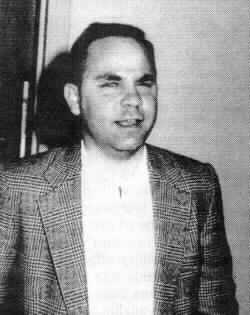
 Tom
Ley is a Past President of the Diabetes Action Network of the National Federation
of the Blind.
Tom
Ley is a Past President of the Diabetes Action Network of the National Federation
of the Blind.MY JOURNEY TO THE PUMP
by Thomas A. Ley
Tom
Ley is a Past President of the Diabetes Action Network of the National Federation
of the Blind.
Tick. It's my first day with an insulin pump, and I just received a micro dose of Humalog insulin. I rarely hear my pump, metering precisely a tenth of a unit of insulin each time... but it ticks every six minutes, whether I hear it or not.
Today I welcome these ticks, but I haven't always felt this way. I used to think of pump users as militant diabetics who spent so much time and energy managing their diabetes that their diabetes took over their lives. I didn't want to be one of them. After all, my diabetes was in good enough control, or so I thought. I felt OK, and I never had to rush to the hospital for care.
So here I sit writing, trying to figure out what changed inside me. What transformed me and helped me welcome these ticking sounds?
I have no doubt God led me to this decision, both through prayer and through new circumstances in my life. First and foremost, I fell deeply in love with a wonderful lady and her delightful little girl. Then I began a new job in computer marketing and training. For the first time in years, I felt determined to do what I must, to live a long and healthy life. I sought treatment from an endocrinologist with expertise in diabetes. I met with a diabetes educator who helped me sharpen my meal planning skills. Results from my regular glycosylated hemoglobin testing motivated me to work diligently toward tighter control. I increased my blood sugar tests to three per day, and intensified my insulin therapy, going from two to four shots per day.
What a surprise I had! My diabetes actually began consuming less of my life! In retrospect, I now realize that for years I wasn't managing my diabetes; my diabetes was controlling me. How? Unhealthy food choices sprouted guilt and ruined my fun. Unnecessarily high blood sugars depressed me and decreased my productivity. Frequent low blood sugar episodes interrupted my activities and stole my peace of mind. So, despite my best efforts not to be inconvenienced by diabetes, much of my lifestyle had been adversely affected by the disease. I discovered that the better my control, the less diabetes imposed on my life.
Conceptually, the pump makes a lot of sense. In combination with frequent blood glucose monitoring, it offers at least the same tight control as my previous regimen of four injections per day. I'm told some pumpers find it offers better control. And pump therapy only uses short-acting insulins (R or Humalog). Why is this better for me? When I was taking NPH (intermediate-acting insulin), I needed to be sure to eat a meal five to six hours after taking it. My job as a Marketing and Training Manager requires long hours and frequent solo travel, so scheduling meals was rather problematic. I often ended up eating whatever was available, to avert low blood sugar when the long acting insulin peaked. Unfortunately, candy bars, Cokes and greasy fast food are often the only foods available at airports and conference exhibit halls.
In theory, the pump simulates a real pancreas, administering tiny doses of insulin throughout the day. The user self-administers an appropriate level of insulin just before the meal. Now I can wait until a nutritious meal is available. I don't need to worry about low blood sugars. This means a huge improvement in my life.
The advantages of insulin pump therapy seem obvious, but what about the downsides? I thought there would be many. But, to my relief, many of my misconceptions concerning living with a pump were false. Today, a pump is about as obtrusive as a beeper.
In preparation for my pump, I reviewed a number of educational videos provided by my diabetes nurse educator at Johns Hopkins. Upon studying the materials from both pump manufacturers, I was surprised to learn that pumps no longer deliver their insulin through metal needles—today's "infusion sets" (the tubing between pump and injection site) are soft and flexible. Only a simple Teflon "cannula" remains under the skin. Another great feature is the "quick release mechanism" in the tubing that connects the needle to the pump. In just two seconds I can detach the pump from the tubing, as easily as undoing a button.
Most impressive is the fact that no one has ever reported receiving an insulin overdose due to a pump malfunction. What great information!
As I sit here composing these notes, I can honestly say I feel practically no discomfort at all from the cannula that delivers my insulin. I find its presence far more comfortable than taking four insulin injections per day.
So I decided to get a pump. What did my endocrinologist, diabetes nurse educator, and family members think? Family was easy. They wholeheartedly encouraged me, what a comfort! My health care team was also supportive, but they voiced legitimate concerns about how a totally blind person might independently operate the pump. Concerns are not prohibitions—they were open to learning with me. I'm glad my team voiced their questions, and I'm even more glad we found the answers.
We were all reassured to learn that blind diabetics around the country successfully use pumps. I reread a few key articles from VOICE OF THE DIABETIC and passed them along to my team. Along the way I taught them how to use a plastic straw to make a nifty and accurate insulin measuring gauge. Together we discovered that one can hear the air bubbles pass out of a 500-unit pump-filling syringe, and that with a little ingenuity, a blind person can change "infusion sets" unaided, holding the new cannula in place with one hand and applying an incredibly sticky piece of tape over the infusion site with the other.
I've shown my health care team that creative blind people can find alternative ways to complete necessary tasks. I'm glad they recognize and respect my independence and sense of responsibility. Perhaps this will help them encourage other blind diabetics to pursue tight diabetic control with the pump.
I am grateful to the National Federation of the Blind for instilling in me the belief that I can live a productive and meaningful life despite my blindness. Through the organization, I continue to meet hundreds of blind role models, who actively encourage me to achieve higher levels of independence. I've enjoyed world-class training through the Louisiana Center for the Blind, where I learned the skills of blindness. Our colleagues in the Diabetes Action Network support and challenge one another to manage our diabetes, and to proceed with grace despite complications. For all of these blessings, I am truly thankful.
I'm now home from the hospital, having spent a day and a half at Johns Hopkins Hospital to work out the initial insulin dosing. With the MiniMed 507 pump at my side, I'm eagerly beginning a new phase of my life with diabetes. After 25 years, I welcome days free from insulin injections. I'm excited about the prospect of fewer high and low blood sugar incidents, and I will enjoy my new mealtime flexibility immensely. I'm comfortable, confident, and content... Tick.