Future Reflections
Fall 2006
(back)
(contents) (next)
The Blind in the STEM Professions: Four Profiles
Editor�s Note:
The source for the following information is the Web portal for the National
Center for Blind Youth in Science, a program of the NFB Jernigan Institute.
For more great information about how to include blind youth in math and science,
see http://www.blindscience.org/ncbys, or contact Mark Riccobono, Director of
Education, Jernigan Institute, at [email protected] or (410) 659-9314.
There was a time when it was unthinkable
to have a blind person working in the fields of science, technology, engineering,
or mathematics--the STEM fields--but that time is gone. Long gone. The National
Federation of the Blind Jernigan Institute has done much in recent years to
incite STEM curiosity in young minds, and it is the blind professionals in these
fields who stand as solid reminders that blindness is only another characteristic.
The four men and women featured here have traversed the barriers once set up
against the blind in STEM fields.
SCIENCE
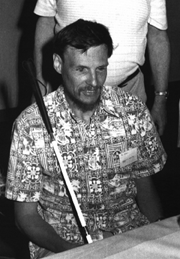 Dr.
Geerat Vermeij earned his PhD in malacology from Yale University. He has been
blind since age three, but that has not stopped him from earning a position
as professor of marine ecology and paleoecology (a word most people don�t even
know the meaning of!) at the University of California, Davis Campus. The world
has been his classroom with studies in Guam, the Philippines, the Galapagos
and Aleutian Islands, Hawaii, and Canada; Dr. Vermeij has a unique understanding
of his field that has students eagerly awaiting his every lesson.
Dr.
Geerat Vermeij earned his PhD in malacology from Yale University. He has been
blind since age three, but that has not stopped him from earning a position
as professor of marine ecology and paleoecology (a word most people don�t even
know the meaning of!) at the University of California, Davis Campus. The world
has been his classroom with studies in Guam, the Philippines, the Galapagos
and Aleutian Islands, Hawaii, and Canada; Dr. Vermeij has a unique understanding
of his field that has students eagerly awaiting his every lesson.
TECHNOLOGY
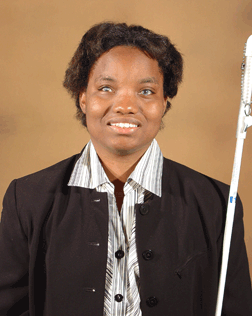 Women
are hard to come by in the STEM fields, making Ms. Ameenah Lippold�s accomplishments
all the more praiseworthy. She is not quite thirty years old and has earned
a bachelor of arts degree from the University of Illinois, made waves in the
adaptive technology field, and organized the Goals for Achieving Math Accessibility
(GAMA) Summit. Now, she works for the Defense Information Systems Agency where
she continues promoting accessibility through enterprise architecture. Ms. Lippold
was diagnosed with blindness at six years of age.
Women
are hard to come by in the STEM fields, making Ms. Ameenah Lippold�s accomplishments
all the more praiseworthy. She is not quite thirty years old and has earned
a bachelor of arts degree from the University of Illinois, made waves in the
adaptive technology field, and organized the Goals for Achieving Math Accessibility
(GAMA) Summit. Now, she works for the Defense Information Systems Agency where
she continues promoting accessibility through enterprise architecture. Ms. Lippold
was diagnosed with blindness at six years of age.
ENGINEERING
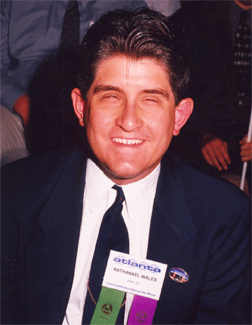 Children
love to use their hands whether they are touching, exploring, or building, and
so does Nathanael Wales. Mr. Wales, now a civil engineer for the Department
of Water Resources, Sacramento, has always loved building things. He was born
blind and spent his childhood constructing and plotting his next move to be
a great engineer. He earned his bachelor�s degree in civil engineering from
the University of California, Davis, and is a solid reminder that childhood
dreams can come true with strong values and hard work.
Children
love to use their hands whether they are touching, exploring, or building, and
so does Nathanael Wales. Mr. Wales, now a civil engineer for the Department
of Water Resources, Sacramento, has always loved building things. He was born
blind and spent his childhood constructing and plotting his next move to be
a great engineer. He earned his bachelor�s degree in civil engineering from
the University of California, Davis, and is a solid reminder that childhood
dreams can come true with strong values and hard work.
MATHEMATICS
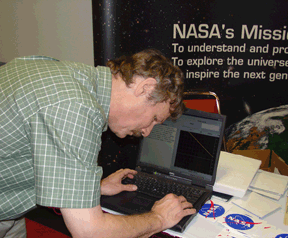 You
don�t have to be a genius to know when brilliance is nearby. Tackling multiple
STEM fields, Dr. Robert Shelton, not only earned his PhD in mathematics from
Rice University, he also completed his postdoctoral work at Princeton. He divides
his time between teaching college and working as both a mathematician and computer
scientist. Dr. Shelton�s work led him to aid in the development of MathTrax
and the Math Description Engine (MDE) algorithm that helped the National Federation
of the Blind�s Rocket On! Science Academy students launch their first NASA rocket
in 2004. Shelton became blind at age eleven after a failed surgery for congenital
glaucoma.
You
don�t have to be a genius to know when brilliance is nearby. Tackling multiple
STEM fields, Dr. Robert Shelton, not only earned his PhD in mathematics from
Rice University, he also completed his postdoctoral work at Princeton. He divides
his time between teaching college and working as both a mathematician and computer
scientist. Dr. Shelton�s work led him to aid in the development of MathTrax
and the Math Description Engine (MDE) algorithm that helped the National Federation
of the Blind�s Rocket On! Science Academy students launch their first NASA rocket
in 2004. Shelton became blind at age eleven after a failed surgery for congenital
glaucoma.
(back)
(contents) (next)