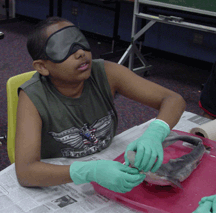
Jordan Richardson has adopted his parent's positive attitude toward the use of sleepshades as a learning tool. At the 2004 Circle of Life Science Academy, he proudly demonstrates his nonvisual skills as he dissects a shark under a sleepshade.
Future Reflections Special Issue: Low Vision and Blindness 2005
(contents)
Future Reflections
The National Federation of the Blind Magazine for Parents and Teachers of Blind Cjildren
Vol. 24 No. 3 Special Issue: Low Vision and Blindness 2005
Barbara Cheadle, Editor
ISSN-0883-3419
Table of Contents
Vol. 24 No. 3 Special Issue: Low Vision and Blindness 2005
INTRODUCTION
From the Editor
Low Vision, Blindness, and Federation Philosophy
by Barbara Pierce
WHO ARE WE?
A Definition of Blindness
by Kenneth Jernigan
Growing Up with Low Vision: An Interview with Dr. Z.
Elizabeth
by Nadine Jacobson
Why I am Choosing Blindness: Personal Reflections on the
Need for a Functional Definition
by Scott Feldman
Faking It No Longer
by Cheralyn (Braithwaith) Creer
I�m Albino, Legally Blind, and a Meteorologist
by Sam Herron
IN THE CLASSROOM
Common Visual Impairments in Young Children
Twelve Tips for Classroom Teachers
by Barbara Cheadle
Best Buy of the Year: New Book by Carol Castellano Now Available
The Problems with Vision Stimulation
The CCTV: A Personal Perspective
by Nathanael Wales
Reading Materials in Large Print
Low Vision and Monoculars
by Edith Ethridge
NFB Jernigan Institute Online Education Program�
Training on Blindness from the Blind Themselves
From One Teacher to Another: When Should
A Low Vision Student Switch to Braille?
by Alison Mckee
Why Megan is Learning Braille
by Marla Palmer
Slate Pals
TRAVEL
I�m Partially Sighted, and I Use a White Cane
by Peggy Chong
My Introduction to Sleepshades and Independence
by Craig Eckhardt
When the Light�s Not Right
Stepping Out
by Connie Bernard
Rehabilitation Training Programs for the Blind
Let the Freedom Bell Ring!
by Kathy Kennedy
Sleepshades
THE CRASH TEST
The Role of Parents in the Education of Blind Children
by Carrie Gilmer
Raising kids is very much like hiking up a mountain. Sometimes the path is clear; sometimes not. Sometimes the way is easy and pleasant; sometimes rocky and perilous. Sometimes an unexpected glimpse of the summit gives you heart and hope to keep going; and sometimes you wander lost in a fog, not sure if you are going forward or around in circles.
In 1979, my husband, John, and I embarked on such a hike into largely uncharted territory. We began the task of raising our adopted, two-year-old, and partially sighted son with the compass of the National Federation of the Blind (NFB) philosophy to guide us. I say �uncharted� because at the time, only a handful of parents of very young blind children were active in the NFB. The overwhelming majority of parents had either never heard of the NFB, or had heard about it from professionals who warned them to stay away from that �radical� group. If parents employed the Federation philosophy (and some did) it was out of a common sense approach to life in general, and not a deliberate philosophical choice backed by the loving support and mentorship of organized blind adults and other parents.
There were many times when I wondered if what we were doing was effective. Would it work? Would it make a difference? In a sense, this special issue about low vision and blindness marks for me a personal summit. Our son is now an independent adult with a job and a life of his own. Best of all, he is a man who is at ease with himself; whose use of visual and nonvisual techniques blend seamlessly into a way of functioning that is as natural and automatic as breathing.
The Federation philosophy made a difference for our son, and it can make a difference for your child or student, too. In this issue, you will find a practical road map, travel guide, road sign warnings, and directions, and a glimpse of the summit in the stories and suggestions provided by parents, teachers, and blind adults. Because a correct understanding of the Federation philosophy and approach is so important to understanding the perspective of the articles in this issue, I strongly urge readers to begin with Kenneth Jernigan�s �A Definition of Blindness� and Barbara Pierce�s �Low Vision, Blindness, and Federation Philosophy.� However, feel free to read the article at the back of the issue, by Minnesota parent, Carrie Gilmer, at any point, just be sure to read it!
One of the most annoying misconceptions about the philosophy of the National Federation of the Blind is the notion that committed Federationists are proud of their blindness and, if given a chance, would choose it over returned vision. Those who have heard and believed such statements are enraged, I think, because they consider it needlessly cruel to encourage the development of neurotic and twisted ideas in people who are already facing vision loss. Federationists, on the other hand, are frustrated when we are accused of holding such notions because, in fact, we don�t.
Learning to be unapologetic and to resist feelings of inferiority because of blindness is healthy and very different from being proud of the characteristic. It is as absurd to be proud of blindness as it is to take pride in being six feet four, having size five feet, or demonstrating an IQ of 145. One may be comfortable or not with any of these characteristics, but one can certainly claim no credit for possessing them.
A person might well take pride in developing his or her artistic ability, athletic skill, intellectual powers, or expertise in the alternative skills of blindness, but that is very different from claiming personal credit for a God-given characteristic. Of course, being only human (and therefore often a little ridiculous), people frequently take pride in their naturally wavy hair, quick reflexes, or green eyes. It isn�t surprising, then, that, in the process of evolving a healthy identity as a competent blind person, some of us act for a while as though taking pride in blindness were the goal rather than achieving self-confidence and effectiveness as a blind person.
Debunking the second half of the misconception is more complex. I don�t think I know a single blind person who would actually choose blindness above fully functioning sight, if the exchange were an actual option. In a world structured for and largely dependent upon sight, it is obviously more efficient to use sight to get things done. But such a choice is virtually never an option. Most people with a little residual vision are faced with the dilemma of either depending on very restricted visual data for doing tasks or mastering the alternative techniques for getting the job done. The pragmatic question these people face in situation after situation is which strategy would be more efficient. The emotional freight that such decisions carry can be heavy indeed. If one has never learned effective alternative techniques and if one has always depended on vision, then vision--even very poor or painful vision--often seems the easier and certainly more obvious choice. Family and friends reinforce this tendency every time they urge the person not to �act blind� because, after all, he or she can still see something.
Recognizing these pressures, experienced members of the Federation understand the importance of encouraging those with vision problems to get to know able blind people who are comfortable using the alternative skills of blindness. It isn�t that we prefer blindness; we just prefer efficiency, confidence, comfort, and success. For almost everyone with less than 10 percent of normal vision, this means using some combination of blindness skills and remaining, genuinely usable vision. Working out the combination is time-consuming and often emotionally demanding.
When members of the National Federation of the Blind say that we are changing what it means to be blind, we are in part dreaming of and working toward a time in which efficient blindness skills are not assumed to be inferior, when vision, and all that goes with it, is not held to be more virtuous, only more common. We are working toward a time when children with significantly compromised vision and adults losing sight will face life free of our millennia-long prejudice against tactile exploration and auditory learning and find it easier to embrace the learning of such skills. When all people accept the challenge of sharpening all their senses instead of concentrating on visual data only, the world will indeed be a richer and more interesting place for all of us, and those with partial vision will move more easily and naturally from visual to nonvisual ways of accomplishing the business of living. Then we will truly have changed what it means to be blind.
by Kenneth Jernigan
Editor�s Note: It may seem odd to begin a special issue about low vision with a definition of blindness, but sometimes the fastest route to a destination is not the most direct. As you read this issue, you will find the words low vision, visually impaired, partially sighted, legally blind (and maybe a few others) used interchangeably with the word blind. Over the decades professionals have often attempted to establish definitions for these terms based on a hierarchy of degree of vision loss; all of those attempts failed. In other words, there is no one accepted definition of, for example, �low vision� or �visually impaired.� But the National Federation of the Blind does not view this as a problem. Dr. Kenneth Jernigan, president of the NFB from 1968 to 1986 and an active leader of the organization right up to his death in 1998, explained it this way:
Before we can talk intelligently about the problems of blindness or the potentialities of blind people, we must have a workable definition of blindness. Most of us are likely familiar with the generally accepted legal definition: visual acuity of not greater than 20/200 in the better eye with correction or a field not subtending an angle greater than 20 degrees. But this is not really a satisfactory definition. It is, rather, a way of recognizing in medical and measurable terms something which must be defined not medically or physically but functionally.
Putting to one side for a moment the medical terminology, what is blindness? Once I asked a group of high school students this question, and one of them replied--apparently believing that she was making a rather obvious statement--that a person is blind if she �can�t see.� When the laughter subsided, I asked the student if she really meant what she said. She replied that she did. I then asked her whether she would consider a person blind who could see light but who could not see objects--a person who would bump into things unless she used a cane, a dog, or some other travel aid and who would, if she depended solely on the use of her eyesight, walk directly into a telephone pole or fire plug. After some little hesitation the student said that she would consider such a person to be blind. I agreed with her and then went on to point out the obvious-that she literally did not mean that the definition of blindness was to be unable to see.
I next told this student of a man I had known who had normal (20/20) visual acuity in both eyes but who had such an extreme case of sensitivity to light that he literally could not keep his eyes open at all. The slightest amount of light caused such excruciating pain that the only way he could open his eyes was by prying them open with his fingers. Nevertheless, this person, despite the excruciating pain he felt while doing it, could read the eye chart without difficulty. The readings showed that he had �normal sight.� This individual applied to the local Welfare Department for Public Assistance to the Blind and was duly examined by their ophthalmologist. The question I put to the student was this: �If you had been the ophthalmologist, would you have granted the aid or not?�
Her answer was, �Yes.�
�Remember,� I told her, �under the law you are forbidden to give aid to any person who is not actually blind. Would you still have granted the assistance?� The student said that she would. Again, I agreed with her, but I pointed out that, far from her first facetious statement, what she was saying was this: It is possible for one to have �perfect sight� and still in the physical, literal sense of the word be blind.
I then put a final question to the student. I asked her whether if a sighted person were put into a vault which was absolutely dark so that he could see nothing whatever, it would be accurate to refer to that sighted person as a blind man. After some hesitation and equivocation the student said, �No.� For a third time I agreed with her. Then I asked her to examine what we had established.
1. To be blind does not mean that one cannot see. (Here again
I must interrupt to say that I am not speaking in spiritual or figurative terms
but in the most literal sense of the word.)
2. It is possible for an individual to have �perfect sight� and yet be physically
and literally blind.
3. It is possible for an individual not to be able to see at all and still be
a sighted person.
What, then, in light of these seeming contradictions is the definition of blindness? In my way of thinking it is this: One is blind to the extent that the individual must devise alternative techniques to do efficiently those things which he would do if he had normal vision. An individual may properly be said to be �blind� or a �blind person� when he has to devise so many alternative techniques--that is, if he is to function efficiently--that his pattern of daily living is substantially altered. It will be observed that I say alternative not substitute techniques, for the word substitute connotes inferiority, and the alternative techniques employed by the blind person need not be inferior to visual techniques. In fact, some of them are superior. The usually accepted legal definition of blindness already given (that is, visual acuity of less than 20/200 with correction or a field of less than 20 degrees) is simply one medical way of measuring and recognizing that anyone with better vision than the amount mentioned in the definition will (although he may have to devise some alternative techniques) likely not have to devise so many such techniques as to alter substantially his patterns of daily living. On the other hand, anyone with less vision than that mentioned in the legal definition will usually (I emphasize the word usually, for such is not always the case) need to devise so many such alternative techniques as to alter quite substantially his patterns of daily living.
It may be of some interest to apply this standard to the three cases already discussed:
First, what of the person who has light perception but sees little or nothing else? In at least one situation he can function as a sighted person. If, before going to bed, he wished to know whether the lights are out in his home, he can simply walk through the house and �see.� If he did not have light perception, he would have to use some alternative technique--touch the bulb, tell by the position of the switch, have some sighted person give him the information, or devise some other method. However, this person is still quite properly referred to as a blind person. This one visual technique which he uses is such a small part of his overall pattern of daily living as to be negligible in the total picture. The patterns of his daily living are substantially altered. In the main he employs alternative techniques to do those things which he would do with sight if he had normal vision--that is, he does if he functions efficiently.
Next, let us consider the person who has normal visual acuity but cannot hold his eyes open because of his sensitivity to light. He must devise alternative techniques to do anything which he would do with sight if he had normal vision. He is quite properly considered to be a �blind person.�
Finally, what of the sighted person who is put into a vault which has no light? Even though she can see nothing at all, she is still quite properly considered to be a �sighted person.� She uses the same techniques that any other sighted person would use in a similar situation. There are no visual techniques which can be used in such circumstances. In fact, if a blind person found herself in such a situation, she might very well have a variety of techniques to use.
I repeat that, in my opinion, blindness can best be defined not physically or medically but functionally or sociologically. The alternative techniques which must be learned are the same for those born blind as for those who become blind as adults. They are quite similar (or should be) for those who are totally blind or nearly so and those who are �partially sighted� and yet are blind in the terms of the usually accepted legal definition. In other words, I believe that the complex distinctions which are often made between those who have partial sight and those who are totally blind, between those who have been blind from childhood and those who have become blind as adults are largely meaningless. In fact, they are often harmful since they place the wrong emphasis on blindness and its problems. Perhaps the greatest danger in the field of work for the blind today is the tendency to be hypnotized by jargon.
Dr. Betsy Zaborowski is the Executive Director of the National Federation of the Blind Jernigan Institute. Her life is full of activity and accomplishments. She also has a deep personal commitment to expanding the opportunities for all blind individuals of all ages. In an interview for Future Reflections magazine, Dr. Z. (as she is commonly known) talked about growing up as a low vision child, about visual and nonvisual techniques, about parenting low vision children, and about some of the education goals of the NFB Jernigan Institute. Here is what she said:
Q: What is your eye condition and has your vision changed over the years?
Dr. Z: The cause of my blindness is bi-lateral retinal blastoma (cancerous tumors in the retinas of the eyes). I was born with this condition and I had one eye removed when I was a baby. The other eye was treated with radiation until I was five years old.
When I was younger my vision was 20/100 with glasses and I could read regular print. In my thirties I had some problems with my eye and I lost some additional vision. This made it impossible to read print for any length of time, so I started using auditory methods and I began to learn Braille: I was in the middle of my graduate studies at the University of Denver. This is when I found the National Federation of the Blind and began to deal with myself as a blind person.
Q: Were you placed in the regular education classroom?
Dr. Z: Yes, I was in a regular classroom. I tried to use large print books when I was very young. I remember the books being very big and very heavy. It turned out that I didn�t really need them; I could read the regular print at a satisfactory level for many years, but I read it very slowly and did not read as much as I could have had I learned Braille at that time. I also needed to hold the print very close to my eyes and I experienced fatigue because of this. As I got older, the headaches came as the reading demands increased. I functioned as a low vision student for the first twenty-five years of my life: holding print very close, using a lot of magnification in my corrective lenses, and, occasionally, using one kind of magnifier or another. (This was before closed circuit televisions--CCTVs--were available, but if they had been around at that time, I probably would have used them.) I started using recorded materials when I entered college in my twenties, but I also continued to struggle with print.
Q: Did you feel different as a child?
Dr. Z: Yes, I did feel different as a child. For me it had more to do with wearing heavy �coke bottle� glasses. I held on to the crazy notion that if I wore the glasses all the time people would not see me as that different. You know, when your vision is that impaired there is no way of really hiding it; it�s there. I lived in a very small town and everybody knew that I had visual limitations.
I was told that I was legally blind and that was the term that I always used to tell people about my vision. Now as I think back on it, I think that probably was a better way to define my eyesight. I do not think that I would have been comfortable with the term visually impaired. As a child, I did not think of myself as impaired because I would try and do anything. My parents also encouraged me to be independent. I did everything the other kids did with the exception of driving.
Q: Today, what do you consider yourself? Are you blind, visually impaired, legally blind, partially sighted, hard of seeing?
Dr. Z: When most people hear the word blind they tend to think of totally blind people and all the misconceptions and stereotypes that go along with that. Because of these negative stereotypes, people with some residual vision may not think of themselves as blind and may resist learning the nonvisual techniques. But being blind does not mean being less than--it simply means doing things differently. Those with low vision must know that many of us in the Federation have some vision, but we also see ourselves as blind people.
There seems to be this thinking that one has to fit into the sighted or blind world, but in reality there is only one world and we all live in it.
Today, I consider myself a blind person. I came to that understanding in different dimensions through my relationship with the National Federation of the Blind (NFB). I have always been a blind person. Even when I was younger and I could see more than I can see at present, I was a blind person. I consider myself a blind person more today because I use alternative techniques: Braille, the long white cane, screen-reading software, and electronic speech notetaking devices. I seldom wear my glasses; they hang around my neck mostly. I do use a CCTV, but only to fill out a short form or identify mail. I do not use it to read anything of length because it is very taxing on the eyes. More and more, I use my vision less and less.
Q: As a low vision child, were you at all excited and hopeful about your future?
Dr. Z: I think I was excited about my future. I did believe that I could do a lot of things. I was pretty successful in school. When I first went to college I was really frightened. I remember thinking: �Can I really do this? Can I make it on my own? Can I compete in a post secondary environment?� It was scary, but I was successful in undergraduate work and obtained my masters right after. And then I was a school guidance counselor for a number of years.
My work was interesting but as my vision began to deteriorate, so did my work. I had difficulty in reading handwritten notes from teachers. Counselors have to deal with so much reading and writing and, at that time, I did not know anything about nonvisual techniques outside the ones I naturally adopted. The reason: I knew no blind people. It would have been very beneficial to have known blind teachers, counselors, and administrators who could have given me tips on how to do my work nonvisually instead of having to depend on my vision.
I ended up quitting my job and moving from Michigan to Colorado to get my doctorate in clinical psychology. That�s where I found the NFB. Since then, I have had my own counseling practice, taught at a university, and now I am developing and administrating research and training programs for the NFB.
Q: What advice do you have for parents who have concerns about what kinds of jobs or careers their children might be able to do as adults?
Dr. Z: I think it is important for parents to be exposed to successful blind people so that they know firsthand that blind people are doing all kinds of jobs today. That�s why parents should attend our annual NFB convention and the seminars that we offer. It is then that they can come to realize that their children can have a bright future.
We are very fortunate in this country that there are wonderful opportunities for the blind--if the blind person is prepared. That is a big IF. My experience in getting jobs meant that I had to be a little better than the next guy in order to convince the employer to hire a blind person. I had to work a little harder, dress a little better, and talk a little faster. Today, the opportunities are better, but it is still a challenge. You have to have confidence in yourself or no one else will. We (blind people) must be able to sell ourselves. But the younger generation must also realize that they cannot do it alone. They must seek out other blind people that they can talk to and get advice and support from.
Q: Let�s talk a little about the Jernigan Institute. What are the goals for the Institute?
Dr. Z: The Jernigan Institute is a center of innovation. This is the first time in history that an organization of blind people has founded, and is operating, a research and training center. We are developing programs in a number of areas including technology, education, employment, and rehabilitation; programs for senior citizens, and a state of the art research library named after the founder of our organization, Jacobus tenBroek. I think what is different about this facility is that the model programs, the research, the training--all of it comes out of the experiences of blind people. We are directly responsible to our membership.
Our first initiative was a science academy. We held summer sessions in 2004 and 2005. The one for older kids, Rocket On!, is conducted in partnership with NASA. These kids learn about rocketry and then they launch a rocket. The other academy, Circle of Life, is geared to middle school kids. These students study all aspects of sciences that relate to life: marine life, plant life, human life, etc. The Academy�s mission is to stimulate the minds of blind students and let them know that science and math can also be an avenue of learning for them.
We also have an early childhood initiative, online courses for teachers and parents of blind children, and so much more.
Q: Why should future educators of blind and low vision children seek out guidance or training from the NFB Jernigan Institute?
Dr. Z: That is a very good question. In this whole low vision and blindness arena there is a tremendous emphasis on vision. Maybe it is natural for medical experts and low vision specialists to focus on augmenting vision, and the NFB is not opposed to that. Using CCTVs, magnification, or corrective lenses is acceptable if a person can use such tools efficiently. At the same time, there needs to be an emphasis on teaching those individuals nonvisual techniques, technologies, and strategies.
The nonvisual approach has to have the same value as the visual approach. That is why those studying to work with the blind, especially in education, need to come to us, because we specialize in the nonvisual approach to low vision and blindness. We want a smorgasbord of approaches and techniques for low vision people to use at home, in school, and on the job.
I remember a discussion I had with a gentleman who argued that low vision individuals should be taught to use their vision. I asked him why should you have to teach someone to use his or her vision? He went on to give the example of a low vision person walking into a dark theatre. He thought that this person needed to be taught to not go charging down the aisle, but to wait for his or her eyes to make the adjustment. I agreed that, indeed, this was one strategy. Another strategy, I suggested, would be for that low vision person to carry a white cane so that when the lighting suddenly changes, the cane could be used instead of awkward delays and uncomfortable squinting.
When I started using the white cane it was challenging because I had sufficient vision to see people�s reactions to it. They stared or moved their children out of my path of travel and that made me feel uncomfortable. But I persisted because I found that the cane made me more effective. I could look at my companions when we walked down the street together; I could walk down a flight of stairs with my head held high. There is real value in using the combination of vision and the cane. Those are the things that low vision experts should learn and then teach their clients.
Q: What advice or guidance do you have for parents who are considering, but not yet convinced about, Braille, cane travel, and other blindness skills training for a low vision child?
Dr. Z. Most parents like to enrich the lives of their children. Parents can think of blindness training in nonvisual techniques as enriching the life of their child. The concept is simple: exposing blind children to Braille, cane travel, and technology for the blind is the equivalent of exposing a child to theatre, dance, and foreign languages. It increases their awareness and gives them options.
Q: In conclusion, what other advice do you have for parents?
Parents should not shelter their blind child, but encourage independence and active play. All children need recreation and room to make mistakes; all of us have, at some point, skinned our knees. Research suggests that physically active children have better mental capacities. Karate, judo, swimming, and wrestling are all great sports for low vision kids. Parents should find a physical activity that their child can be successful at, but also encourage the child to try different things.
Parents should also encourage the low vision child to use her sense of touch. When I cleaned my mother�s house, she taught me early on that I had to check it with my hands. My mother had an incredible fashion sense. She taught me to feel the textures in fabric. She didn�t have to look at the different wools to find the better quality wool, she felt them! To this day, when I shop, I touch everything I look at. The combination of using vision and touch gives more information than using residual vision alone. And why force a low vision kid to look at everything in his environment when what he sees is not an accurate image or the process is painful?
Most importantly, parents should put their child in contact with other partially sighted, competent blind people. Children find comfort and encouragement in knowing they are not alone; that there are other people like them. This helps them realize that they can live full, normal lives. In our organization, we have a history of being able to connect parents to competent, well-trained, blind role models; men and women with many different interests and experiences.
______________________________
Adoptive Families Needed for Waiting Vision-Impaired Children
The World Association for Children and Parents (WACAP) is seeking loving adoptive families for beautiful children from around the world. Currently we have 26 children with various forms of vision impairment ranging from mild to significant. WACAP has been placing children in loving adoptive homes since 1976. WACAP has adoption programs in six countries including China, Korea, India, Russia, Thailand, and the United States. Xiao Min, born in February of 1997, is outgoing, friendly and full of life. He loves music, singing, and playing the drums, all of which he does very well. He dreams of attending a music school, and though his music, �bringing happiness to everyone in this world.� Xiao Min is blind but he doesn�t let that stop him from living life to the fullest. He has a wonderful dream, now all he needs is a wonderful family to help him make his dreams come true. For more information, contact:
Debbie Sweetland
Family Finders Recruitment Specialist
WACAP, World Association for Children & Parents
(206) 575-4550, fax (206) 575-4148
www.wacap.org
by Nadine Jacobson
Parenting is a challenging and rewarding experience. When my husband Steve and I adopted Elizabeth, she was one-year-old, and she changed our lives for the better forever.
My husband and I are both blind. We use white canes for travel, and we read Braille. I have light perception now, but as a child I was able to see much more. However, I never saw well enough to read print.
When Elizabeth came to us, she was diagnosed with a visual condition called optic atrophy, and the doctors thought her acuity was about 20/1400. As she aged, it became obvious that she could see much better than that. Now, her visual acuity tests at 20/125. She is not legally blind, but her acuity definitely puts her in the category of visually impaired. She is unable to see things at a distance, she reads print, and she has also learned Braille.
In her speech below, she refers to being afraid of balls. That was three years ago, and she has improved. Just last week, she came home and proudly told me she�d hit a home run in softball. She uses and enjoys her vision, and that is a good thing.
As parents, we also teach her other ways to accomplish things she cannot do using vision. We encourage her to ask for information when she can�t see something (the menu on the wall of a fast food restaurant); we show her how to use her hands to find objects when her vision is not useful (cleaning under her bed); we gently insist that she tells her teacher when she can�t see something in the classroom (writing on the board, overheads, scientific or sewing demonstrations, etc.); and we have taught her how to use smell and touch for cooking and cleaning. (She is becoming a very good cook.) We take pride in watching her grow in confidence and skills.
As you can see, it is important for a visually impaired child to learn how to speak up and not be ashamed of letting people know that she has low vision. The NFB has helped us with that in many ways, and one of those ways has been in providing Elizabeth opportunities for public speaking. A few years ago, Elizabeth was asked to speak on a youth panel at a seminar for parents at the National Federation of the Blind convention in Louisville, Kentucky. Her speech was later reprinted in Future Reflections (volume 22, number 1) along with the speeches of the other panelists. The theme was, �The Serious Work of Play.� Here is what she said:
**************
Hi, my name is Elizabeth Jacobson. My dad�s name is Steve and my mom�s name is Nadine Jacobson. I live in Edina, Minnesota. I�m going into fifth grade and this is my tenth NFB national convention. I�m ten years old and I go to Concord Elementary School.
I like to pretend a lot. I like to pretend house and school. When I play house I like to pretend I�m the mom and my sister, Catherine, is my daughter. Sometimes I make a car out of chairs. I like to do this because I won�t be able to drive a car.
I also like to play school. I usually play this with my old school supplies and workbooks, too. I like to play this because I want to be a teacher when I grow up and teach at Concord Elementary School.
I also like to play store. When I play store, I like to be the cashier. Sometimes I also like to play camping. I play this with my sleeping bag and play tent. When I was younger I liked to play restaurant.
There are a lot of things to do outside like playing basketball. Our family has balls that have bells inside them. I also like to do switch board, which means it turns from a scooter to a skateboard. We got a volleyball net just a few months ago. There�s also a park nearby. It�s great to hang out at. My next-door neighbor has a trampoline that they let me jump on. They have a swing set my sister and I can play on, too.
Inside I use my karaoke machine that I got at Christmas. My sister and I do puppet shows and plays for my mom and dad. I�ve had sleepovers. One time we played hospital. Another time we watched movies and made the sounds we heard in the movie. My mom and I play scrabble. One time I beat her.
At school we play kickball. I used to have somebody kick for me because I didn�t like to have balls come at me. But that all changed when I tried to kick it by myself. I kicked it hard and high. I was proud of myself.
Sometimes when we�re on the bus my dad thinks of a character from TV, a movie, or a book, and we try to guess it.
Thank you for letting me talk at the parents division meeting.
I hope you like my report and that it is helpful.
by Scott Feldman
Editor�s Note: This article originally appeared in the Braille
Monitor, the monthly publication of the National Federation of the Blind,
and was later reprinted in Future Reflections, volume 16, number 4.
The author is a man who has given the definition of blindness a lot of thought.
Scott Feldman was a graduate student in clinical psychology and a member of
the Chicago Chapter of the NFB of Illinois when he wrote this reflection about
his journey into self-understanding:
�But that�s not you--you�re only print-impaired.� It was my best friend Amy speaking, and she was clearly concerned about me. Until recently I suppose that I thought of myself in this way as well. My visual problems first manifested themselves after extended periods of reading, and reading print was the first activity that I eventually had to relinquish, in my early twenties. Even today, several years later, I could force myself to read a small amount of print in an emergency, but I would pay the price with accommodative spasms. When I try to see things at near distance, my eyes lock, as in a muscle cramp, and later double vision and a throbbing headache set in as my eyes struggle to relax. I do not like pain, nor do I like setting myself up for failure. Since 1990 I have listened to my books instead, and I write with a speech-adapted computer.
Last year I began to learn Braille because in many situations speech is an inadequate substitute for print, such as when I have to give a lecture or presentation from notes. Braille is coming slowly, and materials in any accessible format are hard to come by. Only five percent of printed material published each year is converted to speech or Braille. So I most certainly do feel print-impaired.
This might have been the end of the story, except for one, well, two little problems. To begin with, there are many other things besides print that can get too close for my comfort: people�s faces, a kitchen counter or dining room table, or a Rembrandt, to name a few. I suppose that you could say that I am face-impaired, food-impaired, and art-impaired as well. Better, let�s say that I am functionally blind at near distance and leave it at that. This is where I was several months ago, after much kicking and screaming--not to mention a year-long depression that nearly sapped my will to live.
Life is not fair, nor is it simple. At present I get around without the assistance of a cane or dog. Walking outside is one of the activities recommended to me by my visual therapists because it allows me to gaze into the distance and relax my focusing system. (A world-renowned neuro-ophthalmologist who first diagnosed my condition as �severe accommodative and convergence insufficiency� suggested that I become a forest ranger. When I said that I wanted to be a scholar, he asked me if I would mind if he prayed for me. I did not.)
If you are sighted, you may be aware of relaxing your eyes, particularly when you are walking along, lost in thought. Your eyes do not fixate on anything in particular but take in the general environment. You perceive gross forms, color, and most definitely movement. You do not crash into things. This is how I have gotten around for the past six years. It works, except for the fact that I cannot make out street signs or other such niceties of modern travel. To be precise, if I squint through the various overlapping images, I can sometimes make out street signs, but then I get back into that same painful cycle that I described earlier.
So traveling is the second little problem. I was not aware of it while in Los Angeles for graduate school, where my range of independent travel was effectively limited by my busy campus schedule and inability to drive. Nor was it a problem when I returned to Chicago on a leave of absence since I know the city very well, having spent the latter part of my childhood and my adolescence there.
But this past October I traveled with my family to London and Paris. It was a lovely trip, especially because of the English theater. During a side trip to Stratford-on-Avon, I scalped a ticket to the Royal Shakespeare Company�s performance of Macbeth. I sat next to a delightful old woman who had been coming to Stratford for decades. She recalled the glorious days when the likes of Richard Burton were members of the company. The lights went out, and we fell silent, expectant. At the end of the performance, she asked me whether I had enjoyed it, not being able to make out the individual actors. As it turned out, I had enjoyed the performance more than she because I had been able to focus on the poetry, while she had difficulty getting beyond her aggravation at the inauthenticity of the costumes and stage set. (At one point, to her horror, the gatekeeper lit a cigarette.)
It was walking around on my own in London that made me realize how compromised my ability to navigate new places visually has become. The first day I went out I squinted at the street signs painted on the sides of buildings to make out where I was. I did not enjoy the theater that evening or the following afternoon because my eyes reminded me, in no uncertain terms, that I had mistreated them. A couple of days later, I wanted to venture north to visit the Folk Institute because I am very fond of Irish music. My parents said that it would be no trouble to go with me, but I felt that it was important to figure out how to travel there independently. The influence of the National Federation of the Blind was in full evidence here. With the help of an excellent map--and my parents� eyes--I familiarized myself with the general layout of central London and with the specific route I planned to take. Then I set off for the Kensington underground station, our local base of operations. To make a long story short, after a few wrong turns and requests for directions from a couple of polite Londoners (they are so polite), I found the place. Happily, I returned to the subway with four new CDs in hand, the result of a thoughtful introduction to the institute�s collection by another extremely polite Londoner.
My travels the following few days were much the same. Instead of asking my eyes what street I was on, I asked someone more reliable. As you might suspect, this strategy failed miserably after we took the newly constructed tunnel under the English Channel to Paris. Being a native English-speaker and a sometimes Spanish-speaker, I couldn�t even begin to formulate the appropriate question, let alone understand the response. To the extent that I walked around on my own, such as when my parents indulged in a visit to a museum, I traced large circles around prominent landmarks.
As I sit here in my new apartment in Minneapolis, staring out into an impossibly early snowfall, the little question of how to navigate an unfamiliar city blossoms into a preoccupation. Besides the question of how to map out the city, pinpointing the places that hold special interest for me (such as a folk music club or dim sum restaurant), I wonder how I will shop for necessities. Twice now my refrigerator has gone empty before I asked a neighbor with whom I am acquainted for assistance shopping. Of course, I could walk into the grocery store and ask for customer service, but I am not blind, right?
Actually, Amy, I suspect that you and I are wrong. It is true that I do not meet legal criteria for blindness, which are based on simple indices of acuity and field of vision. I am not a low vision candidate--I have plenty of it. It just doesn�t seem to be working for me.
True, many people have strong negative stereotypes about blind people, into which they will try to lock me if I identify myself as blind in public by using a long white cane, for example. They will see me only as a blind person. But I have seen much more in many of the people I have met through the National Federation of the Blind. When I am in their company, rather than feeling ashamed of who I have become, I feel empowered to work to create a more positive image of blindness. I am starting here.
by Cheralyn (Braithwaith) Creer
Editor�s Note: Cheralyn Creer was a single woman and a special education teacher from Bountiful, Utah, when she gave this presentation to the 1998 National Convention of the National Federation of the Blind (NFB) under the title �The Blind in the Teaching Profession.� The speech was later published in the Braille Monitor and in Future Reflections, volume 16, number 2. (I changed the title to one that more closely captures the essence of the struggles Cheralyn describes as a partially sighted child and young adult.) Today, she is happily married, a new mom, and a state and national leader in the NFB. She has also moved up the career ladder. She currently provides technical support, training, etc. about sensory impairments and other disabilities to local school districts as an Education Specialist with the Utah State Office of Education. As you read Cheralyn�s story below, you may find it helpful to consider the following questions: 1. What visual techniques did Cheralyn use before she met the NFB and went to her first NFB convention? 2. What visual techniques did she use afterward? 3. Did she give up visual techniques, add new ones, or both? 4. What nonvisual techniques did she use before and after her introduction to the NFB?
I was born to a family of ten children. When I was one-year-old, my mom noticed that I held books close to my face and that I watched TV with my chin on the TV table--there are still teeth marks on the edge of it to prove it. My dad and some of my brothers and sisters dismissed it as a bad habit. None of them wanted me to visit an optometrist for fear we�d find out I was going to be different, need glasses, and be made fun of. As well-intended as my family was, they were afraid of my vision or the lack of it.
I fell into that fear by pretending I was no different from anyone else. We found out that I had �extreme myopia, a lazy eye, and astigmatism.� I got glasses when I was almost two and contact lenses at four. They helped, but just hid the problem. When asked if I could see a deer at the side of the road, I pretended I could. I endured backyard vision screenings, playing catch with a brother who was convinced that the harder he threw the softball, the more likely I�d be to see it. When watching a movie or play, I laughed on the cue of the rest of the audience, pretending I knew the punch line without admitting I needed an explanation. It goes on and on.
My scheming worked for years--or so I thought. In school I pretended to read as all the other students did in class. I pretended I could take the quiz written on the chalkboard or overhead projector. Although I was a relatively hard-working student, I allowed my grades to slide and allowed myself to accept being less than I was.
One experience I had during this period of pretending to be normal still haunts me. I had just proved my ability to perform in an advanced English class in the seventh grade. The transfer was made, and soon I was involved in a group presentation on The Red Badge of Courage. My turn to present came. It was accompanied by an all-too-familiar anxiety attack. I looked at my notes and then at my peers and decided it just wasn�t worth the humiliation of holding the paper at the necessary reading distance, the end of my nose. Instead, I chose an alternate route to humiliation. I attempted to read my notes at the normal distance. The student next to me (as well as the teacher and the rest of the class, I�m sure) sensed my difficulty. This student began whispering my notes to me like a parent to a timid child performing for an audience. I dismissed my frustration with a laugh here and there between my disjointed prompts. Finally it ended. I hoped I could now put the experience behind me. But that wasn�t possible. The adolescent devastation was there to stay. My teacher didn�t let it go either. She called my parents to find out if I was able to read. She thought I wasn�t intelligent enough for her class. Dad made the necessary excuses, and I was able to remain in the class. Unfortunately the memory also remained. Trying to be normal wasn�t worth the pain.
This faking continued until my vision decreased significantly in my eighth-grade year. The issue could no longer be ignored. I saw a specialist and was finally given a label. �I have cone dystrophy,� and soon thereafter I was able to say, �I am visually impaired.� The second label came after being introduced to special education and a dear friend named Carol. She helped me face my fears of admitting there was a problem and helped me to make adaptations. This was a huge step in my life. I no longer allowed anything to keep me from getting straight A�s.
I still had a lot of learning to do by way of admitting to myself that I couldn�t do things the same way as others around me. I even got a driver�s license. (I guess legally I could drive, but realistically I was crazy to try--especially when I cheated on one of the vision tests.) Driving lasted for only a few years until I�d put others and myself in danger too many times. Giving it up, as much as I needed to, was devastating. I remember other periods of devastation, sitting in classes and other situations with tearful eyes, wondering why I was so stupid and why couldn�t I do things the same way as the students or friends around me could. All of this in an attempt to be normal. It too wasn�t worth the pain.
College wasn�t a huge adjustment. I entered Brigham Young University as a special education major with two scholarships and the same old insecurities. I learned quickly that I couldn�t depend on Support Services for Students with Disabilities. Classes weren�t easy, so I had to start developing my own adaptive techniques. With each semester I learned techniques that would make the next one even easier. I got my own readers; I learned to rely on descriptions while using binoculars to distinguish objects in slides or on the board. I figured out that I could read print on certain colors more easily than on others, so I began using colored transparency sheets to lay over the page I was reading. Through this I gained confidence, but I still avoided computers at all costs.
This confidence greatly increased when I came in contact with Norman Gardner, Ray Martin, and their wives. They introduced me to the National Federation of the Blind just over two years ago. They came at just the right time. Relationships, my choice of major, and other serious decisions in my life left me doubting myself as I never had before. I was dragged to Anaheim, California, by Norm and Ray for the 1996 National Convention of the National Federation of the Blind.
It really was quite an ordeal getting me there. I was very scared. I had never traveled alone; I never did anything alone. (I went out of my way to plan for family members or friends to be with me wherever I went. I couldn�t even walk into church alone for fear I wouldn�t find the pew where my family sat.) Now this! Flying alone, navigating an airport alone, claiming baggage alone, coping with possible transfers alone. My dad never really liked the idea of my going places alone, and I knew I hated the idea myself. But I finally consented because there would be other people whom I had met once before on the same flight, and they were willing to help me.
Although overwhelmed, I soon came to know many people who have become some of my best friends and role models: Kristen Cox, Ron Gardner, Robert Olsen, their spouses, and Bruce Gardner. I began to learn that I had potential that I�d never given myself credit for and never let others see. I knew I didn�t have to be afraid anymore of who I was. I knew I would be more honest with myself and be able to let others see the real me. All of these feelings culminated at the banquet. I had heard all the incredible plans of the scholarship winners, and I realized I didn�t want to live any of the misconceptions that President Maurer referred to. Most of all, I knew my life could never be the same. The pretending and the fear had to end. I went from doubting my identity, my career choice, and even my self-worth, to craving independence that I�d never experienced before.
In fact, I was accepted to go on a study abroad program to London. This is where the craving began. By the end of the program, I was navigating and using the Underground or Tube (the subway system) independently. I loved the freedom of getting from place to place, experiencing the culture, etc., with the group or on my own if I wanted to.
Just one year after Anaheim I had school schedule conflicts that caused me to have to leave a few days late for last year�s national convention in New Orleans. This meant flying alone, transferring alone, claiming baggage alone, and getting to the hotel alone. This time, however, I had a much different experience. I looked at it as an opportunity and adventure to test some of my new travel skills and self-reliance. My friend Norm described it as an example of personal triumph and independence. What a contrast to the previous year. That convention only reinforced and intensified the feelings from the year before.
Back to school now. As required at BYU, I had opportunities to volunteer and later to teach in different classroom settings each semester in the special education program. I encountered frightening, stressful, and even dangerous situations. But, as my mom likes to remind me, a thought hit me one day near the end of my college career. I realized that I was capable of handling any one of these classroom situations. My traveling experience as well as experiences in my education soon helped me realize that I didn�t want to be the average blind person with the average job. (I think most of us have heard the quotation). I wanted to be the best! Doing the best job!
Before I found this determination, I had been terrified. I was convinced that I was crazy to think I could be a teacher. I dreaded applying for jobs because I just knew I would be a joke, walking into any interview. I had begun to talk myself into settling for a teacher�s assistant position. That way I wouldn�t have to be as responsible and could just follow in someone else�s footsteps.
But, as I said, my introduction to the NFB came at just the right time. I began using a cane (after leaving my lasting impression in college when I missed the barricades and stepped into fresh cement on campus), and I also began learning how to be up-front about my blindness in professional situations. I absolutely hated the interviewing process, but I kept at it. Suddenly the terror ended when I interviewed with some very open-minded people. I was amazed to find that I wouldn�t be turned down because of a disability but instead that I was hired; not only because of my accomplishments, but also because of the determination and sensitivity my blindness has given me. Soon I found myself tearfully saying good-bye to my parents (both natural and in the Federation) to accept a position an hour away in a junior high intellectually-disabled unit. Here was the independence I�d longed for.
I am fortunate enough to have a boss who is very sensitive to the needs of his teachers. He knew there was a possibility that I�d need some adaptive technology. So for Christmas he gave me a request form for the things I needed. Now I have a large computer monitor (my jumbo tron), with speech and enlargement software on the way (I can�t survive without the one thing I hated and dreaded in school--I�d die without my computer), and I also have a lighting system in my classroom that dims above my desk to make my reading and paper work more bearable.
I am also fortunate to work with amazing teachers who are willing to support and help each other whenever needed. They aren�t condescending in their offers to help. But I think they are still learning about me as an individual and about blindness in general. (I really confused them when I won the turkey at the Thanksgiving faculty free throw contest.)
It�s hard to believe I ever considered being merely a teacher�s assistant. I now have two full-time assistants and one part-time assistant working under me. I also supervise several students who get credit for being peer tutors in my classroom. My assistants understand my limitations (not seeing problem behaviors at the back of the room, etc.) and are able to follow my cues to deal with such situations. They know that I�m in charge, and I�m able to give them unique responsibilities that they might not have in a sighted teacher�s classroom. I find that this brings accountability and consistency to my classroom.
I can even recognize ways that my students benefit from my blindness. I�m sensitive to their feelings of inadequacy. I�m able to come up with alternative ways of learning the same thing. The concepts they learn are practiced and reinforced since I have to ask them to read or tell me what they are working on or what their answer is. I�m not afraid to admit, and even laugh, when I make a mistake.
I absolutely love my job! I never expected to enjoy being a professional so much. It wasn�t an easy road getting to this point, and I know the journey continues. I know I owe much of this to my involvement in the National Federation of the Blind. It was this organization that helped me gain confidence, self-respect, initiative, and courage to do the things I�ve mentioned. I was strengthened by the philosophy, the history I learned from reading Walking Alone and Marching Together, the leadership, the political influence I witnessed at Washington Seminar, etc. I will forever be grateful for what I have gained and will continue to gain from the NFB and the people and philosophy that make it what it is. I now hope to bring it to others so that it can dramatically change their lives, too. Thank you.
by Sam Herron
Editor�s Note: Sam Herron�s story was originally published in Insight a publication of the National Federation of the Blind of South Dakota, and shortly afterward reprinted in Future Reflections, volume 16, number 4. Parents and teachers might find it instructive to compare Herron�s description of the techniques he used in school to those he finds most useful on his job. Here is Sam Herron:
My name is Sam Herron. I work as a meteorologist with the National Weather Service in Rapid City and I am legally blind. Before I tell you about my current job, I�ll give some background information. My eye condition is the result of albinism, specifically oculocutaneous albinism. This is a genetic condition in which the body is unable to produce the usual amounts of melanin, or pigmentation. Albinism is typically linked to fair skin, very light hair, and poor vision. Due to the lack of pigmentation, the eyes do not develop normally before birth and during infancy. My vision is stable around 20/200 with glasses and I am very light sensitive. I also have a condition called nystagmus, which is irregular eye movement.
While growing up I attended public school and used large type books when available. However, I was not happy dragging around the large books, and the pictures in the large print versions were not very good. Most of the time I used a magnifying glass to read books and papers. I would sit close to the board, but often had to borrow a classmate�s notes or ask for the teacher�s notes. I became a very good listener and was forced to memorize a lot of information to keep up with classroom activities.
When I was in sixth grade we studied weather. I knew at that time that I wanted to become a meteorologist. I had always loved weather as a child--the sound of a thunderstorm, the feeling of the wind, and even the simple beauty of a sunny day. I enjoyed using maps and making measurements.
After high school, I attended the University of North Carolina at Ashville. I continued to use regular texts with a magnifying glass. I graduated with a Bachelor�s Degree in meteorology in the spring of 1993 and was immediately hired with the National Weather Service. After a few moves around the country, I came to Rapid City late in 1995.
My job is visually demanding. As a weather observer, I have had to observe cloud types, precipitation, and other elements; read various instruments, and use a computer to enter these reports. When reading instruments I am able to use a magnifying glass. Most computer programs that we use have some flexibility in the size and colors for display. This is important, because I spend about ninety percent of my work time in front of a computer!
I spend a lot of time collecting and processing data. We receive reports from many volunteer observers around western South Dakota and northeast Wyoming. I quality-control these observations to ensure correct data and formats of the reports. Also, I monitor automated observing stations around the area, such as the Rapid City airport station, to make sure that the sensors are reporting properly.
A fun way in which we gather data is with weather balloons released twice each day. After preparing a battery-powered instrument which is about the size of a shoe box, I attach it to a large hydrogen-filled balloon and release it outside our office. The balloon is about four feet wide and six feet tall. As the balloon goes up through the atmosphere, reports of pressure, temperature, and humidity are relayed back to our computer. After the release, I quality-control the data and make sure that the information is distributed. The data goes to Washington, D.C., where powerful supercomputers generate forecast information.
Another big part of the job is analyzing maps and computer output to make forecasts. Regardless of what may be heard from some television personalities, we all use the same computer information, and our performance is very much based on the performance of the computer predictions. Differences in forecasts can occur due to the various levels of forecaster experience and knowledge.
The main mission of the National Weather Service is to issue warnings of severe or life-threatening weather conditions. Severe thunderstorm and tornado warnings are often issued based on radar information. We often record severe events and then study them afterwards, so that we can better recognize the types of storms that produce severe weather. The radar displays that we use are very detailed. However, computer technology allows zooming in on areas of interest and use of high contrast colors to assist with interpretation.
My work involves some direct contact with people. I have given talks about weather safety, such as what to do during a thunderstorm. Also, I enjoy providing weather information for people with travel plans or to those who just want a more detailed explanation about weather conditions.
I have not requested or felt the need for major modifications in my office. I do ask for simple things like having computers set up so that I can sit close to the screens comfortably. I also request the cooperation of co-workers to have the lighting set to proper levels. I benefit from my ability to work well with others and ask for help when needed. I believe that my ability to memorize and having enthusiasm for what I do have been the biggest factors in my success and satisfaction with my job as a meteorologist.
Editor�s Note: This information is reprinted with permission of the Visually Impaired Preschool Services (VIPS), 1229 Garvin Place, Louisville, KY 40203(502) 636-3207, <www.vips.org>.
ALBINISM
Albinism involves the absence or reduction of pigment in the eyes, skin, and
hair. It may affect only the eyes. Effects on vision may include decreased visual
acuity, photophobia, nystagmus, and strabismus.
ANIRIDIA
Aniridia is a hereditary condition where the iris of the eye is underdeveloped.
The effects on vision include decreased visual acuity, photophobia, nystagmus,
cataracts, and underdeveloped retinas.
CATARACTS
A congenital cataract is a hereditary condition in which there is opacity of
the lens. The effects on vision include decreased visual acuity, photophobia,
nystagmus, cataracts, and underdeveloped retinas.
COLOBOMA
Coloboma is a hereditary condition in which various parts of the eye may be
deformed. The effects on vision include decreased acuity, nystagmus, and strabismus.
CORTICAL VISUAL IMPAIRMENT (CVI)
Cortical visual impairment is a result of damage to the vision center of the
brain due to trauma, anoxia, or malformation. The effects on vision include
decreased acuity, nystagmus, and strabismus.
GLAUCOMA
Congenital glaucoma is a hereditary condition in which the tissue of the eye
is damaged from increased intraocular pressure. The effects on vision include
excessive tearing, photophobia, opacity or haze on the lens, buphthalmos, poor
visual acuity, and constricted visual fields.
OPTIC NERVE ATROPHY
Optic nerve atrophy is caused by damage to the optic nerve. It can be hereditary
or may result from trauma, inadequate blood or oxygen supply before or shortly
after birth, or hydrocephalus. Effects on vision include decreased visual acuity,
decreased central vision, decreased sensitivity in all visual fields, and nystagmus.
OPTIC NERVE HYPOPLASIA (ONH)
ONH is generally of unknown cause. It may appear by itself or in conjunction
with neurological or hormonal abnormalities. The effects on vision may include
decreased visual acuity, peripheral field loss, poor depth perception, and mild
photophobia.
NYSTAGMUS
Nystagmus is an involuntary, rhythmic side-to-side or up-and-down eye movement
that often accompanies other visual disorders.
RETINOPATHY OF PREMATURITY (ROP)
Retinopathy of prematurity is a condition in which the retinas are scarred due
to an unusual growth of blood vessels in the retina and vitreous. This is usually
found in premature infants, but may also be found in full-term infants. The
effects on vision include retinal detachments, severe myopia, decreased visual
acuity, and blindness.
For more detailed definitions and descriptions, the U.S. National Library of
Medicine and the National Institute of Health sponsors a medical dictionary
at: <http://medlineplus.gov/>.
by Barbara Cheadle
The following tips are based upon my experiences as the parent of a son with partial sight and are a revision and expansion of an earlier article I wrote for Future Reflections entitled �A Partially Sighted Child in the Classroom: Tips for Teachers.�
Let me begin with some background about my son. Chaz is totally blind in one eye (glaucoma) and has nystagmus, a cataract, and strabismus in his other eye. His visual acuity during his toddler and early school years was about 20/70, but that shifted to 20/200 (legal blindness) by the time he graduated from high school. He attended a Montessori preschool and a regular public school from kindergarten through high school.
It was never necessary for him to have an instructional assistant, or aide, in the class. He had an Individualized Education Program (IEP) and the services of an itinerant teacher of the blind (TVB), who provided direct instruction to him as needed and consultation to his classroom teachers and others as needed. He used regular print primarily in the class, but was also taught Braille and keyboarding by his TVB. (Getting Braille instruction for a partially sighted child at that time was unusual and would never have happened without the help of the National Federation of the Blind. But that�s another story. Today, the 1997 amendments to the Individuals with Disabilities Education Act (IDEA) requires that all visually impaired children be provided instruction in Braille unless an evaluation indicates it is not necessary now or for future literacy needs.)
Before he finished high school, my son was independent in making decisions about what alternative techniques to use and discussed or negotiated these individually with his teachers as needed. He went on to graduate from college with a major in Ancient Studies and currently works as an educator and sailor for the Living Classrooms Foundation in Baltimore, Maryland.
That�s the background. Now, here are the tips:
1. Before you do anything else, read the child�s IEP then ask the TVB and/or the parents to clarify anything you don�t understand about it. If the student does not have an IEP, he or she should have a Section 504 plan. If the student has neither, this is a serious oversight and I urge you to call it to the attention of the proper authority in your school system. In the meantime, with or without an IEP or Section 504 plan, you can still proceed with the strategies below:
2. Verbalize everything. All of your students will benefit if you read everything as you, or others, write it on the whiteboard or review it from a PowerPoint presentation or overhead projector. Even when you call on students for answers, don�t just point--say the names aloud. You can even occasionally rattle off several names, �Oh, I see that Kevin, Tyesha, Rachel, and Ryan have their hands up. Ryan, what is the answer?�
When doing a demonstration, it might help to stand close to the low vision student and to over-verbalize as you go. My heart still aches when I remember the time I observed my son in a fourth grade class. The teacher was demonstrating how to peel the thin membrane off an onion so the kids could put it under a slide to look at the cells. My son was totally lost and confused. If she had been more explicit in her language and had stood next to him (or him to her) and casually dipped her hand down for him to get a visual close up of what she had done, he could have proceeded with the other kids.
Kids with partial sight can see some things and not others, and sometimes what they can see will vary from day to day or hour to hour depending upon the lighting conditions, eye fatigue, etc. My own son loses a lot of vision in glare or overly bright light; he always does better in low light. However, some kids can�t see well in dim light. Observe your student and try to determine what works best for him or her. If you learn to verbalize everything as you go, you don�t have to worry about whether your student is having a good day or a bad day with his or her vision.
3. Please don�t ask your student �What do you see?� or �Can you see...?� Instead, observe the child, ask for his or her feedback about your verbalizations, and ask her how he or she prefers to manage certain tasks. A partially sighted child at this age very often cannot tell you what he or she can or cannot see. Remember that he or she has no idea what �perfect� vision is like. There is much in the visual world that the student is missing, and doesn�t even know he or she is missing. It takes time and training for kids with low vision to understand their vision, and more time to learn how to describe it to those with good vision. My son, for example, didn�t realize until middle school that other kids could look out the car window and see their friends waving at them from the sidewalk. He was upset because other kids thought he was being stuck up and ignoring them when they waved to him; he didn�t know they expected him to be able to see them. After all, he recognized his friends visually in the hallways. It was hard for everyone--including himself--to understand the quirks of his low vision.
4. Whiteboard work, PowerPoint presentations, overheads, demonstrations, movies, and materials on bulletin boards in and around the room will need consideration. Follow the IEP if it is clear and detailed. If not, work with the student, the TVB, and the parents to determine what techniques will work best for him or her. Your verbal descriptions and reading aloud of everything may be enough. On the other hand, he or she may need to be allowed to go close to read the material and copy it down. Don�t always make him or her sit up front, however, if he or she doesn�t want to. Let him or her move about the room as needed to read things. This should be done quietly and unobtrusively, and taken for granted as a matter of course. In other words: no big announcements to the class. If other students ask about it answer them honestly but briefly and move on to other topics.
5. Allow your student some flexibility to experiment so he or she can find out what works best for him or her. My son found that if he sat or stood next to the overhead projector, he could read the material on the projector slide without interfering with the projection on the wall. He always sat next to a friend in the back of the room when a video or movie was shown, and his friend quietly described any necessary action that wasn�t verbalized. He would stand close to the blackboard to read and copy down assignments, then return to his seat. Sometimes he would ask a friend, who would read it quietly to him. (It was best if he copied it himself since he could not always read others handwriting.) Although we didn�t call it this, he was doing what blind people call �using readers�--that is, live people who read materials to you under your direction and instruction. It�s no big deal, and often at this stage only takes a few moments and is especially easy to do when students are working in groups or pairs.
6. Touch is important. Your student�s education will be much enhanced if you actively encourage tactile exploration. Tactile clues help the student verify what he or she may see only imperfectly or perhaps not at all. Even older students, especially in the sciences, should continue to use their tactile sense for learning. When our son was twelve, we discovered that he thought that the large ears on goats--the kind that stick straight out from the head and are horizontal to the ground--were horns. We were at a petting zoo and he asked us why some of the goats had four horns and some had horns but no ears. Although our son could �see,� he did not have enough knowledge about the world around him to accurately assess the information his limited vision provided to him. A lot of the time he was guessing.
Many tactile techniques are also safer--especially those used for cutting and measuring. This is most important in classes such as home arts (cooking and sewing), industrial arts, chemistry class, and biology lab (dissections). When cutting (or dissecting), for example, use the curled knuckles of the opposite hand against the flat of the blade as a guide. You can�t cut a finger this way because the finger is never exposed.
One caution: some children may be embarrassed to �touch� if they are the center of attention and other students are not touching. See tip number eight (below) and also consider how you might make activities more tactile for all your students.
7. Large-print and/or magnifiers might help, but are not always the answer. Usually regular print, as long as it is crisp, sharp, and with good contrast and no glare, is best. In fact, the worst thing you can do is give a low vision kid fuzzy, smeared, blurred, or faint copy--no matter how big it has been enlarged. My son used a combination of regular print and large print. In his IEP he was always given permission to take a good master copy of something to the copy machine in the office and to make an enlarged copy of it as needed. Of course, this didn�t help if he had a bad master copy, or if he had a substitute teacher who didn�t have good instructions (or didn�t follow them). That was one of his biggest complaints: a substitute who would give him a worksheet, or even a test, that had not been enlarged and when he told the substitute that he needed to go to the office to enlarge it, the substitute would refuse and tell him to �Do the best that you can.�
Hand-held magnifiers, a monocular, and/or a high-powered closed
circuit television (CCTV) system might also be used by the low vision student.
(My son had a hand-held magnifier but seldom used it.) Efficient use of these
aids requires patience, skill, persistence, and training. It is critical for
teachers to understand that these aids do not restore or correct vision to a
low vision person in the same way that glasses or contacts restore vision to
most people with common eye problems. Magnifiers are most effective when teachers,
parents, and the student understand the limitations of the devices and the student
uses them in combination with other nonvisual techniques.
Some low vision kids struggle with print when they really need Braille. It�s
much easier to learn Braille as a child than an adult, and children can learn
both. Your observations and recommendations do count. If your student is having
difficulties with print, or if you can anticipate that he or she will have trouble
when the print gets smaller and the reading demands increase, then please call
this to the attention of the TVB, the parents, and the IEP team. You might want
to remind the team about the IDEA Braille provision that requires Braille instruction
for blind and visually impaired children.
8. Don�t make a big deal about the student or the techniques used. Do be up front about it; just take the attitude that �Of course we do it this way because this is how it�s done in classes with blind or partially sighted students in them.� Don�t tolerate teasing or harassing of the student, but do so in the context that no one is allowed to tease or harass others for any reason.
9. Expect your student to take notes independently. One unfortunate trend in education is to provide a �scribe,� that is a live person, such as other classmates, to take notes for a visually impaired student. On some occasions this may be acceptable (taking a pop-quiz for example), but it is not necessary nor desirable for this to be the primary note-taking method for the average blind or partially sighted student. There are better, more independent, note-taking methods for both Braille-reading and print-reading low vision children to use.
My son learned to write Braille primarily as an alternative when he could not read his own handwriting. He had touch-typing instruction in third grade and began to use a computer to write his essays in fifth grade (and should have done it sooner). Before then he wrote as little as possible because it was hard for him to read his own handwriting, to check his spelling and grammar, and to make corrections. He did his math work and the true/false and fill-in-the-blank test items in handwriting, but used a computer at school and at home to do all other writing assignments.
Keyboarding instruction and access to a computer with accessible features for the blind is essential to all visually impaired students from the earliest grades on. If this instruction or equipment is not in your student�s IEP, it should be. He or she needs a fast way to independently prepare print materials for classroom teachers. Some schools provide laptop computers with synthesized speech and/or screen enlargers to blind and low vision students. Portable electronic notetakers for the blind are another common option.
10. Expect your student to do the work. Please don�t excuse him or her from assignments; think about the purpose of the assignment and adapt as necessary, but don�t exclude. For example, the student needs to learn how to use the dictionary, even if he or she can�t read the small print. He or she can learn, for example, to direct someone to read it to him or her. But to do that, he or she needs to know what information is included in a dictionary and how it is organized.
If the student isn�t getting the work done but he or she has the cognitive ability to do so, and you have eliminated other possible causes, then the problem is not the low vision; it�s lack of proper materials, adapted technology, techniques, and/or compensatory skills. Again, you can call this problem to the attention of the IEP team or to your supervisor.
11. Expectations matter. Although students who are blind or have low vision may do things differently, they are as capable of doing academic work as their peers. If we expect them to perform and provide them with the tools they need, they will do their work with speed and competency equal to any other child.
12. Attitude counts. My husband and I adopted the philosophy of the National Federation of the Blind (NFB) in raising our son: �It is respectable to be blind.� We decided that since his vision loss required extensive educational services (and would prevent him from ever driving a car), then he was, indeed, blind--not just low vision. That attitude made a world of difference in our acceptance of nonvisual techniques and in our son�s confidence and self-esteem. If his vision wasn�t sufficient for a task it was no big deal; there were perfectly good blindness techniques that he could use to get the job done. As he grew up, these nonvisual strategies became a part of his personality. For him, touching and listening is as natural and as automatic as looking.
Recently, my son and I were working together in the kitchen. My vision is not as good as it used to be and as I took my glasses off and put my nose down to look at my work, my son laughed and admonished me, �Use your hands, Mom, use your hands!� I had forgotten how much we had used that phrase when he was growing up! We were always encouraging him to trust all of his senses and not to rely only on his limited vision.
Chaz currently works in a high-glare environment (the worst possible condition for his vision): on the sea every day in bright sunlight teaching kids about ecology, sea life, and sailing on a 19th century Skipjack. He�s good at it and he loves it. I don�t think he would be doing this job today if he had spent his childhood trying to use his limited vision for all tasks and avoiding or trying to modify all high-glare situations. Today, he�s an adult with confidence, skills, and a job--and it all started with an attitude.
Title: Making It Work: Educating the Blind/Visually Impaired
Student in the Regular School
Author: Carol Castellano
Copyright: 2005, IAP-Information Age Publishing, Inc.
Pages: 227
Price: $25 plus shipping/handling
�This is the most useful book of the decade for parents and educators of blind
children. I will keep two copies on my desk at all times: one for my own reference,
and one to give away. It is that good, that important.�
-- Barbara Cheadle, Editor, Future Reflections; President, National
Organization of Parents of Blind Children
Making It Work is a complete how-to guide for the successful inclusion of a blind/visually impaired student in the regular classroom. Written in a clear, straightforward style, the book provides both the guiding principles and the nuts-and-bolts advice which will enable classroom teachers, teacher�s aides, school administrators, IEP teams, teachers of the visually impaired, and parents to create a learning atmosphere in which both the teacher and the blind/visually impaired student can thrive.
The effective teaching strategies and practical information offered will empower school staff not only to meet the challenges but also to enjoy the experience of having a blind/visually impaired student in class and will enable the blind/visually impaired student to be a full independent participant throughout the school day. Comments, advice, and inspiration from experienced classroom teachers who have taught a blind/visually impaired student are a unique and helpful aspect of the book. The resources chapter is extensive and includes information for blind/visually impaired students with additional disabilities. .
Topics included are:
�Making It Work is destined to be the definitive guide for years to
come on how to make the regular school education a successful experience for
blind/visually impaired children. With chapters flowing logically and full of
detailed, useful information, it will be an essential handbook for school staff,
specialized service providers, and parents of blind/visually impaired children.�
-- Joe Cutter, Early Childhood and O&M Specialist
To order, contact:
Information Age Publishing, PO Box 4967, Greenwich, CT 06831; (203) 661-7602;
www.infoagepub.com
National Center for the Blind Materials Center, 1800 Johnson Street, Baltimore, MD 21230; (410) 659-9314; www.nfb.org
Parents of Blind Children-NJ, 23 Alexander Ave., Madison, NJ 07940; (973) 377-0976; www.blindchildren.org
Editor�s Note: In a 1996 issue of the Journal of Visual Impairment and Blindness (vol. 90, no. 5, Sept-Oct, 1996), researchers and professors Kay Ferrell, Ph.D., and D. William Muir, M.A., raised questions about the efficacy of teaching visual perceptual skills in a piece entitled, �A Call to End Vision Stimulation Training.� In it, they state: �The cautions against using vision stimulation are significant. The main ones are 1) the research to support visual skills training is ambiguous at best; 2) the procedures violate the principle of normalization and diminish the self-esteem of children, families, and teachers; and 3) the training consumes time better devoted to instruction for real-life demands.� Unfortunately, many programs and educators have chosen to ignore these cautions and continue to practice and promote vision stimulation training. In the excerpt below from the Handbook for Itinerant and Resource Teachers for the Blind and Visually Impaired, published by the National Federation of the Blind, co-author Doris Willoughby discusses in more detail the problems of vision stimulation:
The Young Child�s Development
All the senses of infants and preschool children, along with other physical
and mental abilities, are in the process of development. It may be hard to know
just how much potential exists for a particular faculty such as vision or hearing.
In addition to the maturation of the faculty in question, one must also consider
the child�s ability to communicate. For example, a very young child cannot answer
a sophisticated question such as �Which lens gives a better focus?� even if
the meaning is carefully explained. He/she may not even answer apparently simple
questions accurately, due to fear, misunderstanding, a desire to please, etc.
Tests using letters are impossible for children who cannot read; even the �E�
chart is unreliable with very immature children.
Parents will naturally ask their children questions about what they see, in words they can understand. Parents will naturally teach children to recognize colors, to name the things they see in daily life, etc. Up to a point, it makes sense to say, �If they don�t try to use their sight, no one will know how much vision they have.�
Stretching to the Breaking Point
Unfortunately, a strong system of beliefs has grown up among many eye doctors
(chiefly optometrists)--a system of beliefs which stretches the idea of �vision
development� far beyond good sense.
Equipment, exercises, and workbooks (by Dr. Natalie Barraga and others) are promoted as �stimulating� or �developing� vision. They are promoted for older children as well as for preschoolers.
Advocates say these programs help students to make better use of existing vision. Promoters seem to imply, also, that vision will actually improve, although they avoid actually making that statement.
However, the authors of this Handbook, together with the National Federation of the Blind, are convinced that �vision stimulation� programs (as carried out by educators of the visually impaired) do not improve vision or the use of vision to any significant degree. Furthermore, overemphasis on such efforts actually does harm in a number of ways.
The appropriate thing for a teacher to do is to explore, for practical reasons, the question of how well a child can actually see. Then the teacher should proceed to teach the child efficient techniques.
False Hopes
Parents of blind children, like parents of children with other disabilities,
usually find it very hard to accept the fact of the disability. They tend to
consult one professional person after another, seeking someone who will tell
them what they want to hear: �No, your child is not disabled.� Parents, therefore,
are extremely vulnerable to a promoter of �vision stimulation.� False hopes
are easily raised. Inappropriate expectations are easily encouraged. Development
of a positive philosophy on a solid basis (including the realization that alternative
techniques can be very effective) is easily destroyed.
Inappropriate Expectations
Despite occasional remarks to the contrary, advocates of �vision stimulation�
raise inappropriate expectations.
When the print-reading student who struggles with headaches, slow speed, and fatigue is given �vision stimulation� workbooks--then the viable alternative of Braille is forgotten. When a child whose eyelashes brush the page is pushed to discern huge capital letters--then the idea of reading print on a regular basis springs up. When a child walks hesitantly forward and is prodded to guess, �is that a tree?�--then the idea of traveling without a cane is solidified.
Poor Techniques Encouraged, Effective Methods Ignored
�Vision stimulation� programs encourage codified guessing. Typically, a few simple shapes are used and the child strains to distinguish among them--often despite the fact that she cannot see enough detail to recognize a given shape reliably. Print �reading� is applauded even when letters cannot be seen clearly, and even when only part of a word can be seen. All of this takes time which could have been used in learning to read Braille quickly, comfortably, and reliably.
�Vision stimulation� exercises for mobility teach students to
guess about their environment. Examples include:
· Slowing down for shadows on the sidewalk
· Noticing blobs of light and estimating them to be doorways, windows,
etc.
· Trying to see part of the traffic light if one cannot see all of it
· Watching for jagged lines which may indicate steps
· Assuming that if the head of the person in front goes down, there is
probably a stairway going down
Children and adults with low vision usually figure out approaches such as these on their own. They are unreliable and unsafe methods. For an educator or an eye doctor to encourage and codify such things is unconscionable. Such approaches encourage slow and unsafe travel, and discourage effective travel with a cane.
Misleading, Emotional Phrases
�The child (about five years old) walked up the steps unaided. He had never walked up steps outdoors alone before.�
This remark was part of a talk promoting �vision stimulation.�
Consumer education, sociology courses, etc., teach citizens to analyze statements made by merchants and politicians. The educated consumer is alert for propaganda, which may be defined as one-sided communication designed to discourage analysis. However, most consumers have little familiarity with the choices available in regard to techniques for the blind, and are not likely to analyze, as they should. Popular myth holds that the use of vision is always best, however inefficient
Consider a careful analysis of the remark about the child on the steps:
How do we know that �vision stimulation� is the cause for his walking upstairs alone for the first time? Other possibilities reasons include: his parents stopped being afraid; the child stopped being afraid; he was urged and expected to do it; he had reached an appropriate maturity level (note that we do not know if he has additional disabilities); etc. It is quite possible that he does not see any better than before, and does not use his vision any better, but is succeeding because of other factors.
A child of five could have learned long ago to go up and down steps safely by using a cane (or, for that matter, without one, by using other tactual techniques). Yet the speaker clearly implied that the reason this child had not done so is because he had not had �vision stimulation.� It is much more likely that he simply has not been allowed to go alone before.
Since the child has very little vision, he probably does not see the steps well. He may simply be holding the rail and proceeding tactually. Or, he may be using some of the visual guessing discussed above. In any event, climbing these particular steps does not necessarily mean that he can easily and safely go up and down steps everywhere by use of his vision.
Following are some other examples of emotional, slanted remarks often used in promoting �vision stimulation.� Each is followed by a comment (in brackets) by the authors of this Handbook.
�See how this child goes around things without a cane!� (Seeing some things visually does not prove that a cane is not desirable for efficient, speedy travel.)
�We will help him interpret a blurry world.� (Blurry vision does not need to mean �a blurry world,� if proper techniques are used so that one need not rely on vision.)
�He has greater independence and a better self-image by using vision.� (The self-image of a person trying to rely on inadequate vision is indeed poor. But it cannot be raised to normal levels by trying to compete on an unequal basis. Independence and self-image can be improved only by recognizing that it is respectable to be blind, and that using alternative techniques--which do not require vision--can enable a person to compete on an equal basis. Urging a person to �improve� the use of inadequate vision is a way to lower self-esteem, because he realizes he cannot possibly �do better.�)
�Now this boy is walking unaided.� (Unfortunately, this expression is often used to mean that a person has no cane. In contrast, we should regard the cane as one way of walking �unaided�--that is, without the assistance of another person. It is a better way than the use of inadequate vision. Here is an interesting comparison: A carpenter would not say proudly, �I did this job unaided--I didn�t use any of my tool!�)
�She is losing vision. It is important for her to have �vision stimulation� to build up her visual memory.� (A person losing vision should spend her time learning methods which will continue to work. There are other ways to learn besides through vision; one need not have a �visual memory� of something in order to understand it.)
What Really Works?
If a visually impaired person really has enough visual potential to perform
up to his/her general ability by using vision alone, then this will be demonstrated
in the context of regular daily life. If regular medical attention (including
corrective lenses) and the experiences of daily life demonstrate that the student
cannot comfortably and reliably do things as well as others do them, then alternative
techniques (not requiring the use of vision) should be taught. The student will
then be able to rely on vision if and when it is really best for a given situation,
and use other methods when vision is not efficient.
Reprinted from the Handbook for Itinerant and Resource Teachers of Blind and Visually Impaired Students, by Doris M. Willoughby and Sharon L. M. Duffy. Available from the National Federation of the Blind, (410) 659-9314, <www.nfb.org>.
by Nathanael Wales
Editor�s Note: Nathaniel Wales was a college student when he wrote this article for the Student Slate, a publication of the National Association of Blind Students (NABS). He has since graduated and currently works as an engineer for the State of California Department of Water Resources. When I asked Wales to update our readers on the techniques he uses today, he explained that he uses a computer with speech and an electronic notetaker with a refreshable Braille display. And for those who might find this information useful, he says that the cause of his blindness is congenital cataracts and glaucoma, and various complications arising from these conditions. Here is what he has to say about his personal experiences with the CCTV:
There was a night during the third grade when I couldn�t wait to fall asleep. The sooner I fell asleep, the sooner I would wake up and go to school. Then I could use this new machine that made print really big. My �vision� teacher, Bobbie, brought the machine to my school just for me to use. (From time to time, Bobbie visited my school, called me out of class, helped me with class work, and showed me how to use different magnifiers.)
On that big day in third grade, she showed me how to use this machine called a CCTV (closed-circuit television). It was about the size of a television and made the print in papers or books that you put under it look really big. There was a knob to adjust the size of enlargement or magnification, a knob to focus the image on the screen, a switch to make black print on white paper look like white print on black paper, and a switch to make the image look really weird and upside-down so you could use the machine with a typewriter.
The CCTV was a really cool machine. It made it easier for me
to read my schoolwork. It was so helpful to me that my grandparents bought one
for me to use at home. My vision decreased through the rest of third grade and
into fourth grade. Little by little, the print needed to be magnified larger
and larger. I began to use and depend upon the CCTV more and more. It became
the way that I got things done for school. I regularly spent several hours a
night using the CCTV to do my homework.
I developed many ways to make using the CCTV faster. For example, when I did
math homework I used the textbook, a sheet of glass to flatten out the pages
of the book (this made it easier to focus on), and the piece of paper on which
I was doing the homework. I put the homework paper under the CCTV, put the opened
textbook (with the piece of glass on it to flatten the pages) on top of the
homework paper, and focused the CCTV. Then, after I read the problem, I removed
the book (with the glass balanced on top) and put it next to me on my desk,
re-focused the CCTV on the homework page, wrote out the problem, put the book
back under the CCTV, re-focused the CCTV, and read the next problem. It was
slow but I got the work done.
In the spring of my fourth grade year, I had a surgery that improved my vision enough so that I wasn�t completely dependent on the CCTV. I began to use it in combination with high-powered magnifiers and enlarged photocopies of pages of my schoolbooks. For example, I now could put my math book next to me on my desk and read the math problem using a high-powered magnifier and write out the problem under the CCTV. I called the system the �Fast Glance System� because it was faster than moving the book back and forth and re-focusing the CCTV.
As I entered junior high, my vision began to decrease again. At that point, my vision teacher brought me a portable CCTV. This portable machine was always slower and I could never write under it, but it was better than nothing. I still had a full-sized CCTV in my English class and a full-color one in the library. My vision teacher got a few more full-sized CCTVs later that year, so I had two more: one in my math class and one for my social studies/science class.
In high school, I had CCTVs in four of my six classrooms, a
large color CCTV in the library that I shared with a couple of other visually
impaired students, and a portable CCTV for the two classrooms where I did not
have a full-sized CCTV. Outside of my class work, I was on my school�s mock
trial team all four years of high school, and I used the portable CCTV during
competitions at the counsel table in courtrooms.
In my sophomore year my vision teacher brought me a new portable CCTV that I
could use for writing as well as for reading. That was the ultimate. Sure, it
fit in a case that was the size of a suitcase, but now I could read and write
anywhere there was a table and a few minutes to set it up when I needed it and
a few minutes to pack it up when I was finished.
My parents and I were always interested in the latest adaptive
technology, especially CCTVs, screen-enlarging software for computers, and scanners.
We regularly went to vendors� exhibits. During my sophomore year of high school
we went to such an exhibit at the state convention of the National Federation
of the Blind (NFB). The exhibit was one of the best I had ever attended.
However, there was much more at that convention of the National Federation of
the Blind than a technology exhibit. I attended a meeting of blind college students
and they were talking about a number of things that caught my attention. They
talked about Braille, which I thought was reserved for only the most poorly
off blind people. They also discussed something called a Disabled Student Services
Office as well as the administration of the S.A.T. tests. All this stuff didn�t
seem to matter too much to me since I was only a sophomore in high school, but
I noted the information in my mind anyway.
After the NFB state convention, I began receiving tapes from
the NFB. It was a magazine called The Braille Monitor and I read it
because, in-between doing homework and mock trial, I had little else to do.
There was an article by a blind man who had been a teacher of blind students.
He talked about teaching Braille to all of his blind and partially sighted students,
and he showed his students how to get around the playground with their fellow
sighted students. He even taught them how to play tag.
The Braille Monitor also published testimony on Braille literacy legislation.
Blind college students and professionals talked about how fast and useful Braille
was in their lives. I came to the conclusion that Braille was something I ought
to learn. By that time I had realized that a CCTV isn�t versatile in all situations.
During my senior year of high school, I asked my vision teacher to teach me
Braille and she was happy to do it. I had lessons once or twice a week and by
the end of the year I had learned most of contracted (literary) Braille. Most
importantly, as I learned Braille, I began to put what I was learning to use,
particularly in mock trial. I still used the portable CCTV, but I also had notes
in Braille. It was great to use the Braille notes at a podium or when moving
around the courtroom making arguments to the court and questioning witnesses.
One of the coaches remarked that my performance had improved with the use of
Braille because I was now able to read as fast as I could think.
During my senior year of high school, I realized that I could
use some improvement in my skills as a blind person before heading off to college.
Nine days after I graduated from high school, I enrolled at an NFB training
center. In two weeks I finished the contracted (literary) Braille code and I
began learning how to write Braille proficiently with a slate and stylus. I
learned how to take notes in Braille during meetings and in classes. I read
novels and magazines in Braille, and I began learning the Braille code for mathematics
and science. I also worked on my skills of traveling with a cane, using a computer
with a speech synthesizer, and living independently as a blind person. I not
only developed competence in Braille and other skills, but I developed the confidence
to make them my primary alternative techniques.
Today, Braille is the principle way that I read and write. I take notes in Braille,
read as many texts as are available in Braille, and read my Bible in Braille.
When I am home visiting my parents I use the old CCTV from elementary school
and high school days for personal reading, but I haven�t taken it with me to
college. There is a CCTV at my university, and I�ve used it four or five times
in the past two years when it�s not been convenient for a reader or roommate
to read something such as mail or an article from my university�s student newspaper.
I find that Braille is useful in classrooms, meetings, and church functions. I may, depending on the situation, use a Braille writer, a Braille Lite (an electronic notetaker with a Braille keyboard), or a simple slate and stylus. Braille is lighter to carry, more versatile in its uses, and can be faster than a CCTV. Although I didn�t realize it on that night long ago when I was in the third grade, Braille and the NFB, not a CCTV, would end up having a major impact on my future.
The Library of Congress, National Library Service for the Blind and Physically Handicapped (NLS), has issued a new 30 page reference circular entitled, �Reading Materials in Large Print: A Resource Guide.� The contents of the guide include: selected sources of large-print materials; selected classic titles; selected Newbery Medal Winner titles; selected bibliography, 2000-2005; and selected internet resources. To request a copy of the reference guide contact the library for the blind serving your area, or call 1-888-NLS-READ (1-888-657-7323). You can also print a copy from the NLS Web site: go to <www.loc.gov/nls> and select reference publications, circulars.
What is Large Type?
Here is a portion of the introduction of the guide that explains what large
print is:
�Type is measured in points from the bottom of the lowest letter (for example,
the tail of the letter �y�) to the tallest capital: type one-inch high measures
72 point. Most adult books are set in 10- to 12-point type, newspapers are often
8-point, and some editions of the Bible are in 6-point type. The minimum size
for large-print materials is 14-point type. Large-print materials are most commonly
available in 16- to 18-point types�.Large-print materials are easiest to read
if they are printed in heavy leading (spacing between the lines of print), wide
margins, simple type, and non-glossy paper.�
Here is a sample of different size types in two different font styles:
This is Ariel 12-point type. This is Times Roman 12-point type.
This is Ariel 14-point type. This is Times Roman 14-point type.
This is Ariel 16-point type. This is Times Roman 16-point type.
This is Ariel 18-point type. This is Times Roman 18-point type.
This is Ariel 24-point type. This is Times Roman 24-point type.
This is Ariel 30-point type. This is Times Roman 30-point type.
by Edith Ethridge
Editor�s Note: Published in Future Reflections, volume 20, number 4, this article originally appeared in Parents� Writes, the newsletter of the Kentucky Parents of Blind Children, a Division of the NFB of Kentucky. Refreshingly practical and non-sentimental, Edith Ethridge is clearly one expert who understands that visual aids or solutions are not the answer to every problem encountered by a person with low vision. Her advice is sensible and well-grounded in an understanding of the importance of efficiency and effectiveness when making choices about low vision devices or techniques. In a field that is notorious for pushing the use of vision to the point of inefficiency and discomfort, Mrs. Ethridge offers a positive approach to making decisions about low vision devices. Here is what she has to say:
Problem
Our twelve-year-old son will not use his monocular at school when needed. He
attends half-day at the Kentucky School for the Blind and the other half-day
in the public school. He admits while attending public school that instead of
using the monocular, he will ask someone sitting next to him to tell him what
he needs to write down. He has told us that the other students think his monocular
is cool, but still he worries about ridicule from the other students. As a self-advocacy
skill, we know he needs to overcome this, but we�re running out of ideas. Would
love to hear any suggestions!
Carol: Taylorsville, Kentucky
Response
Reluctance to use a monocular may be due to a variety of factors. Consider some
of these questions:
Be sure the monocular improves vision enough to make a significant difference. If just moving a few feet closer can provide the same amount of improvement, most children will just want to move toward the activity. The monocular restricts the field of view and some kids don�t want to miss out on other visual interests.
Be aware that the type of visual condition may affect the benefit of the monocular. Central vision loss may make using it more difficult.
Be sure the child has had appropriate instructions in how to spot, focus, scan, and track using the device.
Prove the difference. Have the child use unaided vision for a task and then try the same task using the monocular. Let him prove to himself just what it can do and the differences in detail that can be observed.
Model it. Use binoculars and a monocular with your child. Create an environment where classmates and playmates use the same or similar devices for fun activities. Have toy binoculars available near the window or door for preschoolers and younger children.
Provide evidence that other people use vision devices for recreation and in their careers. Keep a scrapbook of pictures of vision devices being used and discuss them. Highlight pictures of surgeons, jewelers, and people at sporting events such as the racetrack, football games, and baseball games using vision devices. Look in advertisements for pictures of the monoculars used by golfers, and binoculars used by bird watchers.
Take the monocular and binoculars on family outings and trips. Use it with your child, have other family members use it, too. Keep a journal of time that it is used. Use stickers on a chart or other rewards to show just how many occasions you have used it.
Attend High Vision Games where other children are using monoculars. Find an older child who is a successful monocular user to act as a mentor and describe how useful it is in mobility.
Have realistic expectations. Remember that the monocular is just one device used to increase distant vision acuity for short tasks. It is difficult to watch a movie using a monocular, try it! Although the monocular may not be an equalizer for all demands on distant vision, it is portable, relatively inexpensive, and doesn�t require batteries.
The National Federation of the Blind (NFB) Jernigan Institute, with support from Learning House, Inc., is pleased to offer an innovative training program--the NFB Jernigan Institute Online Education Program.
The NFB Jernigan Institute Online Education Program is uniquely
designed, by the blind themselves, to teach critical information about blindness
and blind people. Educators, blindness professionals, family members of blind
children or adults, and virtually anyone else interested in blindness related
topics can benefit from courses in this innovative blindness education program.
Imagine learning about the most critical topics affecting the blind and those
working with the blind, today--all from the convenience of your school, home,
or office.
The first series of courses in the program includes:
� Introduction to the Education of Blind Children in the Regular
Classroom
� Introduction to Braille
� Introduction to Access Technology for the Blind
� Introduction to Nonvisual Web Accessibility
Take one of the NFB Jernigan Institute�s online courses and get the training you need--delivered right to your desktop. Our self-paced courses are available anytime from any computer with Internet access. Visit the National Federation of the Blind Web site often for updates and new offerings.
For more information visit: http://nfb.org/
nfbrti/onlineeducation.htm.
by Alison Mckee
Editor�s Note: The decision to teach Braille to a low vision child is only the beginning of a series of choices that must be made. And those decisions and choices may continue for years after the initial Braille lesson. That�s what Alison Mckee, a teacher of blind students from Wisconsin, discovered. She first shared her story in response to another teacher�s post on the NFB teachers of blind children listserv, <[email protected]>. I was so impressed when I read the correspondence, that I emailed Mckee and asked for her permission to edit and print it under her name. Not only did she agree, but also she graciously got permission from the student�s family to use his name (Brian Kelley), and she even sent me some pictures. Mckee also sent, at my request, a short biographical sketch about her personal introduction to Braille; a most unusual story which I�ve included at the conclusion of this piece. Here, now, is�from one teacher to another�Mckee�s story about Braille and a low vision student. It begins with a post from a teacher in the Southwest:
Hello everyone,
As a teacher of blind students, I am constantly trying to educate others about
blindness and the benefits of Braille. But I need some help. I need some personal
experience stories to share with resistant teachers and parents.
We have a few elementary students in our district who can read
print material but who also, in my professional opinion, would benefit from
Braille. These students have a variety of eye conditions, some of which are
considered �stable.�
If you are a dual (print and Braille) reader, please share your experience and
the benefits of learning Braille. I would also like feedback from other teachers
about teaching Braille to kids who can read print, even regular-size print.
Too often people just look at what�s happening right now and
don�t look to the future.
Thanks for your input and help.
_____________
To: ___________
I cannot respond to your question as a Braille/print reader myself, but I am
a teacher of the visually impaired who works with such a student, Brian Kelley.
When this young man was first assigned to my caseload (he was in first grade
at the time) it was immediately apparent to me that he read print with great
difficulty. He hunkered down on the page, his nose to the print, and held one
eye shut (to control the nystagmus) while he read with his better eye. I was
puzzled. Should a child such as this learn Braille or be allowed to continue
on as a print reader? By mid-year I decided that we had better give Braille
a try, even though he saw no need for it. By year�s end Brian was doing all
of his reading lessons in Braille and most of his writing in Braille. (He was
unable to maintain neat, legible writing in print, no matter what I tried.)
We continued with both Braille and print in second grade, but he only used Braille for reading lessons. In third grade he decided he�d prefer to use print one-hundred percent of the time, although he would continue to use his Braille ´n Speak for written work. He enjoyed doing his work in print, but there were problems. He could not write out his math work (which is his strongest subject), he could not readily remember his Braille contractions when he was using both modalities, and there was a limited number of print books he could read given the fact that he needed well-spaced larger type. (This also limited the classroom teacher�s ability to select reading material for the entire reading group.)
In the fourth grade he continued using the Braille/print system we had devised. Mid-year he was assigned a research project. It was extremely trying for him. Everyone had to read to him because there were limited print resources that he could manage on his own. At the end of this assignment, I talked to him about the experience. We discussed how things had gone for him and I raised the question about whether or not it may have been easier for him to work entirely in Braille. He admitted that using Braille would probably have made it easier. We talked about how he still required a scribe (a live person working under his direction) to write his math out and how frustrating this was for him. He acknowledged the truth of this, too. By conversation�s end he was saying that he should �probably� use nothing but Braille the upcoming school year. Once he said that, I then asked him if we should talk this over with other teachers and his parents. He thought that was a good idea, too.
Needless to say parents and teachers agreed with this young man�s assessment of his situation. Brian and I then proceeded to develop a plan of action. He was already doing all of his social studies lessons in Braille, so we decided to slowly add on math and then reading. Our goal was to be one-hundred percent Braille by the final weeks of school. We almost made that goal. I worked with Brian on his Braille skills in the summer months and he was ready to do one-hundred percent of his work in Braille when he started school in the fall.
The differences his teachers and I have seen in Brian�s academic
work are astounding. Although he is not yet reading as fast as he would like
to be, he is able to keep up with all academics and do all of his writing independently.
Presently he is doing a research project on Louis Braille and the quality of
this project is ninety percent better than last year�s project. He was able
to read all the books on Louis Braille independently, do some of the Internet
work independently (he is just learning keyboarding and JAWS), and work with
the district Braillist when he needed specific articles Brailled. His energy
level and stamina has improved, his sense of humor has re-emerged, and he is
able to sit up all day long rather than bend over and try to follow along in
the print. He uses his electronic notetaker (the BrailleNote from HumanWare)
efficiently to keep organized (a folder for each subject with files for each
worksheet), to read books and worksheets that have been downloaded into it,
to spell check his work, to print his assignments out for his teacher, do mathematical
calculations, and much more.
I can understand people�s reluctance to have print readers learn Braille. I
have been there. This year though, with all that I have seen improve for this
young man, I feel confident that my initial hunch was right. Braille should
be the first choice when students with low vision are taxing themselves to keep
up. This student can still read print and, with luck, will be able to do so
for quite some time in the future. But the difference, now that he has switched
to one hundred percent Braille, is that he is quite independent, can read for
hours at a time without fatigue, and he has time to enjoy himself.
Alison Mckee: My initial acquaintance with Braille is an interesting
story. In 1958 my family traveled from San Francisco, where we lived, to New
Jersey, where my mother had been raised, for our summer vacation. During that
trip our family spent a day at Perkins School for the Blind. My mother had worked
there before and during World War II. She wanted to introduce us all to Dr.
Gabriel Farrell, who was still there. Dr Farrell gave us the grand tour of the
campus. At the end of it he gave all five of us a Braille alphabet card. I was
enthralled. I wanted to become a teacher of the visually impaired�a TVI�and
work at a place like Perkins.
When we got back to San Francisco my mother showed me a slate and stylus and some old Moon Type books. She also showed me a picture of Helen Keller, inscribed �To Janet Holloway Cairns, with fragrant memories of a glorious day in Honolulu.� My own mother had actually spent a day with Helen Keller! I was hooked. On and off, during the years that followed, I tried to write Braille using my mother�s slate and stylus. Standard binder paper didn�t hold up too well, but I had fun anyway.
As I got older I began the process of learning more about the work of a TVI. In 1973 I did an internship in a resource room as part of my college experience. The TVI there told me about the Braille transcriber certification program offered through the Library of Congress. She also loaned me a Braillewriter. Soon, when I wasn�t studying for my regular classes, I was trying to teach myself the basics of the code.
That summer I married and moved to Minnesota. In 1974-75 I became certified as an elementary school teacher. In the meantime my husband found himself sharing an office with someone whose wife was a TVI. She had told her husband of the shortage of trained teachers in the area. By means of a phone call or two, I soon found myself interviewing for a job. Even though I had no TVI classes under my belt, the fact that I was a certified elementary school teacher and a certified Braille transcriber was enough for them. I was hired and given a provisional license.
I was well qualified for the work with one exception. I had no driver�s license and was being hired to be an itinerant teacher. Sometimes I wonder whether or not I would have been hired if that had come up. Luckily my husband was a good driving instructor and I was a quick learner!
by Marla Palmer
The IEP Team shall--in the case of a child who is blind or visually
impaired, provide for instruction in Braille and the use of Braille unless the
IEP Team determines, after an evaluation of the child�s reading and writing
skills, needs, and appropriate reading and writing media (including an evaluation
of the child�s future needs for instruction in Braille or the use of Braille),
that instruction in Braille or the use of Braille is not appropriate for the
child.
Individuals with Disabilities Education Act (IDEA)
Public Law 105-17
Section 614(d)(3)(B)(iii)
Editor�s Note: The Braille provision (above) has been a part of IDEA since 1997. (IDEA is the federal law which mandates that public schools which accept federal funds must provide a �free and appropriate education� to children with disabilities.) Nevertheless, many parents and teachers still contact the NFB office to ask if, why, and/or how partially sighted children can be effectively taught Braille. The following article was first published in Future Reflections, volume 22, number 3, and it provides some insight into this process from the perspective of a mom. Marla Palmer, a resident of Utah, is an active leader in the NFB parents group in her state and nationally. Here�s what Marla has to say about why and how her daughter is learning Braille:
A few days ago I peeked in on a Braille party that my daughter was attending.
The students were putting on a puppet show that was entitled, �Why I am learning
Braille.� I heard the innocent but profound answers, �I am learning Braille
because I am blind.� Another response was, ��so I can read.� When the spotlight
hit my daughter she said, �I am learning Braille so I don�t have to learn it
when I am big.� I couldn�t help but chuckle. I am sure there have been numerous
times when Megan has overheard her blind adult mentors, including her mom�s
cousin, exclaim how they wished they had learned Braille when they were younger!
When Megan was born and we received the news that she was �visually impaired,� �legally blind,� �partially sighted�--we weren�t sure what to expect for her future. Doctors and educators were positive that she would have a �normal� life with few adaptations. I vividly remember when Megan�s eye doctor exclaimed, �Megan will be just fine, and she won�t need many services like Braille.�
With that in mind I couldn�t understand why my cousin, Kris Cox, repeatedly called me to share her personal experiences with the National Federation of the Blind (NFB). She kept asking that annoying question, �So Marla, are you going to have Megan learn Braille?� I thought I was doing a good job at explaining why I didn�t feel it was necessary, but for some reason (which I now understand) Kris would politely disagree. Kris grew up as a child with low vision and was not given the opportunity to learn Braille. She expressed how much easier it would have been to learn Braille then (instead of now, as an adult) and gave examples of how Braille can be an effective literacy tool.
Kris invited us to our first national convention of the NFB when it was held in Dallas, Texas. Frankly we weren�t sure why we were attending a convention for �the blind� when our child was �visually impaired,� �legally blind,� �partially sighted.� The convention and those we met there created some defining moments for us. My husband and I discovered that Megan has been blind all along (smile) and most importantly that it�s okay to be blind. Our daughter could become a successful, contributing member to society if she could get the proper training and tools. And one of those tools was Braille. At that time, Megan was only eighteen-months-old. It�s hard to believe that five years later she is six-years-old and approaching first grade. Here�s part of our story from that time to now:
Early Intervention
Some parents that have children with partial vision oftentimes don�t take advantage
of the early intervention programs that are available to them. Megan has received
services since she was an infant. It was a great networking tool with professionals
in the field and with other parents. Because it was a zero-to-three program,
there were written individual and family goals. From day one, we had pre-Braille
goals written into our plans.
This was actually suggested by our Parent Infant Program advisor.
She said it serves several purposes:
1. It�s never too early to start pre-Braille skills.
2. When it came time to write your child�s first IEP, there should be no question
from the team that you, as parents, want your low vision child to learn Braille.
It had been documented from day one.
Preschool
Upon the transition from Early Intervention to Preschool we were given three
educational options for Megan: enroll her in the Utah School for the Blind,
choose the Davis County District Preschool, or select a private preschool of
our choice. After careful consideration, we opted to mainstream Megan in the
district preschool program. I would not consider Megan�s first year of preschool
a huge success when it came to Braille services. The preschool teacher had wonderful
talents and skills, but was very uncomfortable with having a low vision child
in her class. She would often forget how to make simple adaptations and seemed
overwhelmed when given advice. Megan received consultant services from a teacher
of the visually impaired two times a month (it would have been once a month
if we had chosen a private preschool). However, the consultant had to spend
all of her time concentrating on the preschool teacher rather than working on
the IEP goals with Megan.
The next year we searched high and low in our district and found a wonderful teacher who truly understood the power of inclusion, was comfortable with working with children that needed adaptations, and was willing to be an integral part of the IEP team. We had overcome a huge hurdle. Now, the consultant for the visually impaired could come in and work one-on-one with Megan to help her achieve her Braille goals.
I had high expectations of the consultant that was visiting my child a whopping two times a month. I quickly learned that in order for Megan to effectively have a head start in Braille, we had to have daily Braille activities at home. I became good friends with Megan�s Braille consultant and we agreed to work together. The two concepts we concentrated on were having a good understanding of the Braille cell, and familiarity with the Braillewriter. After Megan was introduced to these concepts we were able to work on them approximately fifteen minutes per day at home. We concentrated on using the Braillewriter to build finger strength, to type the Braille letters she also knew how to write in print, and to pretend to write stories. (In other words, she �scribbled� pretend stories with the Braillewriter just as sighted children scribble stories with a pencil.) Megan is a visual learner and she liked to see the shape of the Braille letter as well as feel it. She memorized the Braille alphabet by sight and by touch. Megan had no problem wearing her �blinders� as she understood at a young age the importance of learning Braille tactually. I think it helped that everyone--her teacher of the visually impaired, her regular teacher, and her family--had a positive attitude about using the sleepshade (blindfold).
We were able to find some wooden Braille tiles (about one-and-a-half inches wide, two-and-a-half inches high, and one-half inch thick) that had large Braille knobs on one side and large print on the other (Note: Mr. Arnold Dunn in Florida makes these and donates them to families or institutions). One afternoon we found a small box and Megan decorated it the way she wanted. We cut two holes in the side where her hands could fit in. After practicing learning several letters, we would mix the tiles up and put them in the box. Megan would slide her hands through the holes, feel for the different tiles, and tell me which letters they were. This is still a favorite game.
By the end of her third year in preschool Megan could read and type her name in Braille. She had memorized all the letters in Braille (tactually and visually) and could also tell which dot sequence formed which letter. During the summer before her kindergarten year, her preschool consultant for the visually impaired checked out a copy of The Mangold Developmental Program of Tactile Perception and Braille Letter Recognition (Exceptional Teaching Aids, California) for us to use at home with Megan. I feel Mangold was one of the best teaching tools available to us. The workbook was very easy for a parent with little Braille background to use and to follow.
Kindergarten
When Megan entered kindergarten she was 70 percent finished with the Mangold
curriculum. We felt that it was necessary to have Braille instruction every
day for forty-five minutes, and the IEP team agreed. We had a great rapport
with Megan�s itinerant Braille teacher with whom we communicated on a daily
basis. Megan had a Braille homework folder in which the teacher recorded what
Megan practiced that day and what she--the teacher--wanted Megan to practice
for homework. Megan was responsible for helping me record her homework and report
back to the teacher each day. The teacher had a reward system for homework turned
in on time, for good work, etc. This was a great motivator for Megan.
Megan finished Mangold during her kindergarten school year and was introduced to the Patterns Braille Reading Series from the American Printing House for the Blind (APH), which we are continuing with this summer. This series has helped her transition from uncontracted to contracted Braille. She is a dual-reader, learning and becoming efficient in both print and Braille literacy skills. Megan�s latest progress report states that she is on the same reading level in Braille as she is in print. I don�t know what her future holds for her visually, but I do know this: she will be prepared for it. She will never have to struggle to learn Braille as an adult like my cousin Kris.
In summary, never settle for less than your child needs. Have the attitude that each transition in a child�s life is important. Early intervention and preschool CAN and SHOULD be used to concentrate on preliteracy skills and Braille. Of course, each child is different. Be flexible and be aware of how they learn and use that to their advantage. Be involved and work with your child at home. Be part of the working team, not just a cheerleader. If you have high expectations for your child�s teacher, have high expectations for yourself, too, and be willing to do the necessary work at home. And, yes, a child with partial vision can be successful at learning both print and Braille.
�I have a student who is transitioning from print to Braille. If he could exchange letters with another Braille reader I think that would greatly motivate him to learn.�
�My 12-year-old daughter is the only blind child in her school. She would very much like to correspond with another blind girl her age who may share some of her concerns about fitting in.�
�Ever since my son read about Louis Braille he has been fascinated with the Braille system. He wants to find a blind boy his age (ten) so they can write Braille letters back and forth. Can you help us?�
These are only a few examples of the Slate Pal requests we receive throughout the year. Slate Pals is a program for children in grades K-12 that matches students who want Braille pen pals. The program is sponsored by the National Organization of Parents of Blind Children (NOPBC) of the National Federation of the Blind (NFB), and is available, free of charge, to children around the world.
Slate Pals enables children who are blind to correspond with one another in Braille. It also finds blind pen pals for sighted children who are interested in learning the Braille code.
Slate Pal requests have come to us from all fifty states and
most of the Canadian provinces. We have also received requests for Slate Pals
from many nations overseas, including Taiwan, South Africa, Denmark, Hungary,
Uganda, El Salvador, Germany, Australia, and Great Britain. In matching Slate
Pals the primary considerations are age range, gender, and interests. We also
try to match each prospective Slate Pal with someone who lives in a distinctly
different
geographic locale.
If you have a child or student who would like one or more Slate Pals, please complete the enclosed form. Send the form in print or Braille or via email to:
Debbie Kent Stein
5817 North Nina Ave.
Chicago, Illinois 60631
Phone: 773-631-1093 * Fax: 773-792-8245 * Email: [email protected]
Braille Slate Pals
A Pen Pal Program for Braille Readers and Students Who Want to Learn Braille
Name:________________ __________________ Age:________ Grade: _______
Male Female (Circle one)
Address: _______________________________________City________________
State___________ Zip __________ If not the USA, Country _________________
Email: _____________________________ Phone: ________________________
Parent(s) name and address if other than above:____________________________
__________________________________________________________________
Interests/hobbies: ____________________________________________________
__________________________________________________________________
__________________________________________________________________
__________________________________________________________________
__________________________________________________________________
I would like (fill in number) _____Slate Pals.
I would like my Slate Pals to be (fill in age range) ______________
I would like my Slate Pals to be (circle one): male female
both no preference
Check one of the following:
[ ] I am blind/visually impaired. I use Braille regularly at school and at home.
[ ] I am blind/visually impaired. I read some print but am shifting to Braille.
[ ] I am sighted and would like to exchange letters in Braille with a blind
Slate Pal.
Name (please print), signature, and relationship to the child/student
of the person filling out this application: _________________________________________________________________
__________________________________________________________________
__________________________________________________________________
Mail to:
Debbie Kent Stein
5817 North Nina Ave., Chicago, Illinois 60631
Phone: 773-631-1093 * Fax: 773-792-8245 * Email: [email protected]
by Peggy Chong
Editor�s Note: Peggy Chong and her husband, Curtis Chong (who is also blind), are well-known and respected leaders within the National Federation of the Blind. Her story about how she came to use a cane was originally published in the volume 16, number 4 issue of Future Reflections. Here�s what she has to say:As a very young child, I was aware that I did not see as well as the other kids in the neighborhood. It was well-known that the family down the block was made up of a mother and several of her children who could not see too good. Congenital cataracts run in my family.
While I was growing up it was stressed that I should try to fit in, to be like everyone else. What I was being told was to �look sighted.� A graphic example of this was in church. We were always told to sing along using the songbook, even though my sisters and I could not read it. If I would try to read it by putting the book up to my face, a hand would come over and move the book down to the sighted reading distance. So, I pretended to read the songbook, to be sighted.
In my teens I knew that this was not going to work if I wanted to get ahead in life and be happy. I had met blind adults who were working, buying their own homes, and raising families. I wanted to have the same happiness I saw in their lives.
A counselor from the state agency for the blind recommended shyly--and outside of my Mother�s earshot--that I get a folding cane just for identification purposes. She did not get me one or tell me how to use a cane, so the topic was just dropped.
In my late teens I bought a cane and started carrying it to places when I did not know my way around. One of my sisters was about three at this time, and she asked my Mother, �Why does Peggy have a cane?� My Mother�s reply was loud and meant for me to overhear. �She is pretending to be blind.�
That hurt a lot. My Mother was blind. In fact, she had less vision than I did at the time. But she did not want to be blind or have anyone think that she might have difficulty seeing. She always traveled on my Dad�s arm. Mom would not go shopping without a sighted person. This was not what I wanted for myself. But her comment hurt so much that it was very difficult for me to take my cane from the corner where I parked it when I got home.
For the next ten years or more I would only take my cane when I was traveling alone, or to a place I did not know well, or where I was sure no one would see me who might tell my folks.
When I used my cane, people treated me better. They did not get mad when I asked them to show me where something was in a store. Bus drivers were friendlier when I asked what number route that bus was. I felt less frustrated after trips I made with my cane. But because I am a �high partial,� there was this little voice inside of me that echoed my Mother�s words: �You�re just pretending to be blind.�
I started to do some soul searching. Why did I resist taking my cane shopping when I knew it would be helpful? Sales clerks did not follow me around like I was going to steal the place when they saw me looking closely at things. I could get clerks or other customers to read the packages for me if I was carrying my cane. There was no need for lengthy explanations when trying to get a person behind the counter to read me what was on the menu that hung right behind them in a fast food restaurant.
I also took a look at what others might be thinking when they saw my cane. It became obvious to me that there were many conflicting emotions about blindness tied into the symbol of the cane. I found it fascinating to discover that the most negative feelings were held by blind people who did not use a cane, like my Mother and sisters. The blind people that did use a cane felt good about their cane. They felt good about themselves. But most importantly, they were the blind people out there doing something with their lives! They were the happy, successful blind people.
Then in 1992 I decided it was time to get some real training as a blind person. I spent nine months at an NFB training center where I had classes in computers, Braille, and of course, cane travel.
After graduating from BLIND, Inc. in Minneapolis, I wondered how people would treat me now that I had decided that I was going to use a white cane all the time when I went out. My daughter, who had just gotten into her teens, said that it was �weird� to see me with a cane all the time. But it didn�t seem to make that much difference to her for very long. Now she finds my white cane helpful. Now, when she meets me at a restaurant or large room somewhere, to save time she just walks in and asks if there is a blind lady in there.
My blind friends thought the cane was great and gave me lots of encouragement. Most of my sighted friends took it with a grain of salt. The only sticky point left was my family.
My one sighted sister and her family got used to the idea in no time. I talked to her children about why I used a cane, and it was accepted with only a few questions.
The rest of the family were different. Some of my aunts did not understand. They felt that my Mother had gone this long without using a cane, surely I could go without one, too. They were embarrassed.
I have three other sisters who are also legally blind. They are uncomfortable around my cane as though it will give them some incurable disease. But when my cane can benefit them, well, that is another story.
We all attended a cousin�s wedding a few years back. The wedding was held in an old church with long, narrow, and dark halls and many stairs. As I got there before many of my family, I was toward the front of the church, and they were near the back. As we all do at weddings, I stopped a minute or two to talk to relatives I hadn�t seen in a while. When I got to the back of the church, at the top of the stairs, there were my sisters. I stopped and looked at them for a minute; there was a lengthy pause. I asked what we were waiting for. One of my sisters replied, �Well you got the cane. You go first.�
My Mother was diagnosed with cancer not long after that. If she saw the cane she always found a way to make some comment about me trying to focus people�s sympathy on myself. I didn�t need any more emotional upheaval in my life at that time and thought she didn�t either, so I did not use my long, straight cane when I visited her. I took a folding cane and put it in my purse.
That is when I noticed just how much I had gotten to depend on the cane. Over the years my eyes have become more sensitive to light. Many times I will close my eyes when I walk outside in the bright light. It was difficult to walk with my eyes closed when my cane was parked in the car. I walked slower without my cane. Stairs made me nervous. During this time I carried a folding cane to avoid hurting my Mother. I also became convinced that a straight cane was a much better way to travel. Folding canes, fold! Usually right in the middle of a six-lane intersection, or when I am carrying many things and truly need it to find everything in my path. Now that I�m back to using a straight cane, a folding cane is still in my purse or suitcase just in case my straight cane breaks or if I am traveling on an airplane. But that is about all the use I have for a folding cane.
Mom�s doctors all knew I was blind. I found that they gave me more thorough information than they gave my sisters. I have often wanted to ask the doctors why that was. My Mother was in denial of her cancer. Did the doctors assume that Mom�s denial of her cancer was related to the denial of her blindness? Did they assume that my sisters, who are also blind but try to hide their blindness, also would not want to deal with Mom�s cancer? When I went to the doctor appointments or to the hospital, I found the doctors and nurses eager to talk to someone in the family about her condition, test results, their suggestions, and recommendations. The rest of the family reported that no one talked to them. Looking back, I believe that my cane told the medical professionals that I could deal with life�s frustrations successfully and move on.
Since it has been over five years now that I have used my cane almost everywhere, my family knows it is not a phase. I know my cane still makes some people uncomfortable, but this is my life. I need to feel good about myself in order to lead a happy life. If, once in a while, someone is uncomfortable around my cane I figure they will either get used to it, or they are probably not going to be very important in my life for long, anyway. My cane is here to stay.
by Craig Eckhardt
Editor�s Note: The following is an excerpt from a speech Craig Eckhardt gave a few years ago at the NFB of Arizona state convention. Craig, a resident of Glendale, Arizona, had just completed the Colorado Center for the Blind�s summer program for high school students. These remarks were first published in the Arizona affiliate�s newsletter and then later in Future Reflections, volume 19, number 1.I would like to begin by telling you a little bit about myself. I am fifteen years old, and I am a sophomore at Moon Valley High School in Phoenix. I am partially blind.
Until last summer, I was confused, restricted in my thinking and in my activities, and without direction or plans as to what I was going to do with my life. I had not yet been introduced to the National Federation of the Blind.
At the end of May, when the school year was coming to a close, I was anxiously dreading summer. I really had no plans except to stay up until 3 a.m. every night and watch TV. Actually, what I really wanted to do was to find a job. But no one was hiring and, besides, I was too young to get regular employment.
Then, one day as I was pondering my dilemma, I received a packet in the mail from my uncle. It was information about some place called the Colorado Center for the Blind in Denver. Apparently, my parents had told my uncle about my problem of what to do for the summer. He knew about the Colorado program for blind high school students, so he sent me the information.
As we studied the information, I learned that it wasn�t like a summer camp. It was more like a school for the blind and partially blind. Immediately upon hearing that awful word, �school,� my interest faded. I thought I had had enough of school for the year already.
I was about to give up on the Denver idea when I suddenly saw it, the word, �JOB.� A summer job was what I really wanted! After I saw �job,� I became interested all over again. Finally, it looked like I would have the chance to earn some extra cash.
It was at this time that I met up with the National Federation of the Blind. Since I was not a client of vocational rehabilitation services, I had to find some other way to pay for the tuition to attend the Colorado Center school. My mother contacted Jim Omvig and Bruce Gardner, blind leaders of the NFB of Arizona, and, somehow, they took care of it.
On June 7, I flew to Denver to begin my training and job. I didn�t know what to expect, but I was excited. When I arrived at the Denver airport, my counselor, who would also be my roommate for the next two months, met me. Because of the small number of participants, I thought that the place would be small. To my surprise, however, we pulled up to the Cherry Creek Club Apartment Complex. And what a complex it was. It consisted of 1,400 public apartments, two pools, a hot tub, and it was all laid out in the middle of Denver.
Later that day, I attended a little get-together with the other students and staff. During that meeting our group discussed several rules, including curfew. A couple of days after that I became familiar with my surroundings--including the apartment complex, a couple of markets close by, and the bus route to the Center.
My first day of classes was interesting. Quickly I was introduced to Braille, cane travel, and what I first thought would be my mortal enemy--blindfolds, also called �SLEEPSHADES!� I didn�t really have a problem with sleepshades, except that I hated them. Every time I had cane travel and had to put those things on, I became so afraid. However, after a time, I became used to the shades. I still didn�t like them, but I learned to handle it.
Of course we did other activities, too, like rock climbing (under sleepshades), traveling to the mall on the bus (under sleepshades), and buying groceries (under sleepshades). I asked why sleepshades were so stressed in this program. I was told that it is important for those of us with some remaining vision to learn to use that sight efficiently, and not to try to over-use it when it wasn�t helpful. Also, if you learned to rely on your other senses and on blind techniques, you wouldn�t be so afraid and would become more independent.
Independent. Now that was a word that made me ponder. I was not even familiar with the word. But all through the program I noticed how independence was displayed and discussed. My life had always revolved around set schedules, and everything was always laid out for me. Basically, you could say that I had been restrained from independent life, and I hadn�t even known it.
As I learned about independence, things went well. I even got the chance to go to New Orleans to the National Convention of the National Federation of the Blind. The convention was overwhelming. Every day I was so busy going to seminars, visiting the exhibit hall, and generally having a good time, that I can say I literally never got out of the hotel. But that was OK since everything at the convention was unforgettable and inspiring.
After our group got back from the convention it was time to start our jobs. I was honored to work at a federal center cafeteria. The job was fun and interesting, as I had expected. But I soon learned an amazing thing--the job wasn�t my biggest interest as I had thought that it would be. I realized that the job was but a small part of everything I was doing in the program. Yes, everything--Braille class, cane travel, rock climbing, the NFB convention, and the job--they were just parts of one program.
All the parts seemed to somehow connect around one focus, around one meaning. I�ve thought about this meaning for a long time. I finally concluded that all the activities and all the events had to focus around the idea of independence. Finally, it all made sense. And, because of this, other things in my life started to make sense, too. I wasn�t nearly as hesitant and confused as I had been when I started the program. Suddenly, I found out that doors and opportunities were opening up for me. I discovered it then, and I know it now--I have choices. I don�t have to be limited or held back just because I am partially blind. I am an individual, and I have individual needs. Thanks to the National Federation of the Blind, I now realize this. And let me tell you that just knowing and understanding this gives me a great feeling. This knowledge is very important to me; and I am thankful to the NFB that I have gained it.
I would like to thank all of you for letting me speak today,
and for helping me to experience some of the best months of my life. The NFB
has helped me to feel confident and to get my first real taste of INDEPENDENCE--it�s
great!
From the Editor: The Colorado Center for the Blind is one of three rehabilitation
training centers for the blind operated by the National Federation of the Blind.
During the summer months, all three centers offer special programs for blind
children and youth. They are truly outstanding programs, the best in the country.
Another excellent transition summer program for youth, WINGS, is offered by Blind Industries and Services of Maryland (BISM). BISM, a private agency, has a long-standing cooperative relationship with the NFB in Maryland. All of these programs emphasize the use of competent blind instructors and counselors as mentors, a can-do attitude, job experiences for older youth, blindness skills, sleepshade training, and blindness technology.
Program directors will discuss fees and funding with you, but here are a few suggestions about possible funding sources: (1) For older youth age sixteen and up, investigate rehabilitation funding under transition services. (2) Explore with your school district the possibility of using the program to fulfill extended school year services (ESY). (3) If your school district has failed to provide certain services listed on your child�s IEP, ask them to fund a summer program to fulfill their compensatory education services obligation. (4) Check with your local or state NFB and Parents of Blind Children Division affiliates about possible scholarships. If none are available, perhaps your interest, need, and willingness to help can spark interest in getting such a scholarship fund established. (5) Seek assistance from local clubs and organizations.
Editor�s Note: Does your partially sighted child or student avoid traveling after dark, or does he or she hesitate and seem lost or confused when he or she steps into a hall flooded with glaring sunlight? Traveling independently under poor lighting conditions is one of the ninety-plus travel situations Willoughby and Monthei examine in detail in their book, Modular Instruction for Independent Travel for Students Who are Blind or Visually Impaired: Preschool Through High School. The following excerpt from that book is so useful, we are reprinting it for a second time (see Future Reflections, volume 23, number 3). The excerpt is also a good example of the style, approach, and content you will find throughout this excellent resource and teaching guide. (Information about how to order the book is at the end of the article.) Here is what Willoughby and Monthei have to say about promoting independent travel even under poor lighting conditions:
Module 8
Poor Lighting Conditions:
Independence at Night
In Dim Light and With Glare
OBJECTIVE: The student�s independence will be consistent regardless of lighting conditions--including glare, inconsistent lighting, dim lighting, and day vs. night.
AGE OF STUDENT: All ages (Note: Ages are mentioned in relation to circumstances given in a particular Example--e.g., recess in an elementary school. Concepts and techniques apply to all ages. Manner of presentation would be altered according to the student�s maturity.)
PRIMARY SKILL EMPHASIS:
Attitudes toward blindness
Understanding vision and partial vision
Detecting step-downs or drop-offs
Flexibility and confidence
General travel
ADDITIONAL SKILL EMPHASIS:
Finding a person
In a crowd or a line
Finding a seat
Responsibility and citizenship
Weather and temperature
SEE ALSO (Other Modules):
Inclement Weather
Visually Confusing Appearance
Sleepshades
Walking Independently While Following Someone
Unexpected Drop-Off or Step-Down
Auditorium or Theater
TEACHER PREPARATION: Inquire about present level of independence in dim light and in extreme glare. Look for situations and times when the student could encounter these conditions during lessons.
REMARKS: Many persons with partial sight travel fairly well in normal daylight, but have significant difficulty at night or under glare conditions. A person may use a cane at all times, yet continue to rely mainly on the eyes for certain things--e.g., finding doorways or watching for traffic. Or, he may decline to use a cane in daylight at all, believing he �doesn�t need the cane unless the light is bad.�
The remedy is consistent reliance on good cane technique.
First, the student must learn techniques thoroughly while wearing sleepshades, not using sight at all. Outside of lesson time, he may supplement the cane with the use of sight when it is convenient. However, the cane remains in use at all times, and alternative techniques are relied upon whenever sight may be unreliable or inconvenient. (See Handbook, pp. 182-185.)
ACTIVITIES:
EXAMPLE 1: SUDDEN CHANGE OF LIGHTING CONDITIONS
(Primary Grades)
�Mrs. Brown tells me that coming in from recess has been hard for you. People have been helping you find your coat hook and find your seat. Would you tell me about that?�
�Thank you for explaining. So, it�s very bright on the playground, and then the hallway seems awfully dark. It takes awhile for your eyes to get used to the change�
�Mrs. Brown tells me that you have your cane with you when you�re
coming in, and we�re glad you�re remembering. I�m going to help you get the
cane to work even more while you�re coming in, so that you won�t need extra
help.�
Proceed with the following practice:
EXAMPLE 2: LIGHTING IS DIM OR UNRELIABLE
(Middle School or High School)
Problem: The student travels well under sleepshades in various environments. At school, however, even though he has his cane with him, he tends to run into people in the west stairway and the north hallway. He has great difficulty finding a seat in a classroom if the lights are off for a film.
You note that the north hall and the west stairwell are rather unevenly lighted. You say, �I�d like to tell you about an unfortunate high school student I once knew. Although he didn�t see well at all, he refused to use a cane at school. One stairway, especially, was rather dimly lighted. One day he was going down in a hurry and ran into another student--hard.
�The other student thought he had done it on purpose, and slugged him. The blind student hit back, and they both found themselves in the principal�s office. As an added complication, one of the young men was White and one was African-American; each thought the other was racially motivated.
�They were both suspended for three days.
�Now, I am pleased to point out that you are not making that other student�s biggest mistake--not having a cane at all. If he had had a cane, it�s very likely that the other student would have given him space, or at least would not have thought he ran into him on purpose. There probably would not have been a fight. Just having a cane with you provides identification and prevents a lot of problems, as we have said before.
�But I think maybe you sometimes have part of the same problem: you may not be using your cane consistently here at school. I think sometimes you rely on your eyes and your memory, and just sort of carry the cane. Then when the light is poor, you run into people or can�t find your way. What do you think?�
�It�s been quite awhile since we�ve had an actual lesson here at school, since you�re doing so well downtown. I think we�ve been neglecting certain points, and I�d like to do some work here��
Proceed with the following practice:
EXAMPLE 3: AT NIGHT
(Middle School or High School)
Problem: the student never walks independently at night. In fact, he dislikes going anywhere at all at night. He travels quite well in the daytime, and while wearing shades during lessons; however, at night he hangs onto someone else.
Talk about daytime travel vs. evening travel. Emphasize that travel under sleepshades trains a person to use techniques not requiring any sight. Even if a person uses partial vision to some extent in daylight, he should easily be able to change emphasis at night and place more reliance on the alternatives.
�Imagine you are wearing sleepshades,� you might say. �You get along fine when you are really wearing them. Try imagining that you do have them on.�
Depending on circumstances and the student�s abilities, arrange experiences such as the following:
First, practice as usual with sleepshades in situations which particularly bring out the value of the cane: crossing streets, meeting unexpected step-downs, etc. Then continue with comparable practice as a special extra lesson without sleepshades. Urge the student to �imagine the shades are still on� and rely mainly on alternative techniques. Disregarding visual input is wise when it is unreliable or so incomplete as to be confusing.
The above practice (first wearing shades, and then immediately practicing in a similar way without shades in poor light) may be done without the travel teacher being actually present. A mature student may practice alone. Parents or others may assist. But the helper must really understand that alternative techniques are superior to the attempt to rely on inadequate vision.
In time, the student will learn to integrate the use of his vision with alternative techniques in the way most advantageous for him individually. But, especially at first, it is often good advice to say, �Never mind what you see with your eyes.�
It may be helpful to time activities with a stopwatch, record the number of hesitations, etc., both with sleepshades and without.
REMARKS: A student may comment, �I get along fine in good light, even if I�m not really using my cane. Why can�t I just leave it--or use a folding cane and keep it folded--in the daytime? I only need it at night!�
The Handbook discusses this question in detail. Essentially, these are the main points:
REFERENCE(S):
Willoughby and Duffy, Handbook for Itinerant and Resource Teachers of Blind
and Visually Impaired Students, pp. 157-198.
Richard Mettler. Cognitive Learning Theory and Cane Travel Instruction: A New Paradigm, pp. 66-106.
Editor�s Note: Published by the National Federation of the Blind, Modular Instruction is available for $20 plus $9 shipping and handling. Readers may place a credit card order with the NFB Materials Center by fax at (410) 685-5653 or by phone at (410) 659-9314. Checks made payable to the NFB may be mailed with a request for Modular Instruction for Independent Travel for Students Who are Blind or Visually Impaired: Preschool Through High School (order number LSA01P) to NFB Materials Center, 1800 Johnson Street, Baltimore, Maryland 21230. This information applies to print orders within the continental USA only. For information about alternative formats or the cost for shipping to Alaska, Hawaii, USA territories, and to other countries, please contact the NFB Materials Center by mail, phone, fax, or by email at <[email protected]>.
by Connie Bernard
Editor�s Note: What are the benefits of sleepshade (blindfold) training for those with partial sight? Connie Bernard decided to find out. Bernard is a parent of a partially sighted child and also has low vision herself. For the benefit of her child, Bernard overcame her fear of blindfold training and voluntarily donned the sleepshade for a one-hour cane travel session. Here�s her description (as reprinted from Future Reflections, volume 23, number 4) of the experience and her conclusion about its benefits:
I knew that this year�s National Federation of the Blind Convention was going to be a learning experience for me. This was my third convention, but my first as a parent of a blind child. My seven-year-old daughter, Aryel, was diagnosed with tunnel vision and night blindness earlier this year. At the convention, I planned to learn about such things as IEP�s and print-versus-Braille for partially sighted children. I had even decided to explore whether or not to get Aryel a long white cane.
After talking to Joe Cutter (an early childhood orientation
and mobility specialist) at the parent seminar, I decided to get up bright and
early the next morning and take Aryel to the annual Cane Walk; an activity sponsored
by the National Organization of Parents of Blind Children and the Louisiana
Tech orientation and mobility master�s degree program. I listened to the speakers
talk about the need to get white canes into the hands of children as early as
possible, and how even children with partial sight can benefit from using a
cane, and I began to conclude that Aryel should get a cane, even if she only
needed it in certain situations, as I do.
Next was the hands-on part of the walk. I knew that the instructor was going
to put a sleepshade on Aryel and teach her how to gain information using the
long white cane and her other senses. Imagine my surprise when that same instructor
said, �You�re going to try it too, aren�t you, Mom?� and handed me a pair of
sleepshades. I couldn�t refuse. I was not about to give my child the idea that
using sleepshades was frightening. So, I slipped my glasses in my pocket, put
the sleepshades on, took a firm grip on my cane, and said, �Let�s do it.�
Now, I�m not new to orientation and mobility lessons. As a partially sighted
teenager, I had some minor training in high school and than a little more a
few years ago. But I had always avoided the sleepshade. It scared me. I had
a nagging idea that I wouldn�t be able to avoid hazards in time. Even when using
my vision, I have a huge fear of falling down stairs. But I wasn�t about to
show fear or hesitation to Aryel.
My instructor gave me directions on how to get around the large room we were
in. There were tables and lots of people to avoid, but by trusting her directions
and the information from my cane, I safely traveled the room. This was starting
to be fun. Then she directed me to an area of the room and asked me to figure
out what was there. I hit something slightly rounded with the tip of my cane.
My first thought was a table, but it didn�t quite feel right for a table. I
put my hands up and out to see what it was, and was immediately stopped by my
teacher. �Walk up to it, and then put out your hands,� I was told. In no time
I figured out that it was the cold drink machine. My instructor asked me to
pretend to buy a soda; Coke, since it�s always the top one. Once we examined
the microwave, the microwave stand, and the other vending machines, it was time
to take that big step out into the hallway.
At first, walking down the hall was disorienting. I had an odd floating sensation.
I could feel every dip and rise in the floor under my feet and feel the air
currents on my face. I could tell simply by the air movement and the sounds
whether the hallway was wide or narrow at a given point. After learning the
basics, my instructor began to give me more challenging assignments. She asked
me to identify the elevators, a fire extinguisher, and finally a mail slot.
At this point, she put something into my hand and asked me what it was. I knew
by the feel, and the stamps, that they were postcards. She asked me to mail
them for her. This required me to find the slot to put them in. That was one
of the hardest things I did.
I didn�t always get everything right. When I was directed to
a window-like spot, and asked what it was, I had no idea. She suggested I use
my sense of smell. It didn�t help. I was stumped, so guessed something to do
with food service. I was wrong. It was a window that looked into a space with
some sort of tarp in it. It looked like some kind of construction area. As soon
as it was described to me, I knew right where I was though, because I had noticed
it the night before. It was encouraging to know that I could use visual memories
combined with other information to figure out exactly where I was.
After that, we rejoined Aryel and her instructor so that she and I could show
each other what we had learned. Aryel had been a very good student, both under
sleepshade and without. By the end of the lesson she could use proper cane technique.
She also knew how a blind orientation and mobility instructor checks on how
a student is doing. She watched my instructor checking my technique by letting
me hit her cane with mine while she walked backward. A few minutes later, when
my instructor was using sleepshades, Aryel got in front of her and did just
what she had seen the instructor do with me. We were all very surprised at how
quickly she learned.
As soon as the cane walk was over, before she lost her enthusiasm, I took Aryel
to the exhibit hall and bought her a cane. She used it, sometimes willingly
and sometimes not, the rest of the week. I also bought two sets of sleepshades
so that we can both practice what we learned. I still want to learn to trust
myself on stairs, and Aryel needs to continue to gain confidence in her newfound
skill.
This experience taught me that just because a person is blind it doesn�t mean
that he or she doesn�t have as clear an understanding of the surroundings as
does a sighted person. Sometimes I think a blind person may even have more awareness
because he or she pays attention, whereas most sighted people just look and
go on by. Blind people don�t have better senses than sighted people; they just
have better trained ones. I was amazed at what can be learned about a place
without seeing it. I recommend that any parent of a blind child try working
under sleepshade with an orientation and mobility teacher so that he or she
can better understand the amount of information that is available through the
use of a long white cane.
The following agencies have programs for blind children and youth. The first three are operated by the National Federation of the Blind and the last two are state funded programs. These programs are recommended by the National Organization of Parents of Blind Children.
Blindness: Learning in New Dimensions (BLIND, Inc.)
Shawn Mayo, Director
100 East 22nd Street, South
Minneapolis, Minnesota 55404-2514
(800) 597-9558; (612) 872-0100;
fax: (612) 872-9358
www.blindinc.org
Colorado Center for the Blind
Julie Deden, Director
2233 West Shepperd Avenue
Littleton, Colorado 80120-2038
(800) 401-4632; (303) 778-1130
fax: (303) 778-1598
www.cocenter.org
Louisiana Center for the Blind
Pam Allen, Director
101 South Trenton
Ruston, Louisiana 71270-4431
(800) 234-4166; (318) 251-2891
fax: (318) 251-0109
www.lcb-ruston.com
WINGS: Summer Youth Transition Program
Blind Industries and Services of Maryland (BISM)
Loretta White, Director of Youth Programs
3345 Washington Boulevard
Baltimore, Maryland 21227-1602
(410) 737-2600,
email: [email protected]
Iowa Department for the Blind
Allen Harris, Director
524 4th Street
Des Moines, Iowa 50309-2364
Toll-free number in Iowa only: (800) 362-2587
(515) 281-1263
fax: (515) 281-1333
www.blind.state.ia.us
by Kathy Kennedy
Editor�s Note: Getting training in blindness skills seems the logical, sensible thing to do if one is newly blinded. But it isn�t always that straightforward. Vision loss often happens slowly and erratically over months or even years. When, in that process, does one know that �now� is the time to seek training? After the decision to seek training is made, a whole new set of questions arises. What type of training or program is best? Does one have to go to the program offered by the rehabilitation counselor? Are programs really that different? Should a graduating high school student attend an independent living rehabilitation program for the blind before going to college or a vocational school? There is no one right answer for everyone, but the experiences of other students can be useful and instructive. The following article (which was published in the NFB Buckeye Bulletin, a publication of the National Federation of the Blind of Ohio, and later in Future Reflections) explores those questions. The author, Kathy Kennedy, is the mother of Jennifer Kennedy, who is a student leader in the NFB of Ohio and a 2001 NFB Scholarship winner. Here is what her mother has to say about Jen�s rehabilitation training center experience:
What you are trying to tell me, Doctor, is that �Jennifer is now legally blind and progressing towards total loss of vision.� How difficult those words were for a mother to embrace. The only thing that seemed real to me at the time was fear coupled with tremendous waves of grief. After all, this was not what I envisioned when the delivering doctor had pronounced her healthy just thirteen years before this devastating news was dropped like a ton of bricks on our family. �It isn�t supposed to be like this, God!� I cried out in the privacy of my room that night with tears streaming down my face and my fists pounding. I thought, she has the ability, spirit, and determination to be a leader and excel in life. Without sight she�ll lose her independence, have to settle for less of a career than she is mentally capable of, and forfeit the right to live life fully. I could not answer the simplest questions regarding how blind people function in a sighted world. I�ve never felt so helpless, hopeless, and empty.
That was over seven years ago. During these years Jen has lost more field vision, light perception, and visual acuity. With training funded by the Bureau of Services for the Visually Impaired (BSVI), she began using a cane. She was also introduced to Braille and was given some adaptive equipment. She got a CCTV [closed circuit television], a computer equipped with JAWS, magnifiers, etc. Even with this equipment in place, Jen continued to make demands on her eyes. She was in pain both physically and mentally. Blindness began taking a toll on her. Her self-confidence and ability to function independently were slipping away as her vision diminished.
During the spring of her freshman year in college Jennifer bottomed out. Navigating the campus was difficult. Her eyes were no longer trustworthy, and the more she used them the more pain and frustration she experienced. She felt isolated in her journey into blindness, and she knew it was time to get help. �It�s time to head for the Louisiana Center for the Blind (LCB), Mom,� the desperate voice on the phone cried out. After a call to her BSVI counselor and a visit to her academic advisor, she exited the university and returned home.
Jen had done her homework. She had already been to the Cleveland Sight Center and recognized that they had nothing more to offer her. She researched the programs of other rehabilitation facilities in the state and talked to consumers of those programs. None were as thorough and exhaustive as necessary to make blindness skills second nature. Jen knew she had to be in a program that forced her to deal with blindness during every waking hour. Moreover, it was not enough to learn the skills of blindness; she had to develop a positive philosophy about blindness. She concluded that this could only be done if she was surrounded by people who believed in the inherent normality of blind people. After much investigation, consideration, soul-searching, and agonizing about going so far away from home, Jen determined that she needed the rigorous training offered by the Louisiana Center for the Blind. She had done conscientious research and had carefully compared the confidence and skills of LCB graduates against the attitudes and abilities of Ohio residents who had completed the adult training programs offered by local agencies, and she knew that she was making an informed choice about the services she needed and the best provider to deliver them. She assumed that the funding she needed would be approved quickly by BSVI, but two weeks later came the reply--funding to go out of state for services denied.
She spent the next six months at home, frustrated, depressed, and filled with anxiety. It was agonizing for her father and me to watch this. We knew that the adjustment to blindness was difficult enough that she didn�t need anything else added to it. We agonized about what we could do to help her get to the Louisiana Center. Unfortunately, we knew we did not have the money to help her. It was excruciating to know that help and hope were dangling just out of her reach, but we could do nothing to bring them close enough to her to make a difference.
Through Jen�s determination and the commitment, strength, and dedication of Eric Duffy and the NFB of Ohio, the decision to refuse funding was overturned. At last Jen was (as Jim Gashel said in his banquet address at the NFB of Ohio convention) beginning to move from the role of victim to victorious.
Once she arrived in Louisiana, it was difficult for us to catch Jen in her apartment in the evening. She was going roller-skating under sleepshades, rehearsing for plays, cleaning her apartment for inspection, or planning and shopping for groceries to complete her cooking requirement for graduation. She had to cook and serve two meals. One was for eight people, and the other was for forty. How many of us have ever cooked and served a meal for forty people? She phoned one night from New Orleans to tell us about sleepshade navigation in crowds. She was at Mardi Gras!
Her father and I could feel her confidence building as each month passed. She told us about all the new power tools she was using in industrial tech and about the original black-walnut jewelry box she was designing and creating for her final project. We marveled as the LCB, which had once seemed so far away from Ohio, became a part of our home through instructor-emailed pictures of Jen using the band saw, router, table saw, and other power equipment. She completed a college class at Louisiana Tech under sleepshades. She took notes with a slate and stylus. She was determined, as Dr. Fred Schroeder once wrote in the Student Slate (a publication of the National Association of Blind Students), to learn �the skills of blindness which, in the final analysis, will allow him or her to truly function on an equal footing with others.�
After eight months at the LCB, Jen invited her father and me to graduation. We were excited about making the trip. We wanted to see the facility and meet the wonderful people who were inspiring her to achieve such independence. We wanted to see where she lived and how she had learned.
She graduated this past June. The ceremony was a true celebration as each student and instructor took the opportunity to talk about Jen�s growth and reminisce about humorous things. We heard stories about the completion of her final travel requirement. She had to complete a 5.6-mile independent walk around the town of Ruston. As we listened, adults of all ages commented on what an inspiration Jen was to them, urging them to strive to be all they could and to forge ahead on days when they�d rather pull off the shades and say, �I can�t do this!� As one student commented, �This is one spunky girl.� We heard how she recaptured her life and was living it fully. The Center was filled with people--warm, supportive, and loving people--each more special than the next. Here were adults facing their fears and reclaiming their lives with the help of LCB�s outstanding instructors, all of whom either are blind or can function under sleepshades in their area of instruction.
Jen returned home for a visit, but the week after the national convention she flew to Maryland to work with the NFB Corps. She was excited to have a real job and put her skills to the test. It took no time at all to realize that we no longer had a blind daughter named Jennifer Kennedy; rather, our daughter Jennifer views her blindness as a mere inconvenience. It is easy to see why she insisted on the best rehabilitation facility available, with a program unparalleled in its field. She learned the philosophy of blindness and how to handle herself in various public situations. She learned when to accept assistance and when to insist on her right to remain independent. She travels with grace and poise gained from the travel experiences she mastered. Whether she is using public transportation, walking through airports, or exploring new cities, she strides with confidence.
The NFB program worked because she lived it twenty-four hours a day. Sometimes she spent evenings in her apartment memorizing play lines or reading sixty pages of Braille to increase her speed from twenty words per minute to ninety-five. She spent evenings with readers transcribing the autobiography of Michael J. Fox into Braille. She presented the completed book to the LCB library upon her graduation. This fulfilled her computer requirement. Graduation from LCB brought with it far more meaning than graduation from high school. Indeed this was something special she worked very hard to achieve. As part of the graduation ceremony, Pam Allen, the director of LCB, presented her with a freedom bell, complete with engraved name and graduation date. Jen rang the bell with vigor and a smile that seemed to span a mile. As parents, our hearts and eyes overflowed with tears of gratitude and pride. We also left LCB having been given a gift, freedom from the worries about blindness and the future for our daughter. Instead we were filled with the knowledge that our daughter has a future filled with promise, the skills necessary to succeed, and the NFB there to support her each step of the way.
See a list elsewhere in this issue for contact information for the Louisiana Center for the Blind and other recommended independent living rehabilitation programs for the blind.
Editor�s Note: The following essay is an excerpt
from a booklet published by the National Federation of the Blind called, Techniques
Used by Blind Cane Travel Instructors: A Practical Approach: Learning, Teaching,
Believing. The book is a collaboration among six individuals: Maria Morais,
Paul Lorensen, Roland Allen, Edward C. Bell, Arlene Hill, and Eric Woods; all
of whom are blind and are (or have been) employed as mobility specialists in
a variety of settings. Since several articles in this issue (�Stepping Out,�
�When the Light�s not Right�) refer to the use of sleepshades in cane travel
situations, it seemed appropriate to provide readers with a little more information
and explanation. It should be noted that although the word �student� in the
essay below refers to adult �students� in rehabilitation programs, the authors
also have considerable experience in working with partially sighted children
ages nine and up in summer programs.
The use of sleepshades in rehabilitation training is not a novel approach, nor
is it a technique employed only by blind mobility instructors. Sleepshades,
however, are a vital tool in teaching blind persons to develop competent travel
skills fully, and they are essential in helping a student trust and interpret
information obtained with his cane. In almost every case, the acquisition of
these skills is enhanced, and the student becomes a safer traveler.
By definition, a person with partial vision does not see everything in his environment. Most persons with unreliable sight report instances in which their vision actually has been detrimental. For example, many partially sighted persons admit to falling down stairs even in familiar surroundings. Sleepshades allow a person to develop competent skills and confidence in using alternatives to vision. After training, the person may still be able to see things such as exits, chairs, crosswalks and the like, but he will rely on his cane to inform him of such data. Sleepshades may be the single most beneficial tool in assuring that a student is incorporating safe and reliable alternatives to supplement his insufficient vision.
There are at least two reasons most students are hesitant to use sleepshades. Typically, a student openly acknowledges a feeling of fear when putting on sleepshades for the first time. Of course, fear for personal safety is of paramount concern, but this fear begins to diminish as soon as the student experiences predictable success. This often begins to occur after just the first few hours of instruction. As the student gains confidence in his ability to maneuver in a variety of environments without injury or mishap, the level of his anxiety about wearing sleepshades will begin to dissipate.
Another aspect of this same explanation is perhaps less obvious but extremely important to address. It concerns the student�s apprehension about his own blindness. Overcoming this fear is a process which requires considerable time and effort. It will take more than the mere acquisition of skills for a fundamental transformation in the individual�s thoughts and beliefs. In short, the student must learn to accept his own blindness as something respectable, not something shameful or debilitating.
The second reason a student may hesitate to use sleepshades is that of convenience. A student who has partial vision may tend to rely on his inadequate sight as his most dominant sense. Naturally, it is understandable such a student finds the use of sleepshades awkward and even annoying. However, after he has experience using sleepshades for a time, a student normally comes to understand his residual vision is not a necessity for independent living. When a student learns he can indeed function without the use of his sight, real confidence in his abilities to use alternative techniques, including those used for cane travel, begin to develop.
Partially sighted persons often acquire techniques for using remaining sight which are not effective. For example, a student who has some peripheral vision may walk with his head turned at an odd angle, while a student with limited acuity may bend his head to stare at the ground. Despite the ineffective nature of these travel techniques, the student may tend to cling to them because they are familiar. He must understand it is common to feel awkward until he begins to break old habits and acquire new skills.
by Carrie Gilmer
Editor�s Note: Carrie Gilmer is president of the parents division in Minnesota and a national board member of the National Organization of Parents of Blind Children. She works at BLIND, Incorporated, the NFB�s adult training center in Minneapolis. The text below is the speech she delivered to thousands of members of the Federation at the 2005 annual NFB convention in Louisville, Kentucky. In her cover note transmitting the text of her speech, Carrie commented that, while she was profoundly touched and humbled by the reception her remarks received, she continues to feel anger and frustration that, despite the hard work of parents and consumers, her family�s story of roadblocks and resistance from the educational establishment continues to be echoed in school districts across the nation. This is what she said:
Good Morning. In Minnesota since last fall I have been affectionately known
as President Carrie--the one who won the election. For a long time before that
I was known lovingly and simply as �Jordan�s Mom.� I speak today for my son
and those like him who cannot vote and do not yet have their own voice. This
is what parents do--speak and, if need be, fight for their children while teaching
them to speak and fight for themselves. I thank Dr. Maurer for inviting their
voices to be heard today.
Sometimes the problems we face as parents of blind children and the obstacles placed in the paths of our children seem so large and unending that it feels like trying to empty the ocean with a teaspoon. It seems like an impossible dream that someday our blind children will be encouraged, educated, and measured in the same way as sighted children are.
In 1968 Dr. Kenneth Jernigan--an extraordinary leader and an extraordinary human being--was given a special citation by the president of the United States because he had so revolutionized services and training for the blind in the state of Iowa. His success was in turning the worst rehabilitation program in the nation into the best rehabilitation program in the world, and he did it in just ten years. When Harold Russell, chairman of the President�s Committee on the Employment of the Handicapped, presented the award to Kenneth Jernigan, he made (in part) the following statement, �If a person must be blind, it is better to be blind in Iowa than anywhere else in the nation or in the world. The story of the Iowa Commission for the Blind is the story of high aspiration magnificently accomplished--of an impossible dream become reality.�
That was nearly forty years ago in the state right next door to mine. It seems that such great advances two generations ago would by now mean great advances for us too--just a few hours to the north. And I believe, if geography had been the only barrier, what I have to say today would be quite different.
As President of the Minnesota Parents of Blind Children and as a new board member of the National Parents of Blind Children, I am deeply concerned with the way things are if you are born blind or become blind as a child. If you must be blind as a child, what does that mean? What does it really mean when we get right down to where the rubber meets the road for each individual child? That is how we know how far we have come and if the education is effective enough--the answer also lies in the results where the rubber meets the road.
No matter how great the philosophy sounds or what amount of funding and effort go into the policies and training--the philosophy and training have to meet the driving test. If a particular car model has crash after crash, for example, we know that basic things on the car obviously have to be completely redesigned. We don�t merely change the paint or upholstery. Certainly we cannot be less willing to throw out the educational designs and philosophies that can end in the crashed and run-over lives of our children. I�d like to share with you how the rubber has met the road at my house and in my son Jordan�s life in particular.
After many months of tests and waiting, Jordan�s eye doctor called to tell us that Jordan was well within the legal definition of blindness and there was nothing he could do. He acted as though his diagnosis meant fatality for a normal life and a future doomed to gloom. Initially as parents we feared the same thing. He wished us good luck and referred us to Minnesota State Services for the Blind (SSB).
We called SSB, and two months later we had a home visit from a blind SSB counselor. He told us not to sit Jordan down and have a big talk about being blind: we shouldn�t make an issue of it. He encouraged Braille whenever Jordan entered school(which was not for another seven months). He gave us a monocular that was at least thirty years old and worked at an angle like a periscope. He spent half of his time with us talking about his own negative experiences as a blind child and the fact that he still struggled with personal embarrassment over being blind. He had a folding cane, but he never mentioned whether Jordan should have one, and we didn�t ask. We didn�t ask a lot of questions. We didn�t have a clue where to begin. We had really been hoping--counting the days until he came--that he would tell us everything we should do. He was very kind but said there wasn�t much he could do and referred us to the local school district. My husband and I knew two things for sure when he left: 1)SSB was not going to help us, and 2) We did not want our son ever to be embarrassed about who he was.
During this time I had read a few of the NFB�s Kernel Books that my grandmother had given me. I don�t know why I didn�t contact the NFB at that time except that the people in the stories seemed as far off as the hopes they had kindled in me for Jordan�s future. I called the school district instead.
The vision department woman from the district was very nice, and she advocated Braille. But, since Jordan was �doing fine,� that is, he wasn�t bumping into things, everything could wait until school in the fall. She didn�t think she even needed to see him. Things weren�t as bad as we thought. She had been teaching Braille for forty years--a real expert!
|
| Jordan Richardson has adopted his parent's positive attitude toward the use of sleepshades as a learning tool. At the 2004 Circle of Life Science Academy, he proudly demonstrates his nonvisual skills as he dissects a shark under a sleepshade. |
So we went on as if nothing were different, except now we knew--we knew why he wasn�t running, why he walked with anxiety. We noticed more that he played in small areas, chose not to ride toys, and leaned so close to things. But we didn�t understand really what he could and could not see. The doctors couldn�t describe it or tell us how he saw things. Jordan couldn�t describe it, and he had no comparisons. We all wondered. What did �legally blind� really mean anyway? Jordan especially had a lot of trouble with the legal part. Over the years we have found most people don�t understand what �legally blind� means. They assume you can see okay--blurry perhaps--but you can get by and tell what things are. They assume legally blind people all see the same, too, as if it is one specific acuity. It was confusing. The doctors all made it sound serious and severe, but the school vision staff made it sound not so bad.
When kindergarten came, our forty-year expert said Braille was all that Jordan needed. And he didn�t really need it now--it was just easier to start now in case he lost vision later. She never mentioned anything else--no cane, no explanation to us or the classroom teacher of what a 95 percent vision loss would mean in the classroom. All he had to do was to get up close whenever he wanted. As the year went on, everyone told us how great he was doing. He seemed happy everyday. He insisted on wearing a tie everyday--to kindergarten! And so he did. He was serious about going to work. He took to reading easily, it seemed, with absolutely equal ease in large print and Braille. At the end of the year he was picking up Braille so easily the Braille teacher told us she thought he was tactually gifted. We were very proud. Still--he had less than 5 percent of normal vision. Could a person really get by on that?
That Braille teacher retired, so we got a new one for first and second grade. This Braille teacher thought Braille should be fun--not only that, but it needed to be fun. That is, there was something about Braille that was very much un-fun, so one had to do quite a bit of propping it up and turning it into a game to hide the fact that Braille was not something you would like to spend time learning. So they played a lot of Yahtzee and the like. Jordan began to view print as reading and Braille as a game. As the fun increased, his skills decreased. Moreover, the Braille teacher made no attempt to integrate Braille into the classroom.
By now, my husband and I were realizing that, even if Jordan didn�t lose any more vision, the print in chapter books and newspapers would be too small for him. The slow speed of print seemed more limiting than Braille would be. It also seemed fatiguing and unhealthy to be straining and bent over all day. We were starting to be extremely serious about Braille.
By the end of second grade all kinds of problems were popping up besides his slow progress in Braille. Jordan almost always played alone on the playground. He didn�t approach or try to enter groups in his classroom. He ate lunch alone. No one encouraged tactile exploration for him beyond the usual for all kids. No one identified themselves when speaking to Jordan in any part of his day. No one mentioned a cane, and he walked with great anxiety over the distance just in front of him. No one mentioned a slate and stylus or the Library for the Blind. He was frequently made to sit on the floor by the wall in gym class so he wouldn�t get hurt. Once or twice a month he had O and M instruction in how to use his vision to know the cardinal directions and the layout of his perfectly square, small school. The Braille teacher advised us to educate the class about Jordan�s vision by having them look at blurry photographs of deer and by having the class put wax paper over their eyes and look around the room.
We knew there were gaps. Something was not right. We didn�t comprehend yet exactly how much. But the vision, O and M, and phy. ed. teachers constantly told us how great he was doing and how he could do what all the normal kids could do--and in the normal way (meaning of course, visually). We didn�t realize yet that they meant he was doing great--for a blind kid. The regular classroom teacher was concerned, however, and realized that the vision department had helped us no more than her. She told me to seek out a part-time secretary at the school who had raised two blind children. The secretary didn�t seem to want to talk, but she did give me two copies of Future Reflections and advised me to look for expertise there.
I read the articles by Ruby Ryles and Barbara Cheadle and others I don�t remember. I was stunned and shocked and mad at myself and furious with the Vision staff. I was confounded and dumbfounded. First I felt stupid and like the worst mother in the world. I mean, how could I have had a blind son and not know it? Never mind that neither the pediatricians nor other family members had realized it either--I was the mother. I should have known. And now, after I had been told he was legally blind, I had bought into the illusion that he could make it using less than 5 percent of normal vision. Now here was all this perfectly reasonable information--why didn�t the school tell me? Didn�t they know?
It seemed I had two choices--I could take a guilt trip around the world with nightly pity parties, or I could get busy and educate myself and make things right for Jordan. I called the local affiliate of the NFB because I figured (wrongly) nationally in the NOPBC and the NFB they were pretty busy and probably too high up and official to talk at length to a desperate and confused mother way out in Minnesota. Judy Sanders took our family under her wing out in Minnesota, and the affiliate helped send Jordan and me to the national convention in Atlanta.
Merry Noel gave him a cane; Joe Cutter told me why Jordan should use it and showed him how. To this day Jordan still uses Joe�s explanation to him that this was his �third eye on the ground� to explain to little kids what his cane is for. Roland from Louisiana told me to make Jordan take it everyday and use it, and to make it as simple as �wear your shoes� or �get your coat.� Jordan at not quite nine years old had been walking bent over like a ninety year old man. As we walked around Atlanta, he walked erect for the first time, let go of my hand, and went exploring. I realized his spirit had been as bent over as his posture had been. I sat down on a curb and wept.
There I also learned about the slate and stylus. I heard about normalcy and age/ability-appropriate expectations. Much of that convention went over my head, but one thing stuck over all. I learned I had a blind son who could quit worrying about being legal.
In third grade he showed up at school with a cane. You never saw anyone scramble so fast to write up IEP goals. Jordan also got a new Braille teacher; she resisted the slate and stylus. She reluctantly taught Braille. She avoided nonvisual discussions and insisted it wasn�t necessary. She refused to call him blind--he was visually impaired. She did not integrate Braille into his classroom day.
About this time my husband and I went to a local state convention. We were hoping to meet other parents. We were the only parents there. We were elected vice president and treasurer! I felt silly because I didn�t know anything, but I felt responsible to learn and learn quick. Bruce Gardner was the national representative at that convention. He spent a long time talking to my husband and me. He made a lot of sense and only seemed a bit over the edge on one thing--he said he read some NFB material every day. Yes, every day. I didn�t get it.
Then Jordan began going to Buddy Camp. The whole family started to get to know a number of successful blind adults. It was in Buddy Camp that Jordan first felt, deep inside, that it really was okay to be blind. It was the first time that the people teaching the skills also used and believed in them. It began to make a life-changing difference for all of us. From observing the positive changes in Jordan and seeing the nonvisual techniques used efficiently by blind adults, we became more determined to see that Jordan became skilled in alternative techniques. Also the more time we spent with successful blind adults, the more comfortable we became with blindness and viewing Jordan as an independent blind adult. We became more convinced that, if Jordan had proper training, what would limit him would be the same things that limit all human beings, that is, was he lazy or not, organized or not, educated or not, talented or not? Did he have money in his wallet or not? Did he have opportunity or not?
In fifth grade we insisted all of Jordan�s textbooks be in Braille. The Braille teacher rolled her eyes at us and shook her head. Like a curve on a graph, we can look back and see Jordan�s competency in Braille reading relate to the attitude of those instructing him. He ended up not getting Braille into his day much in fifth grade either.
Middle school was coming now, and we believed it was critically imperative that he become more fluent, fluid to grade level in Braille. It was only going to come from constant use and good instruction in proper techniques and encouragement and instruction on changing poor habits from someone who believed Braille was equal to print and from someone who believed Jordan should be a primary Braille reader. We hoped we would find such a person in sixth grade. We insisted on complete Braille immersion. No print, except at home for incidental or leisurely reading. The fifth-grade teacher predicted trauma and failure would result from our plan.
With such dire predictions, off to middle school he went. Every worksheet, every textbook, every notice came in Braille, and he began using Nemeth code in math. Jordan ended sixth grade having made the �A� honor roll three times with seven classes. Nothing was shortened or turned in late. He and I both worked very hard. I read a lot to him because his speed was so slow, and I tutored him in math for an hour, sometimes two, every evening. He spent two to three hours every evening on homework. He did not argue or complain any more than I did. He understood that, if he didn�t keep up in sixth grade, he wouldn�t be able to keep up in high school. He also became more social and started playing the trombone. He auditioned and participated in the school�s spring production of Music Man. So much for the dire predictions of the former Braille teacher.
Overall his growing successes were mostly due to another two summers of Blind, Inc.�s Buddy Camp. The experiences there had reinforced and built on his belief in himself and the methods he needed as a blind person. As important, attending local NFB meetings throughout the year led to the deepening of friendships. This also gave him frequent and consistent exposure to the normalcy and competency of other blind people. Sharing common experiences of the misconceptions of others and hearing how blind adults were taking control of their own futures empowered Jordan in a way that nothing or no one else could. The instruction he received in just four weeks per summer gradually brought his skills closer to true age-appropriate performance. The solidifying of skills reinforced his confidence, and his confidence led to the desire to practice and improve his skills. By seventh grade he was coming to know himself, and he wasn�t going back. He was forgetting he had ever felt uncomfortable about blindness. He began to bloom.
We continued the tug-of-war over nonvisual techniques with the vision teachers for everything besides Braille. Jordan�s vision is useful and convenient for some things, but the visual for him requires some modification over 98 percent of the time. Of course he should use his vision to its utmost. We never understood the concept that you couldn�t enjoy both--or have both be useful. But the truth is that vision usually does not give him all or the most accurate or the easiest-to-obtain information. And sometimes relying on his vision is actually dangerous--such as in crossing the street.
We had some major events at the end of seventh grade that demonstrated to us once and for all just how deeply warped and ingrained the philosophy of the Vision staff in our district is. I�d like to share some of these issues with you briefly.
The O and M person bought a Geordi for travel and gave Jordan the idea his vision was useful and safe to rely on to cross busy city streets. The regular vision teacher agreed to nonvisual techniques in sewing and then abandoned Jordan and the techniques. She left him convinced the only way he could sew was to press his forehead against the sewing machine, straining to follow a green marker line drawn on the fabric.
The Vision staff gave the regular classroom teachers the impression that Jordan�s vision was quite useful --he wasn�t really blind. The teachers took him snow tubing--nobody told him when it was safe to go down. Jordan thought he could trust his own vision to tell. He came home with two black eyes--one swollen completely shut--from crashing into another student. When asked about all of these things, the vision teacher informed me, �You know, Carrie, Jordan likes to use his vision.�
Then, when industrial arts came along, their real beliefs came glaringly to the surface for all to see. The regular shop teacher had no idea what to do with a blind student. We asked him to come down to Blind, Inc., and learn about nonvisual techniques, and he was eager to. The vision teacher didn�t think this was necessary at all; she thought Jordan could get by with his vision. The shop teacher, she said, only needed to know he had to get classroom materials to her to be Brailled.
The vision teacher believed Jordan (and all blind people) in every case in every place preferred to use vision--no matter how costly, uncomfortable, inconvenient, or inefficient and no matter how limiting. Any vision was better than no vision at all. It was obvious to us now that this belief colored every decision, every instruction method, and every plan laid out by the so-named vision staff.
At the end of his tour Dick Davis, the industrial arts teacher at Blind, Inc., told Jordan�s regular shop teacher to paint Jordan�s shop glasses black. The shop teacher agreed. I waited for the phone call. It came.
The vision teacher was very upset. No sleepshades! She said she was worried about the safety of the other students in his class.
�What?� I said incredulous.
She had to consult supervisors and lawyers. A whole range of excuses poured out of the phone. It wouldn�t be possible; it was too dangerous. She concluded by saying she didn�t know how long it would take--maybe the class would be over before she could have an answer. We should just trust her to assess (guess) where his vision was useful, and the teacher could guide Jordan (do it for him) when it wasn�t.
My husband and I began to realize that during all those years, while we were being flexible, compromising, and choosing our battles, when they asked us to ignore the little things, to trust them and be patient, it was Jordan�s rights and his validity as a blind person, his normalcy and full potential, his independence and freedom that we were compromising and being flexible with. Well, we were done. No more. We knew who our son was, and we weren�t going back. We intended to have progress. They had declared war. We were going to man the barricades and prepare to do what we had to do.
By this time I was working at Blind, Inc., as a secretary. I went and stood in the resource room. It was full of NFB literature. A goldmine I had not tapped lay before me. I thought of Bruce Gardner and that I had thought he was over the edge for reading some of it every day. I thought of calling him to apologize. I took a big leap over the edge myself.
Joyce Scanlan, president of the Minnesota affiliate, had been spending hours and hours over the last years teaching me, and so had many others--but I needed more--I was going to war! I began reading Walking Alone and Marching Together. I grabbed a dictionary. I grabbed every speech and article I could find. I found Doris Willoughby and Sharon Monthei�s book. I wept and called them both. Shawn Mayo called Peggy Elliot, and Joyce Scanlan called Dr. Maurer. They closed ranks around us and told us to stand our ground. I read Schroeder and Omvig articles and all your Kernel stories. I read 24/7--laundry, dishes, and dust piled up--no time!--I had to read everything. Soon I was reading so much I didn�t know who had said what anymore. All the speeches were running together, and they all had a unified message. They strengthened me and gave me the depth of words and ammunition for the exact target--prejudice.
We didn�t want strife or confrontation--we wanted Jordan to participate equally and safely in a required course alongside his peers. Then we had the big meeting. Two industrial arts teachers, one vice principal, one assistant director of special education, one special ed. teacher, one Braille teacher, and one diversity specialist were waiting for my husband, Joyce Scanlan, and me.
The Braille teacher and the assistant director of special education would not budge, and they had no intention of listening to us. It was clear that they were there to convince their colleagues that we didn�t know what we were talking about. But because their reasons were not based on accurate knowledge, they had to keep changing their reasoning and arguments. The Braille teacher wanted Jordan to use his vision as best he could. She wanted to make a different and separate plan as she guessed his vision on each separate tool. My husband and I knew that this would lead to her determining--as was her history--that no alternative techniques were needed. The classroom teacher could provide guidance. Jordan could get by.
I asked her, if Jordan could not when seated upright tell me by vision alone exactly what was on his dinner plate on any given evening, how he could possibly stand upright and know where a saw blade was using his vision. �I�m not sure,� was her reply. When the other people in the room realized Jordan could not tell what was on his dinner plate and could not recognize his own mother a few feet away by vision, they realized that, sleepshades or not, they had better get prepared to have a blind student in shop. What does it mean when the professionals who were to be the experts on blindness and special education were the only ones in the room who would not agree to keep an open mind?
The district agreed to send them all to Blind, Inc., for a tour, then we would meet again and decide. It had come out in the meeting that, in our district (the largest in the state) of 43,000 students and about 100 of them receiving VI/blind Services, no one had let a blind student take shop before. Meanwhile we pulled Jordan from the class. They weren�t prepared to teach him safely.
Jordan was strengthened to do this because Dick Davis agreed to spend over thirty hours of his own time to teach Jordan the higher-level projects under shades down at Blind, Inc. If it hadn�t been for that, I don�t know if we would have been able to hang tight. Jordan said he understood the power tools better under shades, and he wanted to stand up for his own rights--but the fear of not being able to complete the projects like everyone else brought tears to his eyes and made him question fighting for the techniques he knew he needed. The knee-jerk reaction to the shades by his vision teacher had shocked him, and he understood that deep down it was really a visceral reaction to total blindness. He was hurt.
On the last day of school they finally gave us their decision. We had won! Sleepshades are now in his IEP as a training tool, and it is our (his) choice when to use them. I have never met a blind person who needed training on how to use vision. I have never met a blind person who needed help learning to like to use vision. I have met many who needed help understanding when it was not usable. Jordan took advanced shop this year, completely under shades. He began by explaining his use of darkened safety glasses to his peers in the shop class. The shop teacher told us that the other kids really watched Jordan closely in the beginning. But Jordan was comfortable, casual, and performed with skill under the shades. He said that Jordan was highly respected by the other students.
Now nobody even notices anymore. And I am proud to tell you Jordan received an A both terms in this advanced industrial arts class. The A was not given; he earned it with superior work, performed as a totally blind person. I must emphasize that Jordan was comfortable and casual and held a belief in blindness techniques as completely viable because of his previous experiences under shades at Buddy Camp. His shop teachers at school loved the click-rule and were highly impressed with the methods. Because of Jordan two other blind students had the chance to take shop in our district this past year as well. That is some progress where the rubber meets the road.
In fourth grade Jordan had told me that he was popular because he was blind. Think about that. This last year, in eighth grade, he realized he�s popular because he is the kid who does the weather, news, and funny skits on the school�s Friday morning news program. He is the kid who is second chair in the trombone section; who is friendly with everyone; who is on student council; who is comfortable with himself; who is on the A-honor-roll; who helps others with homework; who always has a joke to tell; who has been on the bowling team, on the swim team, and in ski club. He is the kid who is active, confident, positive, polite, and kind. There are about 1,500 students at Jordan�s middle school. Once in a while he meets someone who hasn�t seen him with his cane or doesn�t know him; then he is still the �blind kid� for a moment. But they soon learn he is Jordan Richardson, and blindness is only one of his characteristics.
When Jordan brought his class picture home this year, I noticed
something new. A white cane was in the picture, held proudly across his chest.
I ask you, who imparted that casual comfort to Jordan? Whose philosophy passes
the crash test? I thank God for the National Federation of the Blind.
I�ve been asking people in all kinds of positions across my state to Imagine
with us. Imagine a day when it is well to be blind anywhere. I�m just an ordinary
mom--but I know that no human rights advance ever took place without regular
people giving all they had. I�m not a blind person, but I believe in the normalcy
of my son. I believe in the normalcy of all our blind children. I believe in
the normalcy of all blind people. I ask each affiliate to wrap your arms around
the parents and children in your states as Minnesota has wrapped its arms around
us. If we change things for the children, we will change the future. And we
will because, as Dr. Maurer has said, we will never give up. What seems impossible
can become reality. Every one of you is living proof.
(contents)