Braille Monitor January 2007
The Washington Seminar is just around the corner, a new Congress is in place, and the political situation is especially fluid at the moment. This means that it is particularly important for members of the National Federation of the Blind to make our views known in Washington effectively and responsibly. The following information and reminders are drawn from the NFB�s TOPS handbook:
NFB leaders often call upon us to help shape legislation on the federal level. The following information should be of help to you as you navigate the political process.
Contacting Members of Congress
The director of governmental
affairs often sends legislative emails to Federationists requesting that we
call the offices of our members of Congress. Some people feel uncomfortable
making calls to senators and representatives. Practice is the only way to overcome
this fear. The email alerts provide instructions about what our national office
wants members to do. If you need to build your courage, call Jim McCarthy or
Jesse Hartle at our national office or a member of your affiliate to discuss
the topic and develop your strategy.
Hill staffers are not looking for lengthy explanations, and they generally will
not understand them if they are offered. They want to know what you want in
as few words as possible. They will ask you questions if they want greater detail.
If you are making a call to register your views on an issue, try to express
them in one sentence: �Preserve the head of the Rehabilitation Services Administration
at the commissioner level.� "Vote against H.R. (or S.) bill number."
The person you will speak with is simply counting votes�how many for and how
many against.
When communicating with the U.S. Senate and House, consider the following:
Locating Contact Information
Legislative Advice
from the Hill
by Stacy Cervenka
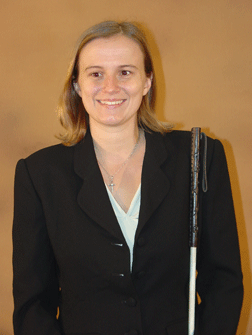
Stacy Cervenka has been an intern in Senator Sam Brownback�s office. She was recently promoted to legislative correspondent.
 |
As a legislative correspondent for a U.S. senator I�ve had a chance to meet with many groups of constituents who have come to Washington to educate us on the issues that affect people in their vocation, region of the country, or interest group. In doing so, I�ve come to understand that a group can do several small things to increase its impact on our office as a whole and on me as an individual staffer.
As you prepare to visit your senators and representatives during Washington Seminar, please keep the following eight tips in mind. (I want to point out that some of these suggestions seem pretty obvious, especially to old pros. However, I would not have put them on this list if I had not seen these rules of etiquette breached by at least one group visiting our office.)
1. Make an appointment.
It is absolutely critical that you make an appointment to meet with a staff
member. Dropping fact sheets off with someone in the front office is a waste
of time and energy. Your fact sheets will inevitably get lost in the shuffle
or more likely be tossed out.
2. Be sure to meet
with the appropriate staffer.
Your first object is to meet with the member in person, but he or she will almost
always be accompanied by at least one staffer. Unfortunately, when you tell
the senator�s scheduler that you are with the National Federation of the Blind,
he or she may automatically schedule you to meet with a healthcare staffer.
If your group is talking about Medicare, this might be appropriate. However,
if you are going to be discussing the Randolph-Sheppard Act, you need to speak
with the labor L.A. (legislative assistant). If you are advocating for delivery
of Braille textbooks on time for blind children, you want to speak with the
education L.A. If you meet with the healthcare L.A. and talk about voting access,
he or she will likely pass your fact sheets on to the voting rights staffer
after the meeting, but you�ve just lost all the benefits of meeting with that
staffer in person, so you might as well have simply mailed the fact sheets in.
Therefore consider calling Jim McCarthy or Jesse Hartle at the National Center
before you make your appointments so that you can tell the scheduler what issues
you�ll be discussing.
As a side note, when speaking
with the senator�s scheduler, I would strongly recommend using the term �labor
L.A.,� �education L.A.,� or �telecommunications L.A.,� and so on, since this
is the lingo we use on the Hill, and it will make you sound like an old pro
at scheduling appointments and will give you a better shot at actually meeting
with the L.A. On the other hand, if you ask to speak with the �education person�
or the �technology guy,� you�ll probably get scheduled to meet with the L.C.
(legislative correspondent) which is not nearly as effective. If you want to
be really slick, call the office first and ask the person who answers the phone
to give you the name of the education L.A., for example. Then ask to speak with
the scheduler and request an appointment with the education L.A. by name.
If the issues we are discussing are spread among several L.A.�s, decide which
is the most important or which you stand the best chance of getting support
on or perhaps which issue falls under the committee responsibility of the member.
Then try for a meeting with that L.A. and collect the cards of the staffers
with whom you will have to take up the secondary issues. All this is very much
simpler to manage if your actual meeting is with the senator or representative.
He or she will tell the aide what to do about the various issues, and you can
get the names and contact information of any other staffers from the member
for later follow-up.
3. Look your best.
When you walk into a congressional office, the first thing most sighted staff
members will notice is your appearance. Therefore men should plan to wear suits
and ties, and women should dress in skirted suits or pantsuits. If you do not
own a suit, dressy slacks or a skirt with a business shirt or blouse and sweater
or blazer will suffice. Be sure to check beforehand that your clothing is free
of stains, and take special care to see that your hair is neatly combed, your
teeth are brushed, and you remembered to use deodorant. (I have one very painful
memory of sitting in a meeting with a group of constituents who were wearing
dirty T-shirts and old jeans and smelled terrible. Needless to say, neither
the other staff member nor I went into the meeting with very high expectations.)
4. Begin the meeting
on the right foot.
Senators, congressmen, and their staffs tend to characterize the various groups
they see as either �friendly� or �hostile.� The chances are that they have never
heard of the National Federation of the Blind and are therefore uncertain about
what to expect. They may also have had some negative experiences with other
blindness or disability groups that have come across as hostile or whiny. Naturally
we want to be considered friendly by all congressional offices. Therefore I
strongly suggest that you start the meeting with a compliment about something
the congressman or senator has done for blind people in the past. Most members
of Congress have done at least one thing during their careers that has benefited
the blind community. Compliment him or her on signing on to a bill a year ago,
even if it was a bill that passed with unanimous consent and wasn�t controversial
at all. This will immediately put members or staffers at ease, and they will
realize that your group is friendly and there to educate them respectfully.
5. Always remain
polite and respectful.
Occasionally a member of Congress or a staffer says something like, �I really
want to help your group out, but with the budget as tight as it is, I just don�t
see how we can afford to fund that� or �I�m not sure whether or not I�m going
to be able to get on board with this, because I hear that there are several
other groups that don�t support this legislation.� Whatever you do, resist the
temptation to start shouting that the congressman doesn�t support blind people.
If anything, the member or staffer is being honest about his or her initial
thoughts. (You should be grateful that such folks aren�t simply saying what
you want to hear to make you happy so that you�ll go away sooner.) From the
research you have done beforehand, you should have anticipated some of these
questions and come up with answers that demonstrate that the bill will actually
save taxpayers money in the long run or that most constituents would indeed
agree with your bill if they understood all the facts.
6. Stay on issue.
Banish certain statements from your conversation with any senator or congressman:
�Well we might have the money to do this if you didn�t support tax cuts for
the wealthy or the war in Iraq!� �Well, if you weren�t so busy wasting our tax
dollars on welfare for those who haven�t worked a day in their lives or shelling
out all this money for Medicare, maybe we would have the money to fund education
properly!� Believe it or not, every staffer has been in a meeting with someone
who has said something like this, and it is the most unwise thing you could
possibly do. First of all, this is a surefire way to get the staffer to tune
you out and write your group off as hostile.
Second, as a nonprofit, the NFB is a bipartisan organization. Blind men and women are a cross section of American society, and we espouse a wide variety of political and personal beliefs. The only characteristics we have in common are our blindness and our commitment to improving the lives of all blind people. The NFB advocates for no policies except those that deal strictly with blindness. Therefore, if you wish to advocate for tax reform, saving the whales, privatization of Social Security, or an end to the war, become active with a group that specifically focuses on your non-blindness-related concerns.
7. Prepare one
story and one factoid for each item on your agenda.
Obviously congressional staffers are as diverse as the population in general.
Some may be analytical and objective, and others are more emotional. Therefore
have one good, strong fact or figure for each agenda item and one good personal
story. You do not want to bombard the staffer with endless facts and figures,
which can be very confusing. On the other hand, this is a legislative meeting,
not group therapy. If your group is talking about textbooks on time for blind
children and everyone in the room has a horror story of getting their textbooks
late, choose beforehand which story is the most powerful and illustrative of
the problem. With one factoid and one figure for each item, you can�t go wrong.
8. Follow up.
Finally, be sure to follow up with the appropriate staffer after the meeting.
Get his or her card, and send a thank-you email, perhaps enclosing additional
information.
I can�t promise that you
will always persuade your members of Congress of your position, but, if you
follow these suggestions, you will be effective and will be taken seriously
as a participant in the democratic process. Good luck at the Washington Seminar
and throughout the year as you forge relationships with your members of Congress.