_______________________________________________________________________________
Braille
Monitor
Vol. 49,
No. 1 January
2006
Barbara
Pierce, editor
Published
in inkprint, in Braille, and on cassette by
THE
NATIONAL FEDERATION OF THE BLIND
MARC
MAURER, PRESIDENT
National
Office
1800 Johnson Street
Baltimore, Maryland� 21230
telephone: (410) 659-9314
email address: [email protected]
Web site address: http://www.nfb.org
NFBnet.org: http://www.nfbnet.org
NFB-NEWSLINE� number: 1-888-882-1629
Letters
to the president, address changes,
subscription
requests, and orders for NFB literature
should
be sent to the National Office.
Articles
for the Monitor and letters to the editor may also
be sent
to the National Office or may be emailed to [email protected].
Monitor
subscriptions cost the Federation about twenty-five dollars per year.
Members
are invited, and nonmembers are requested, to cover
the subscription cost. Donations should be made payable to
National Federation of the Blind and sent to:
National
Federation of the Blind
1800
Johnson Street
Baltimore,
Maryland 21230
THE NATIONAL FEDERATION OF THE BLIND IS NOT AN ORGANIZATION
SPEAKING FOR THE BLIND--IT IS THE BLIND SPEAKING FOR THEMSELVES
ISSN
0006-8829
____________________________________________________________________
 Dallas
Site of 2006 NFB Convention
Dallas
Site of 2006 NFB Convention
The 2006 convention of the National Federation of the Blind will
take place in Dallas, Texas, July 1-8, at the Wyndham Anatole Hotel at 2201
Stemmons Freeway, Dallas, Texas 75207.
The 2006 room rates are singles, doubles, and twins $60 and triples
and quads $65 a night, plus a 15 percent sales tax. The hotel will begin accepting
reservations January 2. A $60-per-room deposit is required to make a reservation.
Fifty percent of the deposit will be refunded if notice is given to the hotel
of a reservation cancellation before June 1, 2006. The other 50 percent is not
refundable. For reservations call the Wyndham Anatole at (800) 996-3426. To
reserve a room online, use the link from the NFB Web site, <www.nfb.org>,
or go directly to <www.anatole.wyndham-hotels.com>.
Rooms will be available on a first-come, first-served basis. Reservations
may be made before June 1, 2006, assuming that rooms are still available. After
that time the hotel will not hold our block of rooms for the convention. In
other words, you should get your reservation in soon.
Guestroom amenities include cable television, coffee pot, iron
and ironing board, hair dryer, and high-speed Internet access. The Wyndham Anatole
has six excellent restaurants, twenty-four-hour-a-day room service, first-rate
meeting space, and other top-notch facilities. It is in downtown Dallas with
$15 shuttle service to both the Dallas/Ft. Worth Airport and Love Field.
The 2006 convention will follow what many think of as our usual
schedule:
Saturday, July 1 Seminar
Day
Sunday, July 2 Registration
Day
Monday, July 3 Board
Meeting and Division Day
Tuesday, July 4 Opening
Session
Wednesday, July 5 Tour
Day
Thursday, July 6 Banquet
Day
Friday, July 7 Business
Session
____________________________________________________________________
Contents
Vol. 49,
No. 1 January
2006
Frontispiece
Victory
in the First Round of the Christine Boone Case
by Barbara Pierce
NFB Highlighted
on NBC�s Three Wishes
by Rebekah Jakeman
The New
Book�The Blindness Revolution: Jernigan in His Own Words
by James H. Omvig
Old Nate
by Fredric K. Schroeder
Building
a Global Library for People with Print Disabilities
by Jim Fruchterman
Ask Miss
Whozit
Termites,
Chapters, and Changing What It Means to Be Blind
by Ray Martin
National
Literary Braille Competency Test: New Partnerships, New Possibilities
by Barbara Pierce
A Reflection
on Martin Luther King
by Ed McDonald
Access at
the Point-of-Sale: The U.S. Netcom Solution
by Chad Allen
Convention
Scholarships Available
by Allen Harris
Recipes
Monitor
Miniatures
Copyright
2006 National Federation of the Blind
NFB-Jernigan
Institute Launches NASA Braille Book, Touch The Sun
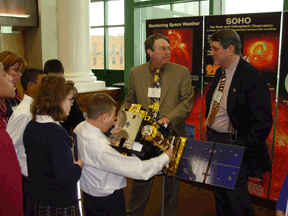 |
| Scientific
consultants for the book, Dr. Steele Hill (left) and Dr. Joseph Gurman,
with SOHO display board behind them, explain the details of the SOHO satellite
model to aspiring blind scientists. |
On December
2 the National Federation of the Blind Jernigan Institute helped launch an exciting
new print/Braille book called Touch the Sun, by astronomy educator
Noreen Grice. As in her previous book, Touch the Universe, Grice innovatively
pairs breathtaking color photographs with tactile renderings of the images.
With words and full-color tactile pictures, Grice conveys the dynamic nature
of our closest star.
 |
Smartly
dressed in school uniforms, students from St. Lucy Day School for Children
with Visual Impairments in Pennsylvania made a special effort to join
us for the Touch
the Sun book release. |
Visually impaired
astronomers, amateur and expert, will delight in the chance to explore the cosmos.
Dr. Joseph Gurman and Dr. Steele Hill of the Solar Physics Department at NASA�s
Goddard Space Flight Center, served as scientific consultants for this book.
As part of
the NFB�s National Center for Blind Youth in Science initiative, we hosted the
book launch in Members Hall. The event was attended by 150 people, including
students, teachers, parents, Federation members, NASA personnel, and volunteers
from both the Maryland Science Center and the Maryland State Library for the
Blind. About fifty of the participants were students from Maryland, New Jersey,
Pennsylvania, and Virginia.
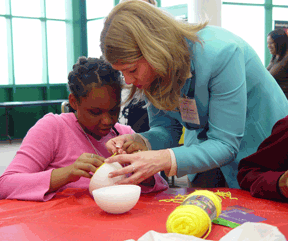 |
| Jernigan
Institute Education Program Specialist Mary Jo Thorpe helps out at the
Interior Solar Layers activity table. |
The students
got to know more about the sun through interactive activities like building
a model of the layers of the sun, simulating a coronal mass ejection, and examining
a scale model of the Solar and Heliospheric Observatory (SOHO) satellite with
NASA scientists. Guests then took their seats for the formal part of the program.
A number of speakers addressed the crowd during the program moderated by the
Institute�s Director of Education Mark Riccobono. President Maurer talked about
the importance of the work being done through the partnership between the NFB
and NASA and introduced Ms. Angela Diaz, associate administrator for education
at NASA headquarters. Ms. Diaz reconfirmed NASA�s commitment to expanding opportunities
for blind youth.
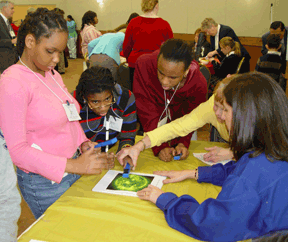
 |
Kit
Bloom (left), children�s librarian for the Maryland Library for the Blind
and Physically Handicapped, teams up with Maryland Science Center volunteer
Rich Stein to show Chelsea Cook a simulation of a coronal mass ejection. |
The audience
also heard from the publisher of Touch the Sun, the Joseph Henry Press,
and the book�s author, Noreen Grice. The last speaker was Skip Barker, chairman
of VIEW International Foundation, a new nonprofit that has committed to publishing
one hundred new accessible books in the area of science, technology, engineering,
and math. Each student present then received a free copy of the book, which
will be distributed by VIEW International Foundation in collaboration with the
NFB National Center for Blind Youth in Science. To wrap up the program, the
audience heard an a cappella performance of �Sun� by The Chromatics.
 |
| Maryland
School for the Blind students check out the way solar activity creates
magnetic fields. |
For purchase
information go to <www.nap.edu> or call (888) 624-7645 or (202) 334-3313.
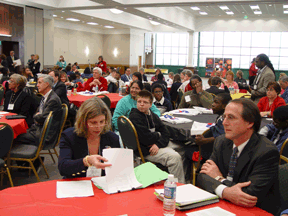 |
Angela
Diaz (left), associate administrator for education at NASA headquarters,
reviews her speech notes while Stephen Mautner, executive editor at the
Joseph Henry Press, listens to the speaker. |
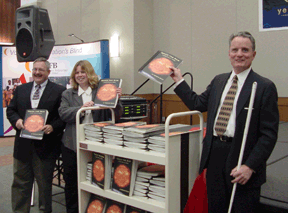 |
| Following
the book unveiling, Skip Barker (left), VIEW International Foundation
chairman; Noreen Grice, author and president of You Can Do Astronomy,
LLC; and NFB President Marc Maurer stand by the crammed library book cart,
each proudly holding a copy of Touch
the Sun. |
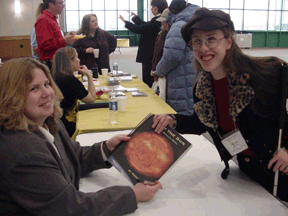 |
Book
author Noreen Grice (left) took time to sign books for the children. Chelsea
Cook happily accepts her signed copy from Ms. Grice. |
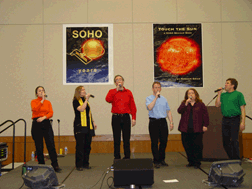 |
| The
Chromatics, a six-member a cappella group of scientists and other science
professionals, took the stage to sing a cleverly written song about science
from their CD titled AstroCappella. |
Victory
in the First Round of the Christine Boone Case
by Barbara Pierce
 |
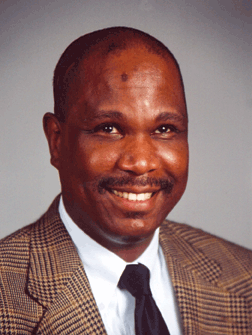
| Christine
Boone |
Those who read
the December 2003 issue of the Braille Monitor will remember the in-depth
report of Chris Boone�s firing from her position as director of the Pennsylvania
Bureau of Blindness and Visual Services (BBVS). During her three years as director
Boone had turned an historically troubled agency around, consumers were being
served efficiently, staff morale was rising, and blind Pennsylvanians were beginning
to hope that they could count on effective services.
Here is the op-ed
statement that former Rehabilitation Services Administration Commissioner Dr.
Fredric Schroeder prepared for publication in Pennsylvania newspapers. It summarizes
the situation at the time.
The
Organized Blind of
Pennsylvania Call
for a Commission for the Blind
by Fredric Schroeder
On Thursday, September
4, the organized blind of Pennsylvania gathered to protest the unjustified and
unceremonious firing of the director of the Bureau of Blindness and Visual Services.
Consumers of Bureau services believe that her firing had nothing to do with
her ability as a manager, are stunned at the dismissal of such an effective
leader, and now wonder why.
For seven years, beginning
in 1994, I served as the U.S. commissioner of the Rehabilitation Services Administration.
President Clinton appointed me to oversee the nation�s job training programs
for people with all types of disabilities, including blindness. I administered
a $2.5 billion budget, funding state and territorial programs, providing the
training needed to enable blind people and others with disabilities to prepare
for and obtain high-quality employment to live normal, productive lives.
Today blind people face
an unemployment rate of over 70 percent nationally. Blind people in Pennsylvania
have long suffered under a sluggish, bureaucratic rehabilitation program, making
a bleak national situation even worse for blind people in the Commonwealth.
Blind people cheered when Christine Boone was named director of the Bureau of
Blindness and Visual Services. Consumers knew she brought to the job an impressive
résumé of professional accomplishments and authority as a blind
person who has herself met the challenges facing the Bureau�s clients.
While she was director
of the Bureau of Blindness and Visual Services, Christine Boone built credibility
and strong relationships with the blind of the state. In three years she dramatically
increased the number of blind people who secured employment annually, established
strong ties with the blind community, and created an environment of trust. She
developed innovative staff training techniques for Bureau employees, raised
staff morale, and fostered commitment to helping blind people find good jobs.
Her record speaks for itself. It is one of accomplishment, integrity, and commitment
to the blind of Pennsylvania.
As the facts unfolded,
the firing emerged as petty jealousy exhibited by ineffective, insecure bureaucrats.
Steve Nasuti, executive director of the Office of Vocational Rehabilitation
(OVR), was threatened by Boone�s effectiveness; threatened by the unprecedented
support she enjoyed from staff, blind consumers, and the community at large;
and threatened by having a blind member of his executive team know more, do
more, and have more respect than he did. He suggested that Boone was too close
to her constituents to be objective. Why? Because she was blind! This is discrimination.
It is like the suggestion that a previously battered woman would be unsuited
to direct a battered women�s shelter.
So what do the blind of
Pennsylvania believe is needed? Boone must be immediately exonerated and reinstated.
But that will solve only one problem within an ineffective structure. To solve
the overall problem of removing employment barriers for blind Pennsylvanians,
a permanent reform of blind services in the Commonwealth is required. Such a
reform is available.
According to data collected
by the U.S. Department of Education, states with separate commissions for the
blind outperform states that bury such programs in large umbrella agencies.
The effectiveness of separate commissions as job preparedness agencies is not
hard to understand. Separate commissions for the blind have a single focus.
They have experience and expertise and know the most effective ways of preparing
blind people for high-quality employment. They are responsive to the clients
they serve, and, most important, they cannot sidestep accountability by hiding
within the larger bureaucracy.
The blind of Pennsylvania
call on the governor and the legislature to reorganize blindness services to
ensure that such an unwarranted attack never happens again. They want blindness
services moved out from under the Department of Labor and Industry; out from
under the Office of Vocational Rehabilitation; out from under the paternalistic,
unimaginative, heavy-handed control of bureaucrats who think �good enough� is
good enough for the blind. The blind of the state want services moved into a
separate commission for the blind run by a board appointed by the governor with
the consent of the Senate, made up of blind people and others who understand
how best to prepare blind people for good jobs in their communities.
Separate programs for the
blind save money in spite of what state bureaucrats say because they develop
expertise and knowledge about how best to invest available funds. Other programs
waste tax money by poorly preparing blind people for jobs.
The end result is rapid and repeated loss of employment, causing the blind person
to return to dependence on
tax-supported disability insurance and to undertake frequent, ineffectual retraining.
An example of just such
a false economy is Nasuti�s proposal to cut tuition support for blind college
students. This policy change will reduce college tuition support by more than
half. Yet the completion of a postsecondary degree is well documented to be
the most effective way to prepare blind people for high-quality, permanent employment.
Nasuti would have you believe that the cuts are needed and harmless even though
they will severely limit badly needed job opportunities for blind people.
One of the issues leading
to Christine Boone�s dismissal was a complaint by Nasuti that the Bureau was
taking too long to prepare blind people for employment. He believes that a newly
blind person can be placed in a job with only three or four weeks of instruction
in use of the white cane. This demonstrates his total lack of understanding
of the needs of blind people and his callousness toward the challenges blind
people face in seeking reentry into the workforce.
In 1994 the Pennsylvania
legislature sent the governor a bill to create a separate program for the blind
in the Commonwealth. Unfortunately the bill was never signed. This year the
National Federation of the Blind of Pennsylvania will ask the legislature again
to pass a bill establishing a commission for the blind. The blind need effective,
specialized services that will move them out of poverty, out of dependence on
public benefits, out of hopelessness, and into good jobs, which will enable
them to live normal lives, support their families, and contribute to their communities.
Please support the blind
of the Commonwealth in their efforts to establish a separate commission for
the blind, not as an act of charity, but as a recognition that, given the right
kinds of services and support, blind people can work�and deserve the chance
to do so.
In October of 2003, after her firing in August, Boone filed a disability discrimination
complaint with the Pennsylvania Human Relations Commission (the state equivalent
of the Equal Employment Opportunity Commission), and then filed a lawsuit in
state court in February of 2004 alleging a variety of claims, including an assertion
that she had been deprived of her Constitutional right of due process when she
was terminated without a fair hearing amid defamatory allegations by her employers
that she had been insubordinate and incompetent. Boone�s legal team (Arch Stokes,
lead attorney, and Anne-Marie Mizel of Shea, Stokes, and Carter) would have
preferred that the case be heard in federal court, but their most compelling
problem was to ensure that it could not be dismissed under what is known as
�sovereign immunity,� the state�s right not to be sued.
The defense, Office of
Vocational Rehabilitation Executive Director Stephen Nasuti and Pennsylvania
Labor and Industry (L&I) Secretary Stephen Schmerin, as they were required
to, referred the case to the Pennsylvania attorney general for review. That
office moved to dismiss the case, but first they removed it to federal court.
The L&I legal staff (Roger Caffier, L&I chief counsel, and Catherine
Wojciechowski, L&I deputy chief counsel) called in Hamburg and Golden P.C.,
an expensive Philadelphia law firm. This was an interesting decision for Caffier
and Wojciechowski to make, given their repeated characterization of the Boone
suit as a nuisance case that they were not paying attention to.
As soon as it is clear
that a case is going to trial, both sides begin filing interrogatories, demands
for documents held by the other side and necessary for the lawyers to prepare
for the depositions. Depositions are detailed interviews of each side�s witnesses
by the attorneys from the other side. Court reporters take down every word,
and the witnesses are under oath to tell the truth.
Because Boone was fired
and virtually escorted from the building, she had had no time to gather any
documents from her office computer or from her files. Catherine Wojciechowski
was known to have spent two months examining the files in Boone�s computer,
so Chris was particularly eager to have that information. The defendants were
even more anxious to drag their feet. For example, Hamburg and Golden delivered
800 pages of requested documents from Steve Nasuti�s files just three days before
that key deposition. The deposition had already been postponed once because
the defense attorney was ill, so there was no good reason for the delay in delivering
the documents. Boone�s legal team, principally Mizel, had to invest long hours
to be ready for the deposition. The final box of documents was delivered to
the plaintiff at 6:00 p.m. on Sunday, November 6, 2005, when the trial was to
open the morning of November 7 in Federal District Court for the Middle District
of Pennsylvania, Judge Sylvia Rambo presiding.
The case lasted eleven
days. It went to the jury on November 21, and eight citizens of the state took
a mere seven hours to decide the verdict. The plaintiff, Chris Boone, brought
twenty-five witnesses; the defense brought seven, four of whom had given depositions.
Six of those seven had their aural testimony impeached during cross examination.
Mr. Stokes repeatedly pointed out discrepancies between the witness�s deposition
and the courtroom testimony. The plaintiff�s witnesses, however, presented a
different picture altogether. One called to request that he be permitted to
testify; he had not been on the list. Another quietly requested a subpoena because
of instructions not to assist the plaintiff. Several voluntarily brought useful
documents with them. Needless to say, the attorneys were delighted with such
cooperation. Perhaps the clearest way to lay out the issues in this case is
to list Chris Boone�s witnesses and briefly summarize their testimony. Sometimes
it may appear vague and unspecific. We have tried to protect some people who
were courageous enough to come forward but who remain in real danger of retaliation
by the agency. The last thing we wish to do is to increase the damage done by
the secretary of Labor and Industry and his minions.
Deb Armbruster,
Pittsburgh BBVS district manager, said that Boone was the best manager she had
ever had. She is still depressed about what happened to Boone and the way the
agency has deteriorated since the firing. A number of witnesses, Armbruster
included, reported that until Steve Nasuti�s unexpected retirement in June of
2004, he was notorious for screaming and swearing at people in the office and
for making denigrating remarks about employees with disabilities. When asked
if she had ever heard Boone swear or raise her voice at people, Armbruster laughed
in incredulity. When asked about what had been accomplished at BBVS since Boone�s
departure, she said, �Nothing.�
Jim Antonacci,
president of the National Federation of the Blind of Pennsylvania and retired
BBVS employee, provided a careful and thoughtful history from the consumer point
of view of what happened to blind Pennsylvanians during the three Boone years
and since.
Wendy Buzzanco,
BBVS rehabilitation supervisor in Erie, testified about the agency�s latest
memo to rehabilitation counselors concerning merit scholarships. Chris Boone
had argued strenuously with her supervisors and the legal staff that BBVS could
not count merit scholarships, like those awarded by the NFB, as similar benefits
that automatically reduce the amount of BBVS educational assistance by the amount
of the scholarship. Boone produced documents from the Rehabilitation Services
Administration (RSA) demonstrating that her position was RSA policy, but she
was told that in Pennsylvania merit scholarships were a similar benefit, and
Nasuti later accused Boone of insubordination in this matter. The new memo instructs
counselors not to ask about merit scholarships and not to reduce BBVS assistance
unless the customer volunteers the information. In that case the reduction can
be made. Buzzanco�s testimony demonstrated that BBVS is retreating from Nasuti�s
position and admitting that Boone�s understanding of RSA policy was more accurate.
Michele Bornman,
a rehabilitation specialist supervisor in the central office who reviews contracts
and does training, described a contract identical in all critical respects to
one that Boone had signed the spring before she was fired. Boone had planned
a statewide staff training conference. Attendees were to pay their own way,
and meeting rooms were to be provided at no cost to BBVS. Two days before the
meeting Nasuti canceled the event, claiming that Boone had no authority to sign
the contract. The contract Bornman discussed was dated shortly after Boone had
left and had been signed by a member of the clerical staff. The terms of the
contract made it clear that only in case of cancellation would the state incur
charges. Though he claimed that Boone had exceeded her authority and incurred
exorbitant charges, it was actually Nasuti�s decision to cancel that cost Pennsylvania
$6,000.
Joan Bruce,
president of Pennsylvania�s Social Services Union, testified to the rise in
employee morale during the Boone years and its decline since she left. She said
that Boone had always been honest with the union, and they respected her. She
described the way that Boone managed to get disabled employees the access technology
and training they needed soon after she was hired.
Jim Bruce,
rehabilitation counselor and union leader, said that Boone had been one of the
three best agency directors he had worked with. He also testified that until
the summer of 2003 BBVS had never actually deducted the amount of merit scholarships
from education stipends. That summer Boone instructed counselors to begin making
these deductions in accordance with the instructions she had been given. This
statement pretty well disposed of defense claims of Boone�s insubordination
in this matter.
Ed Butler,
rehabilitation specialist with cerebral palsy, testified to Steve Nasuti�s disrespect
for and poor treatment of employees with disabilities. He also testified that
unlike Boone he had been granted a parking accommodation.
The Rev. Neal Carrigan,
president of the Pennsylvania Association for the Blind, testified that a few
months before Boone�s firing, Pennsylvania Governor Ed Rendell had publicly
complimented her job performance. After her termination Carrigan got a negative
response at the governor�s office when he called to support Boone.
Vito DeSantis,
director of the New Jersey Commission for the Blind and Visually Impaired, reported
what he knew about agency efforts to defame Boone�s character. He discussed
with his human resources personnel the possibility of hiring Boone, but he was
discouraged from doing so because of what was being said about her by Pennsylvania
officials. He also attended a gathering of the Blinded Veterans Association,
where he heard defamatory comments about Boone based on her conflicts with L&I
officials.
Jonathan Fister,
president of Keystone Blind Association, a member agency of the Pennsylvania
Association for the Blind with more than twenty-five years of experience with
the largest private comprehensive blindness rehabilitation facility in Pennsylvania,
agreed with the Rev. Carrigan about Boone�s abilities. He applied for her job
when she left and was passed over when the decision was made to appoint Pam
Shaw.
Mark Frankel,
acting assistant director of BBVS under Boone with thirty years of experience,
knew more about what was going on with Nasuti and Schmerin than anyone else.
He too was passed over when Pam Shaw was appointed as BBVS director and was
never spoken to about becoming the acting director immediately following the
firing. He was able to expose a number of untruths and inaccuracies in the defense�s
case.
Allen Harris,
director of the Iowa Department for the Blind, also testified that Boone�s professional
reputation had been ruined by what happened in August of 2003. He said that
the reputation of the Pennsylvania program had been improving while Boone was
the director but that it had now eroded again.
Passle Helminski,
blind artist and member of the Pennsylvania Rehabilitation Council, the body
that advises OVR, described the September 2003 meeting of the Pennsylvania Board
of Vocational Rehabilitation, the entity that oversees OVR. The Governor�s Advisory
Committee for BBVS had requested that the OVR board discuss the Boone firing.
Secretary Schmerin refused to allow it to do so. When Judy Jobes requested that
the OVR board go into executive session to discuss this obvious personnel matter,
Schmerin again refused.
Lynn Heitz,
BBVS consumer and president of the Keystone Chapter of the NFB of Pennsylvania,
related the abuse she received from the agency after she protested the Boone
firing. She also explained that she had received NFB scholarships in 2002 and
2004 and is still fighting to reverse the BBVS decision to reduce the amount
of her state assistance by the amount of the two awards.
Judy Jobes,
first vice president of the NFB of Pennsylvania and a member of the Pennsylvania
Board of Vocational Rehabilitation, told the story of the September OVR board
meeting from her perspective and described the BBVS initiatives, particularly
serving blind children, that had begun during the Boone administration and have
now fallen apart.
George Leader,
former governor of Pennsylvania, testified that he had called Stephen Schmerin
to request a meeting for Chris Boone to discuss her firing with him in person.
Schmerin refused.
Harold Longmore,
a rehabilitation supervisor, testified to his conversation with Nasuti about
the upcoming statewide staff training meeting that Nasuti later canceled, saying
that Boone had planned it without his permission or knowledge.
Demielo Luckette,
a bureau director when Boone was, testified that every bureau director had a
parking place underground at the L&I headquarters building except Chris
Boone, who repeatedly asked for one and was refused. She also reported that
Nasuti had commented to her that Boone was not an effective supervisor because
she could not watch facial expressions and alter her approach as a result. She
said that Nasuti habitually screamed and swore at employees and specifically
at her. She left her job soon after Boone was fired. She also said that Nasuti
pigeonholed people based on their race or disability.
Jerry Manganelo,
vendor in the state�s Business Enterprise Program, requested to testify about
how much Boone had done for vendors and what had happened since her departure.
Fred Schroeder,
former commissioner of the Rehabilitation Services Administration, at one time
a state agency director and Boone�s former boss, testified that she was an excellent
employee. He explained that as RSA commissioner he had codified the merit scholarship
exemption in the Federal Code of Regulations. In other words, his testimony
demonstrated clearly that Boone�s position had been correct and agency officials
had been wrong.
Louise Fink-Smith,
a lawyer for the Commonwealth of Pennsylvania and Boone�s carpool driver, testified
that they had requested that Fink-Smith be issued an access card so that she
could step inside the OVR building to let Boone know she had arrived. (At the
time she did not carry a cell phone.) Nasuti refused, saying that to do so would
be a security risk. Fink-Smith already possessed an access card that gave her
entrance to every building in the complex except OVR, whose building was leased
and therefore on a different system. In fact Fink-Smith returned to the stand
to report that she had double-checked to be sure that her testimony that she
did have access everywhere but OVR had been accurate and that, unlike Secretary
Schmerin, who had testified that after 6:30 p.m. even he could not get access
to buildings, her card worked late into the evening. She clearly had a high
level of clearance and was generally recognized as trustworthy.
Since Fink-Smith was not
allowed to enter the building, Nasuti left Boone no choice but to wait outside
since she could not hear Fink-Smith�s voice or recognize her horn from inside.
The neighborhood was run down, and women did not feel safe standing alone in
the dark. At one point Boone had shingles, and cold air was very painful. This
made no difference to Nasuti; she could stand outside to wait for her ride.
In fact, since the end of the trial Boone has learned from a female security
guard who for a while stood with her while she was waiting for her ride that
Nasuti had threatened her with the loss of her job if she continued to
protect Boone at night.
Ed Staudt,
owner of Virtual Vision Technology and an early Boone supporter, was a member
of the Governor�s Advisory Committee for the Blind. He testified that the committee
went to Secretary Schmerin to ask that he meet with Boone to hear her side of
the dispute with Nasuti. The committee asked to record the meeting. Schmerin
refused, saying that his staff would take notes and circulate them afterward.
Needless to say, he never produced the minutes of the meeting, and he refused
to meet with Boone. This is as good a place as any to mention that under oath
Schmerin stated that he never allowed recording of his meetings since he might
say something that he would not want anyone to know about.
Aside from Doug and Chris
Boone, there you have the witness list, and the testimony they gave was powerful.
Previous to his appointment,
Stephen Schmerin, a member of the governor of Pennsylvania�s cabinet, had supervised
only two secretaries and one paralegal in his entire working career. Stephen
Nasuti, the supervisor who believed that Chris Boone could not supervise successfully
because she was blind, himself managed his subordinates by yelling, swearing,
and stereotyping them. Perhaps he simply took it into his head to resign in
June of 2004, but he was in the middle of building an opulent home when he made
the decision. Luckily for him the monetary award made by the jury will be covered
by the taxpayers of Pennsylvania.
Of course the defense has
said that it will appeal the jury�s decision, but a seven-hour deliberation
is remarkably short for a case like this, and the jury�s assessment was clear.
It awarded Chris Boone triple the amount she asked for. The front pay it awarded
was only $180,000 ($90,000 from each official), which is much less than she
could actually have expected to earn in salary and pension during the years
remaining in her working life, but if she is reinstated in the job as BBVS director,
she must give up the front pay award, whereas, the award for emotional damages
is hers unless the decision is overturned on appeal. Here are the questions
the jury was asked to answer and its responses:
Case 1:04-cv-005 SHR Document
171 Filed 11/22/2005
IN THE UNITED STATES
DISTRICT COURT
FOR THE MIDDLE DISTRICT OF
PENNSYLVANIA
CHRISTINE BOONE, Plaintiff
v.
PENNSYLVANIA OFFICE OF
VOCATIONAL REHABILITATION,
et al., Defendants
CIVIL NO. l:CV-04-0588
JUDGE SYLVIA H. RAMBO
FILED Harrisburg Nov. 22, 2005
Mary Dandrea, Clerk Deputy Clerk
VERDICT FORM
Question No. 1
Did Plaintiff prove by
a preponderance of the evidence that her blindness was a determinative factor
that caused her dismissal from her job for any of the following Defendants?
Department of Labor & Industry Office of Vocational Rehabilitation
Yes X No
Stephen Nasuti Yes X No
Stephen Schmerin Yes X No
Question No. 2
Did Plaintiff prove by
a preponderance of the evidence that the following persons aided or abetted
the discrimination against her?
Stephen Nasuti Yes X No
Stephen Schmerin Yes X No
Question No. 3
Did Plaintiff prove by
a preponderance of the evidence that the following persons made false, defamatory,
and stigmatizing statements to the public in the proximate time of her termination
that called into question Plaintiff�s good name, reputation, and professional
qualifications in the field of vocational rehabilitation?
Stephen Nasuti Yes X No
Stephen Schmerin Yes X No
Question No. 4
Did Plaintiff prove by
a pre-ponderance of the evidence that the stigmatizing statements were a substantial
factor that severely impaired her ability to obtain employment in her profession?
Yes X No
Question No. 5
Did Plaintiff prove by
a preponderance of the evidence that Defendants Nasuti and Schmerin had an agreement
or understanding with each other that they would impose a stigma upon Plaintiff�s
reputation and harm to her other employment opportunities in the field of vocational
rehabilitation without giving her an opportunity to defend herself; that one
or more of these participants in the agreement committed an act or acts to accomplish
that objective; and that their conduct caused damage to Plaintiff?
Yes X No
Question No. 6
If the Commonwealth Defendants
had given Plaintiff a meaningful post-termination name clearing hearing, would
Defendants have refused to reinstate Plaintiff in any event?
Yes X No
Question No. 7
Has Plaintiff failed to
mitigate her damages? Yes No X
Question No. 8 - Damages
Plaintiff may be awarded
damages if she has proven by a preponderance of the evidence that she incurred
damages as a proximate cause of Defendants� conduct.
A. Back Pay Damages
Stephen Nasuti $ 0
Stephen Schmerin $ 0
B. Emotional Distress
Stephen Nasuti $1,500,000
Stephen Schmerin $1,500,000
C. Front Pay
Stephen Nasuti $90,000
Stephen Schmerin $90,000
Question No. 9
If you have answered �Yes�
to Question No. 7 and have otherwise awarded damages to Plaintiff under any
part of Question No. 8, by what amount do you find Plaintiff has failed to mitigate
her damages? $ 0
Jury Foreperson signature
From the jury�s punitive
damages form:
Did you find that any of
the following Defendants were motivated by an evil motive or intent or acted
with reckless or callous indifference to Ms. Boone�s protected rights?
Stephen Nasuti Yes X No
Stephen Schmerin Yes X No
Stephen Nasuti $25,000
Stephen Schmerin $150,000
Dated: 22 November 2005
As accurately as we have
been able to record it, this is the information that emerged during the trial.
When asked for comment on the case, Labor and Industry Press Secretary Barry
Ciccocioppo said, �The department is planning to appeal and is confident that
the decision of this court will be overturned.� When pressed for any further
statement about the case, he pointed out that Pam Shaw, who replaced Chris Boone
as BBVS director, is also visually impaired and remains on the job. He said
that she has expressed the desire to find a position closer to home, but unless
she does, she will remain on the job at BBVS. Because the case is being appealed,
beyond this statement Mr. Ciccocioppo was not prepared to make any statement.
The press secretary�s statement
of confidence about the ultimate outcome of the case is exactly what he was
required to say. Time will determine its accuracy. But his comment about Pam
Shaw is interesting because twice on cross examination Secretary Schmerin stated
that he had received Shaw�s letter of resignation the previous week. He explained
that she wished to exercise her right to return to a Civil Service job�a right
that ceases twenty-four months after leaving the Civil Service. Shaw�s deadline
for returning to the haven of the Civil Service occurs at about the time this
article is being written, so who knows how all the seeming inconsistencies of
the various statements will resolve themselves? But the tangle of statements
and misstatements involved in this insignificant detail seem illustrative of
the entire case as laid out by the defendants.
Whatever the final outcome,
the people of Pennsylvania continue to be the losers. Secretary Schmerin recently
told the press that the entire jury award, including punitive damages, will
be covered by insurance. (Pennsylvania is self-insured, so he is clearly planning
to manipulate the system to make Pennsylvania taxpayers pay everything.) When
Chris Boone was hired, blind Pennsylvanians were allowed to hope for better
services than they had ever had, but the jealousy and pettiness of a few incompetent
bureaucrats have destroyed their dream. A jury has done what it could to set
matters to rights. Chris Boone has achieved a measure of vindication. We can
only hope that the good work begun in a Pennsylvania courtroom will be completed
in the appeals court.
NFB
Highlighted on NBC�s Three Wishes
by Rebekah Jakeman
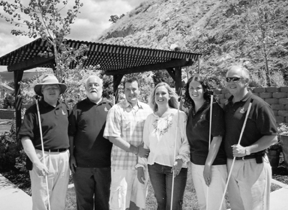 |
|
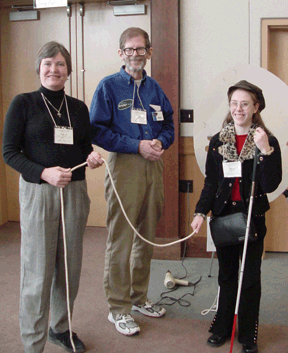
Left to right, Nick Schmittroth (wearing hat), Karl Smith, Brandon and
Nicole Rasmussen, Rebekah Jakeman, and Ron Gardner |
On Friday, November 4,
2005, NBC aired its primetime television show Three Wishes, featuring
a story about a young blind mother, Nicole Rasmussen, from Cedar City, Utah.
In June of this year Brandon Rasmussen attended the show�s live audition in
Cedar City
and recounted his wife�s touching history. He and Nicole were married in September
1999. Subsequently bacteria multiplied in Nicole�s brain, and this affected
the optic nerve, eventually leaving her blind. With only two months of rehabilitation
training after her blindness, Nicole felt helpless.
NBC was intrigued by Nicole�s
struggle and selected her as one of the people whose wishes they would highlight
during a program. Interestingly, Brandon did not specifically ask for anything,
but simply stated the facts, so it was up to NBC to develop a storyline outlining
wishes to grant the young blind mother. They launched a search to learn more
about blindness and the way they could assist Nicole, which led to contacting
leaders of the National Federation of the Blind.
Utah Affiliate President
Ron Gardner recalls, �Robert McLeod, NBC�s associate producer, gave me a call
telling me that NBC was doing a show involving someone who was blind.
He gave very little detail
about the matter but wanted answers to questions about blindness in general.
I basically explained the NFB�s philosophy. A few days later he called again.
This happened several times. The more we talked, the more information we exchanged.
Then one day he called and invited the NFB to assist a blind woman in Cedar
City.�
It�s noteworthy that NBC
was making dozens of contacts across the nation, yet they chose the National
Federation of the Blind to lend a hand with the project. Betsy Zaborowski, executive
director of the Jernigan Institute, was one of those with whom they spoke repeatedly.
She finally told them in so many words that they needed to assemble a team of
competent blind folks to take on the job of training Nicole. They bought Dr.
Zaborowski�s concept completely and settled on the NFB to do the job. Karl Smith,
an access technology consultant in Utah, explains his notion of the reasoning
behind NBC�s choice: �I think it was our willingness to work with them and our
readiness to take the project on. They were impressed with those they talked
to and saw our commitment. We never told them who they should or should not
speak with, and we were open to their ideas.�
The Federation does not
just sit back and wait for things to be handed to us, so it wasn�t long before
Dr. Joanne Wilson and Dr. Betsy Zaborowski of the NFB Jernigan Institute were
on the phone with Ron Gardner, discussing possible strategies for granting Nicole�s
wish. They came up with the NFB team of blind people to help train and educate
Nicole on adaptive techniques and a positive philosophy about blindness. Gardner
proposed the team to NBC, and they loved it. We were in business.
When I first heard of the
project, I was on vacation visiting my parents. Ron Gardner called to ask if
I would be willing to be a part of the team. He explained that Nicole was a
blind mother about my age who had a one-year-old daughter. Since I am a mother
of two small children, Ron concluded that I could offer expertise and support
to Nicole. I readily accepted the invitation.
Besides me there were three
other team members. Ron Gardner led the group and was instrumental in educating
NBC producers and the Rasmussen family concerning the truth about blindness.
Nick Schmittroth, an orientation and mobility specialist working at Utah�s Division
of Services for the Blind and Visually Impaired (DSBVI), joined the group to
do long-white-cane training under sleepshades. Karl Smith came aboard as the
technology specialist who would not only train Nicole on accessible technology,
but provide some of the equipment as well.
As a group we were very
excited about the whole project, but our enthusiasm was tempered with anxiety
about the details. Many of us had seen previous media coverage of blindness.
Such coverage often demonstrates a lack of knowledge and thrives on throwing
a pity party for the blind. More than anything we wanted to give Nicole quality
training and confidence, but we also wanted to help NBC portray blindness in
a positive light.
Early in the planning a
proposal came up which would have been detrimental to a healthy approach to
blindness. NBC originally planned to construct a park with special fencing and
specific textured surfaces so that Nicole would be able to maneuver her way
through the park and not wander off into the street. The production company
feared that unless it put up special fencing it would have a liability case
on its hands if Nicole got lost in the street with her daughter Peyton. Ron
dispelled these worries, explaining that with proper training Nicole could use
traffic sounds and common sense to maneuver through the park and stay out of
the road.
�It was important for NBC
and the producers to realize that Nicole was capable of keeping herself safe.
Sighted people often assume that they have a responsibility to keep blind people
out of danger when traveling, but they don�t; the blind are responsible for
their own safety,� Gardner said.
Working with President
Gardner and others, Glassman Productions came up with a plan for a beautiful
park just like any other. In the television program the host pointed out that
they had installed a water fountain and had incorporated variously textured
surfaces so that Nicole could find her way around the park. But the textures
and layout were nothing new to parks�sand, grass, and cement, coupled with a
few shaded benches and some slides. The final product was a tremendous improvement
on the first proposal.
Giving a person the tools
to live independently again cannot be carried out easily by one person or even
a few people. It is the sum of many people�s industry and generosity. NBC depended
on our resources to provide Nicole with state-of-the-art adaptive materials.
President Gardner made several trips to the National Center to buy Brailled
games that Nicole could play with her family, aids and
appliances for the kitchen, a talking thermometer, writing and labeling equipment,
etc. When NBC mentioned that Nicole wanted to read to her daughter and asked
if we had any Braille children�s books, Ron was able to come up with a whole
library of books with the help of Barbara Cheadle, president of the National
Organization of Parents of Blind Children (NOPBC), who kindly provided some
of her favorite books from the NOPBC collection. We also supplemented the library
with some Seedlings Brailled board books.
After much thinking, planning,
and phoning back and forth, the team traveled to Cedar City in a van packed
with everything we needed, including maroon NFB team shirts displaying the Whozit
logo, provided by President Maurer. We were excited by the prospect of meeting
and working with Nicole. But during the trip we exchanged our hopes and worries
about the project. We felt some anxiety at the uncertainties. We didn�t know
when we would meet Nicole or how many hours would be available for training
off
camera. We had no idea whether NBC�s expectations for Nicole�s training would
match our own. We didn�t even know how long they wanted us in town. One thing
was certain: we wanted to help Nicole and let her know that we were there to
be a resource and a
support for her for the rest of her life.
The producers lost no time
in meeting with us, reviewing the schedule, and appraising the adaptive equipment
we had brought. Next came the filming. The first time we met Nicole a camera
was rolling. We came to her door and introduced ourselves. Of course, since
it was all staged, we had to repeat the scene several times. Each time Nicole
had to act surprised, as if she were meeting us for the first time. This was
typical of all the shoots. The producers did not have a set script for us to
follow, but they often had us repeat scenes or conversations so they could film
it from a different angle or with different lighting. Each time we were expected
to be natural and spontaneous.
Between shoots we took
time to train Nicole. The very first day she wore sleepshades and walked along
the sidewalk in front of her house. We were all pleased at her complete willingness
and confidence in the idea of sleepshades.
Nick Schmittroth says,
�My first meeting with Nicole was recorded on film. I don�t think she understood
what this group of Federationists was all about, but she was willing to learn.
Seeing all of us with our long white canes did something for her self-confidence.
Before we showed up, Nicole was convinced that there was nothing else for her.
Now she knows about the National Federation of the Blind.�
One of the biggest challenges
the NFB team faced was producing media-worthy interactions with Nicole while
at the same time providing substantive training. Truly effective rehabilitation
takes six to nine months. From the beginning we made it clear to NBC that the
training we were providing could not be fully understood, much less mastered,
in a week. But the production company had its own objectives for the show, and
we did our best to help satisfy them while still providing as much quality training
as possible.
One of the main focuses
was travel with a long white cane. Schmittroth was able to pack about three
weeks of travel training into just a few days. On camera he explained the purpose
of wearing sleepshades; then he and Nicole practiced walking around her neighborhood.
Nicole even did a short independent route within the first few days.
Nicole commented, �I was
kind of scared. It was intimidating since it was the first time in four years
that I had gone anywhere completely alone, but I just knew I would be able to
do it. Getting back on my own gave me confidence.�
Another aspect of training
we addressed was adaptive technology. Karl Smith founded his own company, Axis,
eleven years ago. He provides accessible technology and training to blind people.
NBC wanted the adaptive technology part of the story to be a
big secret. They made over the Rasmussens� home office and bought Nicole state-of-the-art
equipment: a PAC Mate, Braille embosser, scanner and accompanying software,
JAWS, and a state-of-the-art computer. Karl was responsible for setting up the
equipment and ensuring that it worked. Then after the host Diane Mizota revealed
the room and all the adaptive technology to Nicole, Karl had a chance to sit
down and train her.
Despite Nicole�s information
overload, she exhibited a real desire to try everything. According to Smith,
�Nicole is quite a bright young lady. She is not content to sit around and do
nothing. She is proactive and has a positive view of what the blind can do when
they work together.�
I was responsible for training
Nicole in basic home economics and advising her on parenting skills. The very
first day we were there, NBC filmed Nicole and me as I showed her how to label
food packaging, Braille directions for food preparation, and give her a Braille
recipe book printed on Thermaform paper. Kara Campbell, a member of the NFB
of Utah, assisted me in putting the recipe book together. Nicole seemed very
excited to have the recipes in Braille. �Before, if I wanted to cook a meal,
Brandon had to lay out all the food for me and read the directions. Now for
the most part I can do it on my own,� explains Nicole.
Throughout my portion of
the training Nicole and I had a lot of time to chat as we read Braille books
to our children, played with our kids at the city park, and walked down the
street pulling her daughter Peyton in a stroller. It was a unique opportunity
for me because I saw so much of myself in Nicole. She and I are the same age�only
one month difference. We both lost our sight four years ago, and our daughters
are four months apart. I could really connect with Nicole because I had been
where she is now. Sometimes I would fold up my rehab cane and throw it in the
corner. I vividly remember my overwhelming anxiety about how to care for my
first baby. But I also recall the glorious moments when I discovered the NFB
and what it had to offer.
Last but not least, Ron
conducted philosophy training with Nicole, her husband, and the NBC producers.
He took time to explain to them that blind individuals are normal people who
do regular things using adaptive techniques. When a blind person receives inadequate
rehabilitation training, it is imperative to share the truth about blindness,
restore hope, and promote personal dignity. Both NBC and the Rasmussen family
were very receptive to these ideas.
�I was profoundly impressed
with the way NBC gravitated to what we were doing with the training,� President
Gardner said. The producers were not the only ones to see the wisdom of our
approach. Gardner describes a highlight of the trip for him. He was discussing
blindness philosophy with Brandon in the living room. Suddenly Brandon rose
from the couch and went to the window. �Oh my gosh, Nicole is walking down the
street by herself. That is the first time I have seen her do that in four years.�
Ron Gardner also reviewed
Braille with Nicole. Nicole had taught herself Braille, which is no small feat.
One of Gardner�s responsibilities was to be sure Nicole felt comfortable reading
such things as her last name, her daughter�s name, and other simple words in
Braille. NBC had planned a dramatic climax for the story. They wanted Nicole
to take her daughter to the brand new park a few blocks away by herself. There
she would read the Braille sign, which revealed the name of the location, �Peyton
Park.�
The last day of training
arrived, and it was time for Nicole to be out on her own. She had never walked
to the park before, but she followed Schmittroth�s directions and did it all
by herself, pulling her daughter behind her in a stroller. NBC captured it on
camera. She didn�t know that the entire neighborhood, along with her extended
family, was waiting to congratulate her when she arrived. Note that this plan
was proof of how much confidence Nicole and others had. There was no doubt in
anyone�s mind that she could take her daughter to the park in a stroller just
like every other mother. NBC placed a few obstacles in Nicole�s path, including
a bicycle and other children�s toys, and had a car peel around the corner where
Nicole had to cross. They even added sound effects to the shoot for the televised
show, but other than that they did not interfere with her travel route. Nicole
did a beautiful job in her street crossing despite the profoundly rounded curb.
After she arrived at the park and read the Braille sign, we all cheered with
enthusiasm. It was a momentous climax to the week and another witness of NFB
philosophy in action.
We concluded the week by
attending Amy Grant�s concert, where we were featured in the middle of the front
row. We sang along and danced, but, most important, we applauded the Rasmussen
family for a job well done. Nicole really had come a long way in a few days.
Schmittroth said, �I saw a lot of self-confidence in Nicole. Her life is not
yet totally changed, but we gave her some skills, and I saw a lot of improvement.�
Nicole felt the boost as
well and acknowledged what the team had done for her. �Until now I�ve had only
sighted instructors. It was so nice to have instructors who were actually in
the same situation as me. The NFB can really offer a lot.�
This was a wonderful experience
for everyone involved. Not only did we assist Nicole in gaining confidence and
acquiring skills, but we developed a great working relationship with NBC and
Glassman Productions. We all agreed that they were splendid to work with and
treated us like the professionals we were.
Gardner gives more detail:
�They recognized us as a group of professionals. They immediately grasped what
we were trying to do. We did not try to run the cameras, and they did not interrupt
our training. The NFB and NBC working together went a long way to raise the
expectations of the blind in America.�
When the show aired on
November 4, we were all pleased with the outcome despite the fact that Nicole�s
story received less than twelve minutes of air time. NBC chose what they felt
was most important. They began with Erik Weihenmeyer rock climbing with Nicole.
Then they turned to the NFB training, placing special emphasis on travel training.
Out of the hours and hours of film footage for this story, they selected sleepshade
training and the multiple times Nicole used her long white cane on the streets
of Cedar City. Karl Smith explains, �No matter how much they said they understood
and believed our philosophy, we felt that we and the NFB message of hope and
possibility we wanted to deliver to viewers were at their mercy. They were the
ones who edited the footage without any input from us. In the end I was impressed
that they did not resort to evoking pity. I think they really did understand.
After all, they showed so much travel and emphasized independence.�
As Karl says, developing
Nicole�s independence was an important goal for us. We realize that developing
it takes longer than a week, so since the television shoot in August we have
each made repeated contacts with Nicole. Karl Smith and DSBVI rehabilitation
teacher Ray Martin continue to give Nicole notetaker training. She and I have
also maintained telephone contact. Now that the glitz of the camera lights is
history, the real rewards for Nicole are the doors of opportunity that have
been opened, the lifetime friendships that were established, and the Rasmussens�
connection with the NFB.
The
New Book�The Blindness Revolution: Jernigan in His Own Words
by James H. Omvig
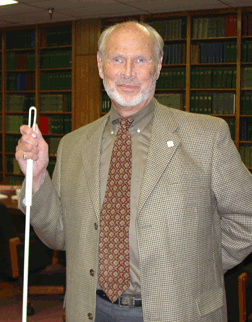 |
|
Jim Omvig |
From the Editor:
Thursday morning, July 7, delegates to the 2005 NFB national convention had
the opportunity to hear author and longtime Federation leader Jim Omvig discuss
his book, The Blindness Revolution: Jernigan in His Own Words, which
was for sale at the convention. Dr. Jernigan and Mr. Omvig were friends and
colleagues for almost forty years. Researching and writing this book was clearly
a labor of love by a devoted student for his dedicated teacher and brother in
the revolution of which he writes. This is what Jim Omvig said:
If a person must be blind,
it is better to be blind in Iowa than in any other place in the nation or the
world!�
These stirring and inspiring
words were spoken in Des Moines, Iowa, in March of 1968 by a federal official
who was honoring Kenneth Jernigan on behalf of President Lyndon Baines Johnson.
The honor was being bestowed by President Johnson because of Dr. Jernigan�s
pioneering and life-changing efforts in work with the blind and the implications
his cutting-edge blindness work in Iowa would offer generally for the broader
field of vocational rehabilitation.
Why would such a signal
honor be given to Kenneth Jernigan by a president of the United States? What
had happened in Iowa that was unique�so revolutionary? Just who was this legend,
this man, Kenneth Jernigan?
As I was preparing these
remarks, an interesting thought crossed my mind: if I were asked to define Dr.
Kenneth Jernigan, my mentor and teacher, in a sentence or two, what would I
say? After reflection, I concluded that the following two sentences filled the
bill: Kenneth Jernigan was a human being of extraordinary talents and abilities
who was driven by a passion for justice for the blind and suffered from chronic
enthusiasm.
Incidentally, he happened
to be blind.
Before turning specifically
to the new book, The Blindness Revolution, let me offer what one might
call a very, very capsulated summary of the history of services for the blind,
including certain relevant parts of the noble history of the National Federation
of the Blind. This brief history sets the stage for Kenneth Jernigan�s Iowa
experience and what I have referred to in Freedom for the Blind as
�the Iowa experiment.�
To begin at the beginning,
those of us who are involved in the National Federation of the Blind understand
full well that throughout recorded history the blind have been perceived by
society as inferiors: we have been looked down upon and rigidly set apart from
others by virtue of our distinguishing characteristic, blindness. We have been
and continue to be a minority group, with all of the negativity which this phrase
conjures up. We have all too frequently been thought of, not as unemployed,
but as people who are unemployable. Far worse, in certain cultures blind men
were sent into galley slavery; blind women were sold into prostitution; and
blind babies were left on cold and lonely hillsides to die.
Historically the public
has assumed the blind to be helpless, incompetent, and irrelevant�these public
attitudes about blindness of course have not been based upon accuracy and truth
but upon myth, misconception, and superstition about the true meaning and implications
of blindness.
Viewing the blind from
this bleak historical perspective, society would inevitably try to do something
to offer help to what it perceived to be an unfortunate group. In the early
days�drawn together because of sympathy and pity for the blind�a group of sighted
volunteers began to do what they could to offer assistance. They formed themselves
into societies, and, based upon erroneous public attitudes about the capabilities
of the blind, they established themselves as custodians and protectors. These
volunteers did their charity work (helping the blind) in their free time and
out of the goodness of their hearts.
Later paid employees were
added, and they gradually assumed leadership and control over the volunteers
and also over the blind, whom they considered to be their wards. Eventually
these paid workers developed certain services for the blind and also established
enclaves and retreats in which the blind could escape embarrassing contact with
normal society. The blind were taught simple tasks from which they could derive
some small measure of satisfaction. These tasks, of course, were not seriously
competitive with
the ordinary pursuits of the larger (normal) community.
By 1905 many of these workers
and other interested people joined together in an organization known as the
American Association of Workers for the Blind. Through this organization the
workers aspired to achieve a kind of professional status; they then assumed
the self-assigned roles of interpreters of the needs and protectors of the blind,
and they developed their own methods and standards for programs in work for
the blind.
Unfortunately for the blind,
however, these new professionals viewed blindness as a disaster�a tragedy�and
as a medical problem, and they sought medically-oriented solutions to that problem.
The public�s erroneous myths and superstitions about blindness had actually
crept into the very service programs set up to offer assistance, and a serious
disconnect developed between the blind and those assisting them.
The American Foundation
for the Blind was established in 1921 by the American Association of Workers
for the Blind and the American Association of Instructors of the Blind. Although
the Foundation certainly did some worthy work, it too soon came to look upon
itself as having a duty to take care of and speak for the blind.
The National Federation
of the Blind, the authentic spokesman for the blind, was established in 1940
when Jacobus tenBroek led the blind in a nationwide movement toward self-organization.
Although many of the Federation�s early years were spent in securing financial
support to provide the barest necessities of life for the blind, it was not
long until Dr. tenBroek and other great leaders like
Kenneth Jernigan also turned their attention to services for the blind. They
were concerned that the agencies failed to understand that the blind are a minority
and that the services which were being provided were far too custodial, serving
to keep the blind down and out rather than helping to lift them up and in. They
were also concerned that the service programs had been established using a medical
model and that expectations for what the blind could accomplish were much too
low.
Throughout the forties
and fifties the Federation�s leaders also began to articulate what we refer
to today as Federation philosophy. Dr. tenBroek reasoned that the blind are
simply normal people who can do what normal people do, given proper training.
He also began to assert with vigor that the blind could and should speak for
themselves and that the principal problems faced by the blind were social and
attitudinal�the problems of a minority group�not physical or medical.
In the early years of the
Federation, the traditional workers virtually ignored the organized blind as
nothing more than a tiny and insignificant group of malcontents. By the middle
1950�s, however, the Federation had grown substantially and had begun to have
influence generally and also in the political arena: so much so that in 1955
and 1956 the governors of three states�Nevada, Colorado, and Arkansas�invited
Federation representatives to come to their states officially to study programs
for the blind and to make
recommendations for improvements. By this time Federationists had also developed
ideas about how blindness training should be delivered.
When this new, elevated
status was achieved by the Federation, dislike on the part of many agency leaders
turned from casual dismissal to fear, hate, and seething rage. In some states
agency officials actually tried to destroy Federation affiliates. This reactionary
hostility on the part of some agencies motivated the Federation to join forces
with then Senator John F. Kennedy to work for passage of what was known in the
late 1950�s as the Right of the Blind to Organize Bill.
Even though some of the
blindness workers of that day were friendlier to the Federation than those who
hated it, these friendly leaders too continued to believe that the Federation�s
ideas about what good services for the blind should be could not possibly work
in the day-to-day operations of an agency for the blind. As they put it, �Your
ideas about the normality and capability of the blind sound great, but you are
dreamers. These ideas won�t work in a service program. You don�t have to work
with those people on a daily basis as we do.� It is safe to say that virtually
all of the professionals of that day rejected the Federation philosophy as unsound
and unworkable in a program for the blind.
One more thing happened
in the early 1950�s which led to an even more extreme disconnect between the
blind and the traditional workers who were trying to assist them: through the
American Association of Workers for the Blind and the American Foundation for
the Blind, workers in the blindness field tried even harder to make themselves
appear to be more professional. They decided that professional workers in the
blindness field should have master�s degrees, so that they would appear to be
as professional as medically trained workers.
The clash between the traditional
professionals and the blind themselves came to a head in 1956 in San Francisco
when Jacobus tenBroek delivered his historic and insightful speech, �Within
the Grace of God.�
In this speech tenBroek
drew a line in the sand, and he spoke clearly and eloquently about the deficiencies
in the attitudes about blindness expressed by many of the leaders of the agencies.
He made it clear that the public�s erroneous myths and superstitions had become
institutionalized in the blindness system itself. Dr. tenBroek knew that, when
expectations for the blind are based upon myth and misconception rather than
truth, those expectations will always be much too low, and the blind will unwittingly
sell themselves short.
Some�even a few among the
blind themselves�thought that tenBroek was too hard on and critical of these
agency officials. Clearly these critics failed to understand the gravity of
the situation in the blindness system, and they also failed to understand that,
when tenBroek said that blind people are normal people who can do what normal
people do, given proper training, he meant exactly that.
Some of these doubters also thought that the fact that those running the programs
really had good intentions was sufficient and that they should not be criticized
for what was clearly just poor performance. On the topic of good intentions,
tenBroek wrote with his usual clarity and flare in San Francisco when he said,
�Credit, I am told, must be given for sincerity and good intentions. This, however,
but serves to raise the question whether, in social terms, sincere and upright
folly is better or worse than knavery.�
The bottom line for tenBroek
and the Federation was that the blindness system was broken and needed to be
fixed. It was in this historical context, then, that Kenneth Jernigan went to
Iowa in the spring of 1958 to foment a revolution.
By the mid 1950�s Dr. Jernigan
was living and working in California as a teacher at the newly created California
Orientation and Adjustment Center for the Adult Blind. John D. Rockefeller might
well have been advising Kenneth Jernigan when he wrote: �In the choice of your
profession, let your first thought be: �Where can I fit in so that I may be
most effective in the work of the world?��
The two giants�tenBroek and Jernigan�had developed what might be referred to
as the Rockefeller Plan for Kenneth Jernigan. They had made extensive agreements
just how his extraordinary gifts and talents might best be used to serve the
blind in what Rockefeller called �the work of the world.� They had agreed that
Dr. Jernigan should do one of two things: either he could settle down in some
California congressional district and get himself elected to the United States
Congress, or he could conduct an experiment: he could become director of an
agency for the blind and prove the validity of the Federation�s philosophy and
alternative training techniques in that venue.
Fortunately for thousands
of us, a position in Iowa came open before Dr. Jernigan got himself elected
to the Congress. He assumed his duties as director of the Iowa Commission for
the Blind in April of 1958, and the rest is history: it was just nine years
and eleven months later that the federal official presenting the Lyndon Johnson
accolade proclaimed boldly, �If a person must be blind, it is better to be blind
in Iowa than in any other place in the nation or the world!�
What happened in Iowa?
How did it happen? That�s what the new book, The Blindness Revolution,
is all about. I am sure that some have always assumed that the transformation
of the Iowa Commission for the Blind from a regressive state agency to one of
international preeminence was an easy task�just find a disgraced agency in need
of an energetic leader, get yourself hired, infuse the Federation�s constructive
philosophy about blindness into all of its programs, and, voilá, an outstanding
agency will be the result.
Those who have made such
assumptions were wrong. The task was monumental; it was epic. In addition to
finding an agency in need of a director and getting hired, Jernigan was faced
with virtually no funding, no qualified staff, no decent space in which to operate
an effective program, no state library for the blind, a hostile state attorney
general who later became a hostile state governor, a devastating fire, and an
encounter with a traditional blindness professional who fought progress every
step of the way. The details behind each of these stories�revealed in the book�are
captivating.
As part of his regular
duties Dr. Jernigan personally wrote the official minutes of Commission for
the Blind board meetings. He also wrote voluminous reports to the commission
board, governors, and state legislators along with letters and other documents
which supported the arguments for the changes he was making. Many of these never-before-published
Jernigan writings are used to tell the story of the revolution. It is said that,
by reading the writings of a prominent figure in history, one may actually have
a sense of carrying on a conversation with that writer. This book offers many
opportunities for such personal conversations between Jernigan and the thoughtful
reader.
Because of Kenneth Jernigan�s
revolutionary work in Iowa, we now have a proven formula for success when it
comes to empowering people who are blind: that is�in the jargon of today�there
is a proven rehabilitation service model. This formula for success is widely
known and available to all simply for the taking.
The programs developed
and perfected in Iowa have been referred to variously as the Jernigan model,
the Iowa model, the civil rights-based empowerment model, or the NFB model.
Whatever one chooses to call it, however, the rehabilitation model developed
by Jernigan demonstrated that skills training alone is not sufficient if the
program objective is truly the complete integration and empowerment of blind
customers. Iowa proved that services for the blind must be aimed at teaching
the program�s customers a new and constructive set of attitudes, the truth,
about blindness based upon an awareness that the prevailing socially constructed
beliefs are wrong and harmful. Iowa proved that, once customers of a program
come to know the truth about blindness, their expectations will rise in direct
proportion to their understanding and emotional acceptance of that truth�that
is, Iowa proved that minority-group thinking can be altered positively through
effective adjustment-to-blindness training.
In other words, the Iowa
experiment was successful�it proved that the Federation�s positive and constructive
philosophy does work in the day-to-day operation of a program for the blind.
Iowa proved that blind people are not defective sighted people, but normal people
who cannot see�people who can compete on terms of complete equality with their
sighted peers, given proper training. Iowa proved that it is respectable to
be blind.
Old
Nate
by Fredric K. Schroeder
 |
|
Fred Schroeder |
From the Editor:
Dr. Fred Schroeder is a member of the National Federation of the Blind board
of directors and president of the NFB of Virginia. He is a research professor
at San Diego State University and a former commissioner of the Rehabilitation
Services Administration. But long before he was any of these things, he was
the first blind person to earn a master�s degree from San Francisco State University
in orientation and mobility. That is what makes his introduction to Nate, a
guide dog in training, so interesting. This is the way he tells the story:
I have been a cane user
for all of my adult life. Over the years I have observed blind people with guide
dogs who travel well and, of course, some who travel less well.
As a cane user I have a
hard time understanding what it would be like to use a guide dog. It seems as
though the method of orientation must be significantly different, and as with
most
differences we tend to assume that the familiar must be better than the unfamiliar.
This is human nature; we assume our way of life is better than the way of life
of others. We assume that our form of government is better than the forms of
government of other countries. The assumption that the familiar is inherently
better than the unfamiliar extends to many things in our lives�to food, dress,
music, religion, and so on. In other words, much of what we assume to be superior
is nothing more than an expression of the comfort of the known as contrasted
with the fear and apprehension of the unknown.
For the most part this
is harmless. It leads us to order the steak instead of the escargots, to select
the soft-rock station instead of the rap. If the draw to the familiar were nothing
more than a choice of meal or CD to add to our collections, no great harm would
be done. The truth is, however, that our choices, our devotion to the known,
are also the root of prejudice and intolerance. They lead us to talk about �those
people,� as if people from other lands, races, and cultures are alien, apart
from us. They lead us to look down on difference. We ask, �How can kids today
listen to that noise?�
So I use a cane; I have
as long as I have been blind. I like using a cane. I find it comfortable, efficient,
and familiar. But does that mean it is better? And, if so, is it better in general
or just better for me?
At the 2004 national convention
I had lunch with an old friend, Michael Hingson. I have known Michael since
the mid-seventies when we were both living in California and active in the Student
Division. Over lunch Michael and I talked about many things, including Michael�s
move back to California following his escape from the World Trade Center on
September 11, 2001. He now works with Guide Dogs for the Blind, one of the largest
and most respected guide dog training programs in the nation. Michael invited
me to visit Guide Dogs, tour the facility, meet the staff, learn about the training,
and try out a dog. So a few months later, in November 2004, I took him up on
his offer.
After a day and a half
of meetings and touring the program, the time came for me to try out a dog.
Michael introduced me to one of the experienced trainers at the school who would
prepare me for my trial experience with a dog. The session began with a Juno
walk�a rolled-up piece of carpet with a harness, affectionately called Juno,
simulating a guide dog. The instructor introduced me to the various aspects
of working with a dog and had me practice walking with Juno.
Then came the part I had
been waiting for, I was introduced to Nate, a young black Lab in training to
become a real guide dog. Now I am not a dog person. I like dogs well enough
but am not the type of person who would have a dog or, for that matter, any
animal as a pet. I assumed I would like the dog but did not expect to have much
in the way of an emotional response or an immediate sense of attachment to him.
Yet from the first moment I met Nate, I found myself deeply touched. He was
the sweetest dog, gentle, loving, and affectionate. He wanted to please, and
even though he and I had just met, he wanted to please me.
We began with a few basic
commands. The trainer told me to give Nate the command to �sit.� Still moved
by the unexpected attachment I was feeling toward Nate, I gently said, �Nate,
sit.� But Nate did not sit. Instead he turned his head and looked up at me over
his shoulder. It struck me that the command to sit was purely arbitrary, and
there was really no particular reason for him to obey. Apparently Nate felt
the same way, also seeing no value in sitting. It might have ended there, but
the trainer told me to repeat the command firmly while pushing down on Nate�s
backside to show him that I meant it.
I knew that dogs are pack
animals, and as a pack animal Nate knew that someone had to be in charge. Clearly
Nate had in mind that the one in charge should be him, and that seemed perfectly
reasonable to me. After all, he had had much more experience with this than
I had, but I remembered the Juno walk and the dreaded leash correction�a sharp
snap of the leash to get the dog�s attention and let him know you are serious.
It occurred to me that, if I didn�t get Nate to sit, the trainer might well
direct me to give this sweet, gentle animal a leash correction. It would break
my heart. I repeated the command to sit with all the firmness I could muster,
silently pleading with Nate to go along with the charade and pretend that I
was the one in charge. To my relief Nate complied and complied with all the
subsequent commands I was asked to give. He sat, stayed, heeled, and so on.
Of course he would; he had been well trained and was a smart fellow.
Then came time to actually
walk around the campus. I had several impressions all at once. I found the speed
exhilarating. I am used to walking at a good pace, but I was surprised by Nate�s
speed. He stepped right out, and I must say I enjoyed the pace. As trained,
when he came to a curb, Nate stopped on a dime, while I, less practiced and
less graceful, did not. In short order, however, I found it was not hard to
react quickly when Nate stopped, but I also found I was concentrating intently
on Nate�s movements so as to be able to react at the right time. This affected
my orientation. While concentrating on Nate and his movements, I was not paying
attention to what was around me. In a few minutes I found myself disoriented,
and I don�t mean a little disoriented�I was lost.
Years ago I taught cane
travel in Nebraska. It occurred to me that what I was experiencing was precisely
what my new students did when first learning to use a cane. I used to call it
�following your cane tip.� New students are so focused on what their canes are
touching that they ignore all the other cues around them. I was following my
cane tip, or more precisely I was following Nate and ignoring the sound cues
and the other information in the environment.
In my short time with Nate,
I never got past concentrating on his movements to the exclusion of other information.
Yet I assume that this is easily remedied with time and experience. All too
quickly the time was up. It was time for Nate to return to his duties and for
me to move on to the next phase of my visit. Hugging Nate goodbye, I could see
just how deep the bond must become between a blind person and his or her guide
dog. I felt bonded to Nate, and Nate, doubtless knowing that he was the alpha
dog in our little pack, seemed genuinely attached to me as well.
I do not know if I will
ever get a dog. Right now I doubt it. I have used a cane for so long and find
it so comfortable and familiar that I cannot imagine changing to a new way of
traveling. I still have a hard time understanding how people using dogs orient
themselves. For me the contact of my cane with objects I encounter is basic
to the way I learn my way around and integral to building a complete picture
of the world. Yet I know that many blind people use dogs. Some are well oriented
and others are not, but the fact that some are leads me to assume that it can
be done. I suspect it is for many of the same reasons that some blind people
who use canes are well oriented and others are not. Some people have better
natural ability to orient themselves than others; some have had better training�training
rooted in high expectations; and some pay more attention than others. If I used
a dog regularly, I assume I would learn to be as well oriented as I am with
my cane, but I don�t know for sure. It may be that in some situations a cane
is better and in others a dog is an advantage.
One problem is that you
really cannot test drive a guide dog. To give it a fair test, I would have to
use a dog for a long time�I assume a year or more. But after a year with Nate,
I would not be able simply to make an objective appraisal and dispassionately
select between my cane and Nate as if they were merely objects. When I leave
my cane, it does not kiss me goodbye. As hard as it was to say goodbye to Nate
after only thirty minutes, I know I would not be able just to hand him over
after months of being together; and, even if I could, it would not be fair to
Nate. Not meaning to be boastful, but I assume Nate would find it as hard as
I to live and work together for a year or more, then simply shake hands and
walk away with no regrets.
The decision to get a guide
dog seems to me to be a kind of leap of faith�acting on the belief that, given
all of the practical and lifestyle considerations�the person decides to go with
a dog instead of the cane. For some I assume the choice is easy. True dog lovers
would probably find the prospect of a dog in their lives a welcome addition.
For others the choice is likely more one of function, the care of the dog, and
the individual�s lifestyle.
Speaking personally I cannot
see a dog in my life; I like using a cane. Perhaps it is merely out of habit
and familiarity, but whatever the reason I am comfortable with it. Perhaps it
is because I suspect that I do not have it in me to be the alpha dog in the
relationship; who knows? Yet I will never forget the experience and the attachment
I felt to this young, energetic dog who seemed so guileless and eager�so loving
and ready to please�ready to become a part of my life and, if I was not up to
the job, the leader of our pack.
Building
a Global Library for People with Print Disabilities
by Jim Fruchterman
 |
|
Jim Fruchterman |
From the Editor:
Jim Fruchterman, founder of Benetech, the not-for-profit organization that developed
Bookshare.org, delivered the following address at the World Summit on the Information
Society in Tunis, Tunisia, on November 15, 2005. If anyone can be said to be
an expert in a field as young as making electronic print material accessible
to print-disabled readers, Jim Fruchterman is that person. This is what he said:
Hi, I�m here from Silicon
Valley, and I�m here to help you.� These words may not always inspire comfort,
but I hope to reassure you in my talk today. Technology people like me love
to solve problems with technology. Important and dramatic problems are even
more attractive. And building a global digital library for people with print
disabilities is one of those attractive problems. Even better, it�s within our
grasp to solve it today.
We want to build a world
in which a blind girl and her sighted friend have equal access in reading, whether
it�s a novel, a textbook, or a newspaper. And for that blind girl it has to
be at least as easy, as cheap, and as fast as it is for her sighted friend to
access all of this information.
Goals in Building
a Global Library
What are the nonbarriers?
What stands in our way? What are the barriers to reaching these goals? First
let me tell you what the barriers are not.
� Money�global society
is already spending the money on book access and disability access that could
achieve the majority of our goals. Amazon and Google have already allocated
the money to scan almost all books available in English and are starting to
scan books in other languages. We spend a huge amount on disability access in
ways that used to make sense but as time goes on will be replaced with much
less expensive ways. The money is there.
� Technology�we already
have the technology to reach the majority of our goals. High-speed scanning,
check. High-quality voice synthesis, check. Increasingly automatic conversions
into disability-specific formats, check (though we could be doing better here).
Free talking software to read books aloud on personal computers, check.
� Individual access�we
could be delivering accessible books on cell phones today and could have these
books to people in all but the poorest countries in the next five or ten years.
A cell phone today has the processing power of a PC of five years ago. In the
coming five years standard cell phones are going to be cheap and powerful enough
to do everything we need to do for disability access.
� Passion for access�people
with disabilities have the passion for reading because it is the key to most
social objectives from education to employment to participation in religion
to integration with society. We have the motivation to gain access as the community
of people with disabilities and the people who care about them.
� Production of digital
content�the great majority of what we want to read is already in digital form,
ready to be converted into accessible forms. Publishers are already realizing
that digital books are going to be critical to their business success. When
the business objectives of publishers overlap with the accessibility desires
of people with disabilities, we are going to be lucky.
The Barrier
The advancements of the
information and communication technology sector have put the global library
within reach and have created the possibility of universal access. Our job is
to find those last few barriers and overcome them to realize this possibility.
Today I am going to talk only about the biggest barrier, finding a way to share
the content across borders and building a consistent culture of sharing that
is legal and practical. Why is sharing hard?
Sharing used to be physically
difficult. The effort and cost to send a physical copy of a book across a border
or an ocean, whether print, large print, Braille, or audio tapes, was considerable.
And in theory the sharer wanted it back. But now that same information in electronic
form can be sent across the world for less than a penny. And the nature of electronic
information is such that, when I give you a copy, it usually doesn�t take away
my copy. Thomas Jefferson famously compared the sharing of ideas and intellectual
property as like sharing the lighting of a candle, �He who lights his taper
at mine receives light without darkening me.� So sharing is still hard because
we have systems and customs that come from a day when it was hard to share.
The main issue is intellectual
property restrictions. Copyright laws and the contracts authors and publishers
make are holdovers from the day when sharing was hard. Copyright law is a national
affair, not an international affair. It is a formidable challenge to realize
that our dream of a global library has to comply with the national copyright
laws of more than a hundred countries.
Now a brief digression
on copyright law. I am a big fan of copyright law. My background is that I started
two commercial software companies in the 1980�s, and it was the commercial success
of these companies that made it possible for me to develop reading machines
for the blind and engage in this important effort for universal access. It is
crucial that the incentives remain for people to create value: to write books
and to prosper when they create something of value to society.
However, it is important
to realize that intellectual property is not the same as real property. A book
is not a house. As Jefferson said, ideas are different: they can be shared without
diminishing their power. Intellectual property law is a bargain among creators,
writers, inventors, and society. Copyright laws give rights to authors and publishers
while at the same time typically reserving rights for society: the right to
quote from a work, the right to lend it from a library, the eventual conversion
of the work to public-domain status, among many others. One of those reserved
rights, those exceptions to the right of the copyright owner to control the
making of copies, is the right to make accessible versions of books for people
with print disabilities. However, these exceptions differ from country to country,
and, of even more concern, they stop at each country�s borders. Part of the
deal in international copyright law is reciprocity and domestic limits. Reciprocity,
in that our country�s laws must treat your country�s authors the same way as
we treat our own authors. Domestic limits, in that our country�s law applies
only in our country, and we acknowledge that our citizens should respect your
country�s copyright laws when they are in your country. Right now that means
we are solving the problem of access for the print-disabled country by country,
and an impediment to sharing across borders is built into the structure of copyright
law.
Let me make some of these
ideas real. My nonprofit organization, Benetech, created a digital library for
people with print disabilities in the United States called �Bookshare.org.�
Under U.S. law it is legal for our nonprofit to make any book in the U.S. accessible
to people with print disabilities in specialized formats. I keep using the term
�print disabilities� because we serve more than people who are blind or visually
impaired; we also serve people who cannot read because of other disabilities,
such as severe physical disabilities that prevent holding a book or turning
a page, or significant learning disabilities such as dyslexia. We now have 25,000
books in our digital library, as well as providing one hundred daily newspapers.
Our users can download these books and access them as large print, Braille,
or synthetic speech. And we have thousands of users in America. However, it�s
difficult for us to serve people outside the U.S. because U.S. copyright law
does not apply outside the U.S.
I have two strategies to
recommend to overcome this copyright law barrier to the creation of a global
digital library. I think we should pursue both of them simultaneously. The first
is global copyright reform, to change national laws to have a disability-access
exclusion as well as a reciprocal-access solution. This strategy is being driven
by the World Blind Union, ably led by David Mann of the Royal National Institute
of the Blind in the United Kingdom. The goal is that each country should have
these exclusions in its copyright law, as well as explicitly making cross-border
sharing possible with like-minded countries.
I used to think that these
provisions were going to be hard to implement. However, I read the latest proposal
from David Mann, and I saw a very clever idea. The concept was that a country
that passed a disability exemption could add a simple additional clause: �The
distribution is also permitted in case the copies have been made abroad and
the conditions mentioned above have been fulfilled.�
We are checking this language
with the U.S. Copyright Office because it could make it possible for Bookshare.org
to start serving people with disabilities in any country that passed such a
law without the U.S. needing to pass a new law. Why? Because the theory
that has stopped us from sending books we scanned under the U.S. copyright law
exemption was that what we did in the U.S. wasn�t legal under another country�s
copyright law. If a country makes it legal, then we could be legal under both
countries� laws. There is a counter-argument that this would need to be true
of both countries, but we�re definitely looking into it.
The second approach is
getting permissions from authors and publishers, but with a much broader approach
to permissions than today�s. The typical approach to permissions�the approach
we used until last year�is to get the narrowest possible permission: limited
to our organization, our clients, and our country. But, if we agree about the
vision of building a global library that makes access for the disabled as easy,
cheap, and fast as that for the nondisabled, we must take a broader view.
Our new permissions form
asks publishers and authors to give us permission to provide access to people
with disabilities around the world and to work through other nonprofit or government
agencies similar to our nonprofit organization. It also asks them to grant permission
for us to work directly with third parties such as Amazon and Google who are
scanning their books. It does not limit our work just to the visually impaired
but to all people with disabilities that significantly impair their ability
to access print. And it asks that these permissions be granted royalty-free.
Publishers and authors are generally willing to grant such permissions. They
want to hear a few things from us:
� that we will limit access
to people with bona fide disabilities;
� that we will work hard
to ensure that the books do not leak out into the mass market; and
� that we will support
them in prosecuting people who violate copyright law by distributing such books
illegally. Authors and publishers want to do the right thing but want to be
reassured that their commercial interests will not suffer. That�s the essence
of the social bargain in copyright law, and if we honor it in the permissions
realm, we can achieve much more. The moment I receive a global permission from
an author or publisher, I can distribute that book to any person with a print
disability in any country in the world. In practice we need to work with our
counterpart agency in that country to ensure that the social restrictions are
complied with and that we are serving people with bona fide disabilities.
� Already we have received
such permissions for more than one thousand books that are currently on Bookshare.org,
as well as for another two thousand books that will be added to our collection
over the next six months. Of these books two thirds will be in English and one
third in Spanish. We are getting ready to serve the world.
But our efforts are not
enough. The global library is not an American library. It is not an English-
or Spanish-language library. We need our peers in countries all over the world
to secure as many similar permissions as possible and pass as many of those
copyright law exemptions as they can. By working together and by sharing, we
can build the global library. Together we can assure that people with print
disabilities in the next decade will have access that is as easy, cheap, and
fast as for everybody else on the planet.
___________________________________
Your
Guide to Planned Giving
Giving through
Your Will
� Designate a percentage of your estate for the NFB.
� Designate a specific amount of your estate for the NFB.
� Designate the remainder of your estate for the NFB, after providing for loved
ones.
Income-Generating
Gifts
� Charitable Remainder Unitrust (CRUT)
� Charitable Remainder Annuity Trust (CRAT)
� Charitable Lead Trust (CLT)
� Charitable Gift Annuities
Gifts of Life
Insurance
� Create a new life insurance policy with the NFB as a beneficiary.
� Life insurance policy with cash value can be reduced to cash and exchanged
for an income-generating gift.
� Transfer ownership rights to the NFB when:
a policy is no longer needed.
a policy is no longer needed for its
original purpose.
a policy does not produce income.
___ I have included the National Federation of the Blind in my will.
___ Please send me/us information on your planned giving opportunities.
___ Please send me/us information on income-generating gifts.
Name ____________________________________________________________________
Address __________________________________________________________________
City ____________________________________
State _______________ Zip _________
Telephone
___________________________ Email _______________________________
Please return
this completed form to:
National Federation of the Blind, 1800 Johnson Street, Baltimore, MD 21230
Fax (410) 659-5129
Phone (410) 659-9314, ext. 2408
Email <[email protected]>
Ask
Miss Whozit
 |
|
A place card reads �Miss Whozit� and includes the Whozit logo. |
From the Editor:
In recent months Miss Whozit has answered reader questions about etiquette and
good manners, particularly as they involve blindness. If you would like to pose
a question to Miss Whozit, you can send it to the attention of Barbara Pierce,
1800 Johnson Street, Baltimore, Maryland 21230, or email me at <[email protected]>.
I will pass the questions along. Letters may be edited for space and clarity.
Here are the most recent letters Miss Whozit has received:
Dear Miss Whozit:
Can you give me advice
about what to do when, even though one is trying to behave graciously, one is
not treated graciously? Let us say that a blind person is dining at a social
event and is confronted by someone who insists on cutting one�s meat or offering
advice about table etiquette�and I don�t mean inquiring whether help or advice
is needed. Even when one courteously refuses the assistance or politely ignores
the advice, one�s comments are often not acknowledged or believed. What strategy
would Miss Whozit employ in such a situation?
Also what would Miss Whozit
advise when a blind person asks for clarification about directions. One needs
common sense and not �it is over there,� or �it is through the blue door.� Many
sighted people refuse to acknowledge that words are needed to convey the information
requested. Instead they play the pointing game. Even though the world is increasingly
visual, people agree, in theory at least, that we have a right to access information.
We would all manage a lot better if they remembered that the world is run by
those who are temporarily able-bodied. It is only a matter of time until they
too find themselves with some dysfunctional body part. What say you?
Thank you for your courteous
attention,
Tired of Being Picked On
Dear Tired:
Grandmother Whozit often
said when talking with the little Whozits about proper etiquette, �Gracious
is as gracious does.� Curiosity about blindness is both natural and appropriate
in everyone, blind and sighted. The biggest problem is that not everyone was
reared under the tutelage of Grandmother Whozit or the National Federation of
the Blind, so silly questions and inappropriate offers of help often tax our
patience and good manners.
As members of the National
Federation of the Blind we are not responsible for the actions of others, but
we are responsible for our own actions and reactions to events. We should take
every opportunity to educate the would-be assistants who intrude themselves
upon us. Granted, in the heat of uncomfortable moments, the impulse to educate
can be overwhelmed by embarrassment, annoyance, and frustration. One�s immediate
response is to refuse assistance and overwhelm the false assumptions by demonstrating
what blind people are capable of doing. Unfortunately, a curt and rigid refusal
of all assistance is usually interpreted as rudeness, and the parties inevitably
separate with a sour aftertaste in the mouths of both. The eager well-doer walks
away from the situation, thinking that not only can blind people not cut their
meat or demonstrate proper table etiquette, but they also have really bad attitudes
and are rude and hateful to boot.
This is not the message
about the skills and abilities of blind people that we want to impart. Dr. Jernigan
gives a great example in the Kernel Book story, �Please, Don�t Throw the Nickel,�
which can be found at <http://www.
nfb.org/books/kernel1/kern1302.htm>. In this article Dr. Jernigan tells
two stories of the ways he responded as a teenager and as a young man in his
twenties to similar instances in which he was offered unwanted and unneeded
help.
Maintaining decorum while
courteously explaining that specific help is unnecessary is always an appropriate
first reaction, but it is well to keep in mind a disquieting possibility. If
we find that different people frequently offer the same kinds of unsolicited
help, we should ask ourselves why. Like other blind people Miss Whozit has found
herself in situations in which a well-meaning but clueless stranger feels a
moral responsibility to do something to help a blind person. However, occasionally
Miss Whozit has been forced to conclude that an unsuspected problem or awkwardness
on her part is eliciting these repeated offers of help. When this happens, she
asks the advice of a trusted friend or an acquaintance whose opinion she respects.
Privately asking the opinion of such people helps Miss Whozit determine whether
some social skills require a little fine tuning.
As for the ongoing challenge
of gathering information, Miss Whozit vividly remembers the day she learned
how to gather good information when traveling. She was having a cane-travel
lesson at a National Federation of the Blind training center, trying to locate
an address. Uncertain of the correct direction, Miss Whozit happened upon a
pedestrian and asked for directions. It was apparent within a few moments that
the other person was uncertain how to provide the needed information. After
listening to a bit of verbal stumbling around, Miss Whozit simply requested
aural instructions. As the traveler began providing instructions, Miss Whozit
would point in the direction for clarification and repeat the directions as
she understood them. This technique is not only a means to clarify directions,
but also provides indirect education. The pedestrian walked away with new skills
and knowledge about giving directions to a blind person but, more important,
with a positive attitude about blind people.
It takes tact, patience,
and honesty to coax members of the public to offer willingly the information
and assistance that blind people need to travel and interact socially while
refraining from imposing assistance that is neither wanted nor needed. None
of us has the wit and discipline to get the combination of clarity and civility
right every time, but attempting to do so especially in the face of absurdity
or rudeness is the mark of maturity and grace.
Dear Miss Whozit:
I consider myself to be
fairly outgoing and to have normal to good social skills. But I have always
had problems dealing with large groups of sighted people. When I was a child,
I managed well when playing with one or two other children, but put them in
a group, and suddenly they had no time to answer my questions or give me the
information I needed to know what was going on.
Now, as a young adult,
I find it nearly impossible to make myself move into a large social gathering
and try to figure out what is going on, where the food or seats are, and who
might be present that I already know. If a band is playing, forget it. Everybody
has to yell to be heard, and I suspect that they are mostly lip-reading in order
to understand what others are saying. A blind friend told me that she had once
ventured into such a gathering only to be grabbed by a probably well-intentioned
man, who led her to a chair in a corner, got her a drink and some food, put
them into her hands, and then walked off, leaving her alone, not knowing exactly
where the door was or anything useful about the room or who was present.
Miss Whozit, I won�t ask
you what possesses sighted people to treat blind people like that, but what
can you suggest to me as a strategy to prevent my becoming such a victim and
maybe even help me to negotiate such situations graciously and gracefully? I
don�t suppose that I will ever enjoy such parties, but I would certainly be
grateful to get to the point where I no longer dread them.
Alone in a Crowd
Dear Alone:
The blind person may have
been born who has not suffered social pangs of the sort you describe, but Miss
Whozit has not yet met him or her. I suspect that most blind people feel more
comfortable in social settings in which they can clearly hear what is being
said and where they have some notion of who is present, where the furniture
is, and how it is arranged.
Nevertheless we all occasionally
find ourselves in unfamiliar settings in which we must mingle or resign ourselves
to shrinking into a corner before eventually creeping home, alone and miserable.
One can, however, make both long- and short-term preparations for such difficult
social occasions.
The more people in your
social circle you know by name and voice before a mixer, reception, or party,
the easier it is to identify people you know in the crowd. Become active in
campus organizations, social groups at work, or residents associations. You
can often get some information about the layout of the space, the location of
the bar and buffet table, and the placement of other points of interest by identifying
an acquaintance and asking him or her a few questions as soon as you come into
the room. The more people whose voices you recognize, the more likely you are
to identify someone to help get you started on your way around the room.
Stay on your feet and keep
moving about as conversations flag and you recognize voices or are introduced
to new people. No one has yet succeeded in depositing Miss Whozit in an out-of-the-way
chair when she did not wish to be seated. And I strongly suggest that you resist
such handling on principle. Members of the public may be uncomfortable when
they observe a blind person standing and listening for familiar voices or even
chatting with strangers. This seems to be one manifestation of the reflex that
afflicts some people to do something�anything �when a blind person does not
appear to be safely in the care of a responsible adult. It is, however, an impulse
worth resisting tactfully whenever possible. After all, the object of such social
gatherings is to meet people and chat. This can certainly be accomplished more
efficiently if one is up and moving.
Successfully navigating
around a large gathering requires the appearance, at least, of confidence and
poise. The congenitally timid should probably avoid such social events as often
as possible and structure their social lives around small gatherings and intimate
dinner parties. Those who are unwilling or unable to avoid large gatherings
should polish their cane skills. A cane or dog brands the user as blind, but
either tool explains why you aren�t engaging in the visual games that often
take place across a crowded room. The blind person who moves with grace and
seeming confidence radiates the message that nothing needs to be done to save
the situation or the poor blind person. In fact, curious or bold strangers may
even introduce themselves and inquire if you are looking for someone in particular.
Working a crowd at such
gatherings is almost always easier than you think it is going to be when you
are worrying about it ahead of time. Developing good cane skills and conversational
gambits, together with the confidence that having them at your command
engenders, will go a long way to making cocktail parties and receptions pleasant
rather than painful.
In closing I will say a
word in favor of sharpening one�s sense of humor. Even among young children,
the blind child�s ability to keep up with the crowd by using a cane and find
tactfully humorous ways of reminding the group that information is needed can
go a long way to smooth the path of fitting in. I am not suggesting making fun
of oneself in the name of being one of the gang. But cheerfully saying, �I�m
not going anywhere till I know whether Kelly has a squirt gun,� reminds everyone
that a little extra verbal information is in order. Finding one�s way through
such situations in childhood helps an adult take command in times of social
uncertainty. The most important thing is to practice. That�s the only way to
gain confidence.
Termites,
Chapters, and Changing What It Means to Be Blind
by Ray Martin
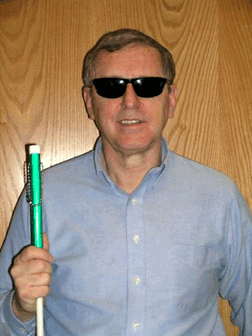 |
|
Ray Martin |
From the Editor:
In recent weeks I have been privy to some grumbling, particularly from the sort
of young, energetic, creative Federationists who are the dream of every committed
chapter or state president. Folks like these are needed by every organization.
As the years go by, we will count on them to assume the mantle of leadership.
The murmurers are voicing their dissatisfaction with what goes on (or doesn�t
go on) in chapter meetings. They want more projects, more challenge, and less
empty talk. They have understood what the NFB is about, and they are ready to
go do something constructive to change the status quo, not sit back and complain
about what is wrong.
None of this is
a surprise. The challenge we face is how to spend enough time building the infrastructure
of the chapter or affiliate to keep it together while channeling the energy
and creativity of the young to generate the programs and activities that have
always characterized our movement. Lean too far in one direction, and we stultify
and lose committed, active members; lean too far the other way, and we gallop
off in all directions and dissipate our focus and efficiency.
I know of no formula
that can be applied to every chapter and affiliate to achieve the perfect balance.
I do know that leaders have an absolute duty to listen to young voices and allow
them to shake us up and out of the rut of the way things have always been done.
I also know that, if we are to continue to succeed, young and enthusiastic members
must make the effort to attend meetings and demonstrate their willingness to
roll up their sleeves and work to share their vision of what we can accomplish.
Wherever everyone focuses on making chapters healthy and active and on drawing
everyone into its decision-making process, all blind people will benefit, and
the NFB will grow and be well served.
The following message
and newspaper article were circulated by Ray Martin, president of the Utah County
Chapter of the National Federation of the Blind of Utah, to his chapter members.
The message seemed a good reminder to us all at the beginning of a new year.
This is what Ray Martin says:
As another new year comes
in, I reflect on the growth and changes that we have made as a state affiliate
and a chapter. The National Federation of the Blind gives us each opportunities
to work together and to change what it means to be blind. We have the chance
to set in motion events that will change the lives of blind people around each
of us and throughout the entire state. But if we put our personal agendas first
and seek to foster our own careers at the expense of our shared philosophy and
commitment to mentoring, we will have failed our common dream even while we
may have individually succeeded in gaining stature in the organization.
The NFB has great leaders
both locally and nationally. As I look at these powerful leaders, two conditions
for their emergence seem always to be present: a persuasive and selfless leader
and a critical mass of willing members that provide the leaven to raise the
whole. Whether or not we have the personal characteristics and drive to become
leaders, we should all try to be a part of that critical mass of willing members.
A telling analogy from
the animal kingdom can be found in the remarkable mounds built by the compass
termites in Northern Australia, which have a north-south orientation to keep
the temperature and humidity of their brooding chambers constant. Thus the flat
side of the mound faces the rising sun to cope with the early morning chill,
while the steep roof deflects the heat when the sun is overhead. But what is
most remarkable, according to Michael Talbot, in his book, Beyond the Quantum,
is that: �No single termite could ever accomplish such a miracle of engineering.
... Even three or four termites gathered together are equally helpless. But
keep adding termites one by one and sooner or later a sort of critical mass
is reached, and as if the truth had suddenly dawned upon them, they gather into
work crews and begin cementing grains of sand together with their saliva, building
arches and connecting columns until the expertly designed fortress that will
ultimately become their home grows like some strange flower around them.�
This is a fascinating biological
phenomenon that has some relation to human society, and more especially to the
National Federation of the Blind. I think a state affiliate could be seen as
a critical mass of good individuals who work together to accomplish much more
than any individual could ever achieve alone. As we work together, we will continue
to accomplish great things. As evidence of the way this is working in our chapter,
the article in the Provo Daily Herald demonstrates that we truly have
a critical mass in action. As you read the words below, remember that each one
of us made this become a positive image of blind people.
Sunday, October 16, 2005
Breaking Stereotypes
about the Blind
by Caleb Warnock, Daily
Herald
Mention putting a group
of blind people into a maze, and you might get snickers. But that is just what
the Utah County Chapter of the National Federation of the Blind did on Saturday�and
the point was all about overcoming such stereotypes. A handful of blind children
and adults, accompanied by their families, spent more than three hours at the
Hee Haw Farms corn maze.
The activity was sponsored
by the Federation. �I think it is important that people realize blind people
are just average, regular people, who want to do everything everyone wants to
do, whether that�s a corn maze or trying out for a play or going skiing,� said
Kara Campbell, a mother of six who has been blind since birth. The common perception
is that blind people are happy to sit at home, she said. �That�s not really
the case,� she said. �We are regular people who want to do regular things. We
might use different techniques to do it, but we get the same results.�
Rebekah Jakeman, who is
a writer and will appear as a mentor on the NBC television show, Three Wishes,
this fall, said joining the Federation and participating in its activities has
taught her confidence. Jakeman was blinded by a genetic condition in 2002 during
her senior year at BYU [Brigham Young University]. She had been legally blind
since age fourteen. �When you are partially sighted, you play you are sighted
when you are really not,� she said. �The biggest thing this organization taught
me is that I didn�t have to play I was sighted. It was kind of a change of heart
for me.�
In addition to advocating
for the blind at the local, state, and national levels, the organization provides
support and camaraderie for those who are challenged by a lack of sight, said
chapter president Ray Martin. Martin was blinded by a chemical burn while working
a summer job at age sixteen.
One of the chapter�s latest
accomplishments was getting the Daily Herald added to a phone service
in which the blind can call and be read the newspaper, he said. The organization
has also been emphasizing writing to its members lately, teaching them how to
tell their own stories, both to show other blind people what is possible and
to explain the blind experience to the sighted community, he said.
�We also try to help blind
people who lose their sight later in life try to keep their jobs or retrain
and regain employment,� he said. �We encourage young kids to excel in the skills
blind people need and to train in using a cane and not be ashamed, and to do
well. We teach people that it�s okay to be blind. We help them break free from
the myths about blindness, whether it�s a mother with children or a mother who
is a teacher or a dad who is able to function as a father and in the community.�
National
Literary Braille Competency Test:
New Partnerships, New Possibilities
by Barbara Pierce
As Monitor readers
know, the National Library Service for the Blind and Physically Handicapped
(NLS) has been working for a decade to develop a test to determine whether teachers
of blind children or other adults have truly mastered the Braille code. What
readers may not know is that the NLS has now asked the National Federation of
the Blind to finish development of the National Literary Braille Competency
Test and take on the certification of those who demonstrate a real command of
the code. Dr. Fred Schroeder, a respected educator in the blindness field and
member of the NFB board of directors, and Mark Riccobono, director of education
for the Jernigan Institute, have been working with a committee of experts to
complete development of the test and set up a certification system. The process
has been long and fraught with setbacks, yet we can now say that the promise
of a national test to measure the knowledge of teachers and others may actually
be closer than we have dared to believe.
For many years the National
Federation of the Blind has been working to expand opportunities for blind children
and adults to become fully literate in Braille reading and writing. We recognize
that Braille is more than a reading medium; it is symbolic of the ability of
blind people to live normal, productive lives. It is a tangible expression of
our equality, and it affirms the legitimacy of the alternative techniques that
allow us to live and work alongside the sighted as equals. It is our gateway
to literacy and our gateway to the dignity and self-respect that literacy brings.
Of course there are other methods for obtaining information, but none of them
can replace Braille. Yet the struggle to increase the Braille literacy of blind
people has been long and hard.
The formal education of
blind children in America began in the mid 1800�s with the establishment of
segregated residential schools for the blind. For the next century virtually
all blind children attended schools for the blind, where they received a reasonably
comprehensive education. In schools for the blind Braille was a given; it was
assumed that, to be educated, blind children must be literate, and to be literate,
they must learn to read and write Braille. Braille was an everyday part of the
blind child�s education. For the most part residential schools for the blind
made textbooks and other materials available in Braille, and many of the teachers
were blind people who read and wrote Braille themselves. However, in the 1960�s
schools for the blind began experiencing significant overcrowding, and accordingly
a large number of blind children were moved to their neighborhood public schools.
While having a practical
origin�the need to address overcrowding�the move away from segregated residential
school education was quickly regarded as a new and progressive model for educating
blind children. The practice of placing blind children in regular public school
programs (known as �mainstreaming�) was seen as an educational innovation and
a move toward greater integration of blind children. Yet the effects of mainstreaming
were not all good. To work, mainstreaming presumed that blind children would
have the support of teachers who could provide the training in the specialized,
skills they needed to succeed. Yet the reality was that large numbers of blind
children found themselves in regular neighborhood schools without Braille materials
or teachers who knew how to read and write Braille. This led to a sharp downturn
in the Braille literacy of blind children in America.
At the same time leaders
in the education of blind children began stressing greater use of residual vision,
emphasizing large print and magnification for blind children who had even very
small amounts of remaining sight. School districts, faced with a nation-wide
shortage of trained teachers, seized on using vision as a way of coping with
the shortage. This lead to a crisis in Braille literacy among blind children
throughout the nation. In response the National Federation of the Blind, the
nation�s largest organization of blind people, began working to insure that
blind children would have access to Braille instruction and would not be forced
to use print simply because the school system did not have a trained teacher
at hand.
In 1987 the National Federation
of the Blind introduced the first so-called Braille bill in a state legislature.
The bill, introduced in Minnesota, called for a presumption of Braille as the
primary reading medium for legally blind children. The idea was to affirm the
right of blind children to receive instruction appropriate to their needs. Although
we eventually obtained some form of Braille legislation in thirty-two states,
we knew we needed to insure the right of Braille instruction for all blind children
throughout the nation. In 1997 the Federation was successful in amending the
Individuals with Disabilities Education Act to include a presumption of Braille
for blind children in federal law. Much had been accomplished, but much remained
to be done.
We knew that a legal right
to receive Braille training meant nothing if there were no teachers to provide
the instruction. In March of 1989 the National Federation of the Blind raised
its concerns about the decline in Braille literacy with the newly founded Joint
Organizational Effort (JOE) Committee. After considerable discussion, the JOE
Committee agreed to ask the National Library Service for the Blind and Physically
Handicapped (NLS) of the Library of Congress to develop a test that would assess
teachers� knowledge of the Braille code. For over sixty years the NLS has certified
Braille transcribers and proofreaders. It had the experience and credibility
to develop a test that would be regarded as professional, thorough, and fair.
The NLS�s Braille Development
Section immediately began work on the test. An advisory committee composed of
educators, rehabilitation teachers, transcribers, and consumers was established
to study the feasibility of developing a test of Braille competency. They decided
that the test would not attempt to measure the individual�s ability to teach
Braille but instead would measure only knowledge of the Braille code. Universities
would continue to address Braille teaching methods as a part of their teacher-preparation
programs. Knowledge of the Braille code was not the only factor affecting the
competent teaching of Braille, but it was the foundation. The National Literary
Braille Competency Test was made available for general use in 1994. Over the
next ten years approximately 475 tests were administered. Concurrent with its
release the National Literary Braille Competency Test was scheduled to undergo
validation. The issue of test validity became important since many states wanted
to use the test in conjunction with their teacher-certification processes. As
a result a validation, a reliability study of the current test, was begun by
HumRRO (Human Research Resources Organization) in 1998.
As part of the validation
phase of the study, HumRRO recommended that the content of the test be revised
but that the basic organization of the test elements remain the same�writing
with a slate and stylus, writing with a Braillewriter, proofreading, and answering
a series of multiple choice questions. The next step was to make the needed
changes and get the test ready for general use. Two advisory committees were
formed: the Test Development Committee and the Administrative Issues Committee.
Each committee had staff from NLS and APH (American Printing House for the Blind)
as well as representatives of the blindness community.
Everything seemed to be
on track. Thirty candidates were scheduled to take two versions of the pilot
test. Each test would be evaluated by a team from APH and a team from NLS. Unfortunately,
just as all seemed to be nearing completion, a major snag developed. Some actual
test materials were sent out by NLS instead of sample tests to one group of
candidates scheduled to take the pilot test. When the error was discovered,
test candidates were contacted. Several of the tests had been opened, and most
test items had been seen by one or more people. This compromised the validation
of the test. According to HumRRO the basic structure of the test was sound,
but because the test had been seen, new passages and items would have to be
written before work could continue.
After a decade of work
on the test, it looked like the project would never be finished. In late 2004
Mr. Frank Kurt Cylke, director of the NLS, together with Dr. Tuck Tinsley, president
of APH, came to the National Center for the Blind to seek the Federation�s help
in completing work on the development of the National Literary Braille Competency
Test. Essentially NLS asked that the National Federation of the Blind finish
the project and assume the role of serving as the certifying body. It seemed
that we had come full circle. The Federation had first raised the need for a
Braille competency test with the JOE Committee, which in turn asked NLS to develop
the test. Now NLS was asking the Federation to take over the work and complete
the development of the test and put together a structure for test administration
and certification.
President Maurer agreed
that the Federation would take on the challenge. In the spring of 2005 the Federation
convened a meeting of experts in Braille to enlist their help. The group (now
known as the steering committee) includes individuals with significant background
in technical aspects of the Braille code, Braille production, and teacher preparation.
Equally important, they are all deeply committed to Braille. The names of the
steering committee members will be familiar to many: Dr. Fredric K. Schroeder,
research professor at San Diego State University, and Dr. Diane P. Wormsley,
program director of the Professional Preparation Program for Teachers of Children
and Youth with Visual and Multiple Disabilities at the Pennsylvania College
of Optometry, serve as co-chairs of the steering committee. Committee members
represent either certain organizations participating in the NLBCT effort or
particular perspectives as individual professionals who contribute significantly
to the field. Members are Mary Archer, president of the National Braille Association;
Dr. Sheila Amato, teacher of blind children and teacher educator; Kim Charlson,
chair, Braille Authority of North America, and designated representative for
the Council of Schools for the Blind; Dr. Judith Dixon, acting head of Braille
Development, National Library Service for the Blind and Physically Handicapped;
Dr. David Ross, president, Division on Visual Impairments of the Council for
Exceptional Children; Lisa Wright, vision/low incidence specialist, Division
of Special Education and Early Intervention Services, Maryland State Department
of Education; and Ramona Walhof, National Federation of the Blind. In addition
the steering committee receives guidance and support from NLBCT project manager
Mark Riccobono, director of education for the NFB Jernigan Institute. Finally,
the committee also receives consultation from the staff of HumRRO company, the
test developer.
The steering committee
has held a number of meetings over the past several months and has made good
progress toward completing development of the National Literary Braille Competency
Test. A series of pilot tests will be given in the spring of 2006, and the Federation
hopes to begin offering certification by next summer.
The National Braille Association,
a well-respected organization of Braille transcribers, will assist in the administration
and scoring of the test.
At long last we are at
the threshold of changing the dream of a Braille competency test into reality.
One of the most encouraging developments has been the response from the blindness
field. In particular professionals running teacher-training programs have expressed
a strong interest in using the test to measure the level of proficiency of their
students and comparing it to the proficiency of students from other teacher-training
programs. The steering committee is actively seeking the involvement of additional
university training programs to expand the pool of individuals taking the test.
This will allow for a better assessment of training materials and curricula
and will provide an important tool for strengthening the Braille preparation
of future teachers. Blind children will be the winners, and so will we all�blind
adults and society generally. Soon we will have a measurable way of telling
how well a teacher knows the Braille code. We will not yet know if he or she
is an effective teacher, but we will know if a teacher can
read and write Braille. As work on the National Literary Braille Competency
Test continues, information will be made available on the NFB�s Web site. To
learn more, go to <http://www.nfb.org/
nfbji/nlbct.htm>.
A
Reflection on Martin Luther King
by Ed McDonald
From the Editor:
On January 16, 2005, Ed McDonald, one of the longtime leaders of the NFB of
West Virginia, was asked to take part in a service celebrating Martin Luther
King Day at Grace United Methodist Church in Keyser. As a former member of the
NFB board of directors and a past president of the West Virginia affiliate,
Ed was not about to miss such an excellent opportunity to discuss the struggle
for civil rights of blind Americans, even as he paid homage to the life and
work of one of the greatest figures in modern American history. This is a moving
tribute to Dr. King and to Kenneth Jernigan, and it is a fine example of the
way to use any occasion to educate the public about the work of the National
Federation of the Blind. This is what he said:
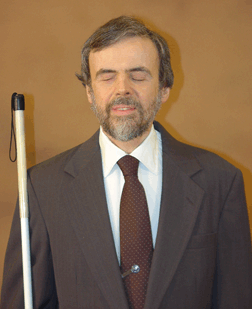 |
|
Ed McDonald |
The invitation to take
part in a program to remember and celebrate the life and the spirit of Dr. King
is a little like one of those class assignments in which you�re asked to write
a theme about the impact of (you fill in the blank) upon my life. If you take
it seriously, the assignment causes you to think more carefully and precisely
about a subject that you�re sure you already understand at some level but which
you�ve really never taken time to articulate. Well, I�ve done a little of that
careful and precise thinking about Dr. King�s life and about my own, and these
are some of the things I understand about the impact he has had and will likely
continue to have upon my life.
First, unlike those who
have studied Dr. King in depth, I recognize that I am not steeped in his words
or the details of his life. I cannot quote extensively from his speeches, and
I�ve not yet read one of his books. Nevertheless, as a person who happens to
be blind, I do understand that his leadership of a widespread movement for civil
rights and social change actually inspired and assisted us as blind people in
a similar struggle. At the same time I understand that my experience as part
of a so-called minority population in our society helps me to understand and
appreciate more completely the wisdom, the strength, the courage, and the commitment
of a man like Dr. King. You may not have thought much about it, but the collective
experience of blind people in our society is indeed very much like that of racial,
ethnic, or other social minorities.
It was in 1968, the same
year Dr. King died, that I joined an organization called the National Federation
of the Blind. I did it mostly because I was invited by some really nice people,
not because of any real crusading spirit for the equality of the blind. Nevertheless,
as I attended conventions, listened to speeches, and read the literature, I
began to understand in a new way what it really means to be blind and what we
need to do to free ourselves from the bondage of what could well be called second
class citizenship in our society.
The leader of the Federation at that time was Dr. Kenneth Jernigan. He was a
lot like Dr. King. First of all he was blind. That made him one of us. He was
also well educated, intelligent, articulate, and wise. He understood that the
greatest problems blind people face have more to do with prejudice and discrimination
than with the mere lack of eyesight. He also understood how important it is
for blind people to join together and work together to change what society believes
about blind people and to change a system of law and tradition that help to
keep many blind people out of the social, economic, and political mainstream
of modern life. He was able to communicate his ideas in a way that helped us
understand the reality of blindness, and at the same time he inspired us to
work for change. He knew how to plan, strategize, and build a strong and successful
movement, and it has been a privilege and a blessing for me to be part of that
movement. What I learned from Dr. Jernigan about confidence, courage, and self-respect
as a blind person has helped me to grow and mature and cope with the kinds of
obstacles that all blind people have to deal with.
So what does this have
to do with Dr. King? I believe that, if Dr. King had not drawn people together
in an organized and dedicated struggle for basic human rights, if he had not
made the nation more aware of the evils of prejudice and discrimination, and
if he had not emerged as he did at a crucial time in history, blind as well
as black people would not have experienced the understanding, opportunity, and
courage that have helped us organize and assert ourselves as we have been able
to do. In the same way, the revelation and inspiration I drew from Dr. Jernigan
have helped me to understand in a very personal way the kind of excitement,
enthusiasm, and determination that a generation of black Americans felt as they
listened to Dr. King�s words and proudly joined him in the struggle for freedom
and justice.
But Dr. King�s impact upon
my life is not limited to the notion of being blind and thus a part of a social
minority. As the stepfather of two biracial sons, I understand that Dr. King�s
words as well as the results of his efforts still have a lot to do with the
acceptance, the opportunities, and the fulfillment that these two young black
men will experience in their lives. I understand that as African Americans their
legacy is Dr. King�s legacy. With the help of Dr. King�s words and his example,
I have a better understanding of the prejudice and discrimination that my stepsons
will continue to experience in their lives more than thirty-five years after
those words were spoken.
So here we are, a room
full of people, gathered together on a cold afternoon in a quiet little West
Virginia town. Some of us are black; some of us are white; some of us are blind.
Each of us has come to this place by a different path. All of us are here to
talk about, think about, learn about, even sing about a man named Martin Luther
King. Our nation has declared his birthday to be a holiday. Each of us will
experience that holiday in his or her own individual way, but coming together
in a place like this is a way for a community of us to experience a part of
the day together. The idea of coming and working together was an important part
of Dr. King�s message, and so it is certainly appropriate for us to do this.
As I thought about the
words I might bring to this gathering, I took time to listen again to a couple
of Dr. King�s speeches. They turned out to be the famous �I Have a Dream� speech
at the Lincoln Memorial and the so-called �I�ve Been to the Mountain� speech
in Memphis the night before he died. As I listened to those words, I was again
reminded that his message was far more than warm, comforting words about an
ideal world where we all love and get along with one another. It�s true, he
assured us, that it�s not an impossible dream, but he also talked about what
we need to do to make the dream come true. He wasn�t afraid to address the hate,
the greed, the prejudice, and the injustice that were still very much alive
in his world. He was not afraid of a nonviolent struggle to achieve those things
he believed to be right.
Thanks to Dr. King and
to the generation he inspired and led, life is better today for black people
and for blind people as well. It�s hard to find any more �whites only� signs
or asylums for the blind. Employers are not likely to tell us we can�t have
a job simply because we�re blind or black or both.
Nevertheless, at the risk
of falling victim to clichés, I must also say that it�s still far too
easy to find hate, prejudice, injustice, greed, and violence around us in today�s
world. I guess that means Dr. King�s work isn�t done.
Perhaps the details of
today�s struggle are a bit different�maybe even more complicated�and the tools
we use to do the work have evolved and have perhaps also become more complex
since Dr. King�s time. Yet his portrayal of the dream and his call to action
are just as real and no less urgent than they were then.
So as we look back and
think about the impact of Dr. King upon our lives, let us also look forward,
remembering the things Dr. King taught us, and finding new ways to keep his
legacy alive by continuing to do the work he called us to do throughout the
rest of our own lives. Thank you for the opportunity to be part of this event
and to share with you some personal thoughts about the life and the spirit of
Dr. Martin Luther King.
Access
at the Point-of-Sale: The U.S. Netcom Solution
by Chad Allen
 |
|
Chad Allen |
From the Editor:
If you shop indepen-dently, you have no doubt frequently faced the dreaded point-of-sale
(POS) terminal at checkout counters across the nation. When the moment comes
to pay, you find that you are expected to use some version of touch-screen technology
to complete the transaction and to enter the PIN for your atm card. If you do
not see well enough to execute this transaction independently, you have no choice
but to trust that all the information the clerk has entered is correct, and,
even more disturbing, dictate your PIN to him or her for entry.
Several years ago,
when this technology was first evolving, such equipment had a keypad that the
blind customer could use to enter the information, but recently this has been
replaced by touch-screen technology that requires the customer to enter data
using a flat screen while reading changing printed information and instructions.
No one in the blindness community has been happy with this turn of events, but
the question has been what to do about it.
The American Council
of the Blind, the California Council of the Blind, and the American Foundation
for the Blind recently negotiated an agreement with Wal-Mart (under threat of
a lawsuit) to lessen the inaccessibility of its checkout procedures. As a result
Wal-Mart announced that it would return to the old keypad technology. Blind
customers still cannot read the instructions or sale information, but they can
once again independently enter their PINs.
A couple of years
ago the NFB of California worked to pass legislation requiring that POS machines
be accessible. This was certainly a step forward, for Californians at least,
even if no one was quite clear about what constituted true accessibility. Chad
Allen is one of the California Federationists who worked with the state legislature
to pass this law. He now works for U.S. Netcom, a company that provides an actual
solution to the access problem plaguing POS machines. We can hope that other
companies across the country will also begin developing solutions to point-of-sale
terminal problems. Because blind consumers should be fully informed about available
POS solutions, we have asked Chad Allen to describe the U.S. Netcom product,
which is certainly an advance over the Wal-Mart solution of turning back the
calendar. This is what he says about this vexing problem and one promising solution
to it:
The growing popularity
of touch-screen-based technology ignores the needs of blind or visually impaired
people. Full accessibility requires devices with both tactile and audible components.
They should be consistent and useable by as many groups as possible. But experience
teaches us that most so-called improvements turn out to be both a help and a
hindrance to the efficient interchange between consumers and retailers.
Ideally the introduction
of new technology into our lives will result in more not less accessibility.
During my five years as a member of the National Federation of the Blind many
devices have become more accessible, but others have not. One of the many challenges
of accessibility which has not yet been resolved is that of credit card transactions.
 |
|
The IC eCommerce
point-of-sale terminal |
At one time access to a
checkout terminal at the completion of every transaction was easy and efficient.
Now touch-screen-based credit card terminals do not allow blind people to enter
their PINs independently. When blind or visually impaired customers use ATM
cards for payment, we are often unable to enter our private PIN code, leaving
no choice but to say it aloud so that someone else can enter it for us. Anyone
nearby can overhear and take note of the code. Furthermore, without knowledge
of the actual recorded total, we are easy victims of overcharge by accident
or merchant fraud.
As an organization committed
to securing, maintaining, and improving the quality of life for blind people,
the members of the NFB must ensure equal access to the devices used every day
in our communities.
Technology devised to make
merchant services easier and more effective for the owners of retail, grocery,
and related places of business is not usually designed to meet the needs of
the customer, especially the disabled customer. As blind people we must advocate
for clear, comprehensive security and functionality, allowing the best solution
for both owner and consumer now and in the future. Instead, at many points of
the POS process we find ourselves losing, not gaining access to pertinent information.
We must ensure access if we are to protect our right to the security and equality
our sighted peers enjoy.
In 2003 AB 2312 passed
the California legislature through the efforts of our California affiliate,
and as a result since 2004 the law has required that any newly purchased touch-screen-based
credit card terminals or any upgraded units be equipped with tactile number
keypads. By 2008 all touch-screen-based credit terminals must be fitted with
a tactile number keypad. With a tactile keypad in place, most blind people can
certainly complete the basics of this process independently, but is the process
truly accessible as legislated? This law was a positive step, but more is required
to provide true equality and complete access in this important process.
During my time as an intern
at the National Center for the Blind, I worked further on this issue. There
I was introduced to Ron Katz, president of U.S. Netcom. He developed a credit
card terminal which offers both a tactile number keypad and an audible component.
It provides the blind or visually impaired customer access to fundamental aspects
of the transaction process. This new card-acceptance device eliminates fraud
and errors by including blind-friendly techniques using a combination of tactile
and audible elements.
The IC eCommerce unit is
a point-of-sale device that meets American National Standards Institute standards
for accessibility. It enables blind people to enter their PIN codes without
assistance and features a terminal keypad with a center key bearing a raised
dot and two raised ridges to guide hand placement. The unit�s critical function
keys have raised letters and high-contrast red and green �enter� and �cancel�
buttons, while a raised circle and a raised X are used as nonvisual elements.
A large screen with high-contrast backlighting enables visually impaired people
to see transaction information, while a built-in, high-quality speaker provides
aural confirmation of encrypted PIN entry and purchase amounts. The PIN unit
also separates from the main device so that it can be handed to a customer using
a wheelchair. Best of all, it costs no more than a typical credit card terminal
sold on the market today.
As members of the blindness
community in the United States, we have economic clout. We should make our purchases
at stores that provide access and security. Elliot Schreier, a distributor of
adaptive equipment and former director of the American Foundation for the Blind�s
Research and Development group, puts it this way: �For the first time blind
and visually impaired consumers have equal access to important financial transactions.�
Curtis Chong, president
of the NFB in Computer Science, says, �This device is certainly the first one
I have seen in today�s marketplace that allows a blind person actually to hear
the total amount of the transaction as well as enter a PIN without requiring
sighted assistance.�
Over twelve million blind
or visually impaired people live in the United States. Some estimate that as
many as one in eight Americans has some sort of visual impairment. Consumers
with significant visual impairments (as well as others) will favor and promote
merchants who provide accessibility and comply with the Americans with Disabilities
Act.
Once I completed my internship
at the National Center for the Blind, I was invited to work with U.S. Netcom
to provide an accessibility solution for credit card terminals throughout the
United States and globally. For further information or to express questions
or concerns, please contact me. If you experience inaccessibility to any credit
card terminal, I urge you to tell the retailer that accessible units are available.
Please contact me if you would like U.S. Netcom to help by offering information.
I can be reached by phone at (323) 467-6712 or by email at <[email protected]>.
Convention
Scholarships Available
by Allen Harris
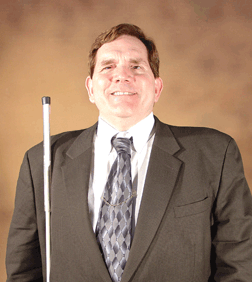 |
|
Allen Harris |
From the Editor: Allen
Harris chairs the Jernigan Fund Committee. He has an important announcement
for those who would like to attend this year�s national convention but find
themselves short of funds. This is what he says:
The Jernigan Fund Committee
has established criteria for the Dr. Kenneth Jernigan Convention Scholarships
for 2006. These factors will be considered when awarding Jernigan Convention
Scholarships:
� Attendance at previous
national conventions (preference will be given to first-time attendees).
� Activity at the local,
state, or national level.
� Recommendation from the
state president. (A formal letter is required. The president must provide a
letter to the committee on an applicant�s behalf. If you do not know who your
state president is, contact Allen Harris at (515) 274-2256.)
� Amount of assistance
requested.
When applying for a convention
scholarship, please write a brief paragraph on why you wish to attend the convention.
Submit your application letter and statement to Allen Harris, 524 4th Street,
Apartment 502 B, Des Moines, Iowa 50309-2364, phone (515) 274-2256.
Applications are due by
Monday, April 3, 2006. Every effort will be made to notify scholarship finalists
by Monday, May 15, 2006. The National Federation of the Blind�s annual convention
is in Dallas, Texas, beginning on July 1, 2006, and adjourning on July 7 at
5:00 p.m. If you have questions or need additional information, contact Allen
Harris. His email address is <[email protected]>.
Recipes
This month�s recipes
are provided by the members of the executive board of the NFB of Georgia to
promote a healthy, happy new year.
Pecan-Crusted Salmon
by Anil Lewis
Anil Lewis is president
of the NFB of Georgia. He was recently diagnosed with high cholesterol, a major
risk factor for heart attack and stroke. He has been encouraged to eat meals
low in saturated fats and has gained an appreciation for seafood like salmon,
which is high in polyunsaturated fat.
Ingredients:
1/3 cup pecans, ground
2 teaspoons flour
1 clove garlic, chopped
Pinch salt
Pinch cayenne pepper
2/3 pound salmon fillets
1 1/3 tablespoons extra virgin olive oil
2 teaspoons butter
Method: Preheat
oven to 500 degrees. Line baking dish with foil. Combine pecans, flour, garlic,
salt, and cayenne pepper. Dip salmon fillets into olive oil, dredge in pecan
mixture, and place in a single layer in the baking dish. Bake approximately
ten minutes or until fish flakes. Top fillets with butter before serving. Serves
two.
Lemon Meringue
Pie
by Robert Smith
Robert Smith is
the first vice president of the NFB of Georgia and is a diet-controlled diabetic.
Employed as a massage therapist, he is very health conscious. He believes that
diet and exercise go hand in hand and that walking is the best exercise.
Crust Ingredients:
1 1/4 cups all-purpose flour
1 teaspoon Equal® sweetener
1/4 teaspoon salt
4 tablespoons cold margarine or vegetable shortening
3 to 5 tablespoons ice water
Filling Ingredients:
15 1/4 teaspoons Equal® sweetener, divided, or 49 packets of Equal®
2 1/4 cups water
1/2 cup lemon juice
1 teaspoon lemon rind, grated
1/2 cup cornstarch
2 eggs
5 egg whites, divided
2 tablespoons margarine
1 to 2 drops yellow food coloring, optional
1/4 teaspoon cream of tartar
Method for pie
crust: Combine flour, one teaspoon Equal®, and salt in medium bowl.
Cut in margarine or vegetable shortening until mixture resembles coarse crumbs.
Sprinkle flour mixture with water, 1 tablespoon at a time, mixing lightly with
a fork after each addition until pastry just holds together. On floured surface
roll pastry into a circle 1 1/2 inches larger than an inverted 9-inch pie pan.
Ease pastry into pan; trim and flute. Pierce bottom of pastry with tines of
a fork. Bake at 425 degrees until pastry shell is browned, about fifteen minutes.
Cool on wire rack.
Method for filling:
Mix water, lemon juice, lemon rind, 10 3/4 teaspoons Equal®, and
cornstarch in medium saucepan. Whisk together over medium-high heat until mixture
comes to a boil, and continue to whisk constantly for one more minute. Whisk
about 1 cup of the hot mixture into combined eggs and 2 egg whites, then whisk
egg mixture back into lemon mixture in saucepan. Remove from heat; add margarine,
stirring until it is melted. Stir in food coloring, and pour mixture into baked
pie crust. Beat remaining 3 egg whites and cream of tartar in medium bowl to
soft peaks; continue beating till stiff peaks form, gradually adding remaining
3 1/2 teaspoons Equal®.
Spread meringue over hot
lemon filling, sealing to edge of crust to prevent shrinking or weeping. Bake
pie at 425 degrees until meringue is browned, about five minutes. Cool completely
on wire rack.
Spinach Balls
by Thelma Godwin
Thelma Godwin is
the second vice president of the NFB of Georgia and used to have high blood
pressure. As a seafood-loving vegetarian, she has always been conscious of her
diet. She has been able to lower her blood pressure by maintaining a healthy
diet and through regular exercise.
Ingredients:
2 10-ounce packages frozen chopped
spinach, cooked and drained
2 cups herb-seasoned stuffing cubes
1 cup sharp cheddar cheese, grated
4 eggs, slightly beaten
3/4 cup butter, softened
1/2 teaspoon pepper
1/4 teaspoon freshly grated nutmeg
1/4 cup finely minced onion
Method: Combine
all ingredients in a large bowl, and mix well. Shape by rounded teaspoons into
small balls. Place on lightly greased baking sheet. Bake at 350 degrees for
fifteen to twenty minutes or until set. Serve warm. Recipe makes three to four
dozen appetizer balls.
Eggplant Casserole
by Shirley Barksdale
Shirley Barksdale
is the treasurer of the NFB of Georgia. She takes medication for her diabetes
and high blood pressure. She is a strict vegetarian and is working to manage
her health more effectively.
Ingredients:
1 eggplant, peeled and diced
1 1/2 cups shredded cheddar cheese
1 cup dry bread stuffing mix
1 clove garlic, crushed
2 tablespoons diced onion
1 egg, lightly beaten
1 teaspoon dried Italian seasoning
Salt and pepper to taste
Method: Preheat
oven to 350 degrees. Place the eggplant in a medium microwave-safe dish and
cook on high (stirring once) in the microwave for five minutes or until tender.
Transfer to a 9-by-9-inch baking dish. Mix in 1/2 cup cheddar cheese, stuffing
mix, garlic, onion, and egg. Add Italian seasoning, salt, and pepper. Bake fifteen
minutes in the preheated oven. Top with remaining cheese, and continue baking
for fifteen minutes until cheese is bubbly and mixture is lightly browned.
Salmon-Tuna Salad
by Patrice Johnson
Patrice Johnson
is the secretary of the NFB of Georgia and has high blood pressure. She is currently
experiencing mobility problems while waiting for knee surgery.
Ingredients:
1 16-ounce can pink salmon
1 7-ounce can white albacore tuna
1/4 cup sweet pickle relish
1/2 onion, finely chopped
Season with Cajun seasoning and freshly ground black pepper if desired
Method: Drain
salmon and tuna, discarding any bones. Place in large mixing bowl, and add all
other ingredients. Mix well and adjust seasonings. Serves eight to ten people.
Arrange in the center of a large serving platter and garnish with chopped parsley.
This is great for a brunch or luncheon buffet, served with bagel chips or gourmet
crackers. Place crackers, bagel chips, and crisp, raw veggies around salad,
and, voilá, a wonderful, tasty dish that will bring your guests back
for more. Serves eight to ten people.
We hope you have made a
New Year�s resolution to be healthier. The members of the NFB of Georgia wish
you all a prosperous and healthy new year. Drink lots of water, get regular
exercise, and visit your doctor for annual physical checkups.
Monitor
Miniatures
News from the Federation
Family
Nuance TALKS
Free for Thirty Days:
Looking for an accessible
cell phone? The National Federation of the Blind has the answer with Nuance
TALKS. Nuance TALKS converts the display text of a cell phone into highly intelligible
speech, making the device completely accessible for blind or visually impaired
people. Using Nuance TALKS on a mobile phone running the Symbian operating system
(such as the Nokia 3650, 6620, or 6682), all of your on-screen content is read
to you out loud using text-to-speech software. It�s the best way to make today�s
mobile phone content available to everyone.
Hear for yourself how the
latest version of Nuance TALKS lets you access all of your phone�s features,
including contacts and caller ID. You can write and hear emails and text messages
and receive audible battery-level and network signal-strength information. Extra
features such as Bluetooth Braille-device compatibility and five great bonus
applications�Mini-GPS, Extended Recorder, Multimedia Player, Extended Profiles,
and World Clock Pro�make Nuance TALKS a must-have for our members who use mobile
phones. Visit <http://www.nuance.com/ talks> for more product information.
Right now the NFB is sponsoring
a free thirty-day trial of Nuance TALKS for our members. Between now and February
1, 2006, members can download a free trial version of the Nuance TALKS software.
As a special bonus, you�ll receive a 20 percent discount if you purchase within
thirty days of downloading the trial version. With this savings the recommended
retail price for the premium version of Nuance TALKS is only $192. Just mention
that you are an NFB member to receive the discount.
To request your free evaluation
copy of Nuance TALKS, contact one of the dealers listed below. Please note that
the National Federation of the Blind is not responsible for sales and support
of Nuance TALKS. Contact one of these dealers for assistance:
VisionCue, phone (888) 318-2582 and (503) 297-1510, email <at.info@ visioncue.com>,
Web site <www. visioncue.com>, Beyond Sight, phone (303) 795-6455, email
<support@ beyondsight.com>, Web site <www. beyondsight.com>.
Please note: Offer
expires February 1, 2006, and is good for new Nuance TALKS customers only. Offer
is available only through the assistive-technology dealers listed above. For
a list of supported phones, go to <http://www. nuance.com/talks/phones.asp>.
Presidential
Releases on the Web:
You can now listen to NFB
Presidential Releases from the Web. The page to find the presidential cassette
releases is <www.nfb.org/pr>. Release #335, December 2005, is there in
MP3 format and can be downloaded to your PC. If you have a dial-up connection,
do not click on the link to the release itself. Instead, right click on the
link and select �save target as...� to download the MP3 file, which can then
be played on your computer.
Elected:
On Saturday, October 22,
2005, the Greater Philadelphia Chapter of the NFB of Pennsylvania held its annual
elections. The following Federationists were elected: Denise Brown, president;
Stanley Ingram, first vice president; Patrick Comorato, second vice president;
Karen Comorato, secretary; Yvonne Mason, treasurer; and Russell Smith, Leon
Conaway, Virginia China, and Ann Walters, board members.
Blindness,
Leadership, and Superior Training 2006:
Mark your 2006 calendar
for the National Association of Blind Merchants spring conference April 27 to
30 at the Nashville Airport Marriott Hotel. The unbelievably low room rates
are good from Tuesday, April 25, through Monday, May 1. Visit with merchants,
agency partners, and suppliers; and even give yourself time to relax and enjoy
all that Music City USA has to offer. Conference activities blast off on Thursday
afternoon, April 27, and conclude midday Sunday, April 30. Enjoy the springtime
in the beautiful Volunteer State, experience a Music City BLAST, and enjoy a
mini vacation.
Training sessions and meetings
will begin Thursday afternoon. We will be in meetings all day Friday and Saturday
and Sunday morning. We are planning receptions, a leadership breakfast, and
a luncheon banquet. We are developing a first class training agenda. Those who
attended our Denver BLAST say that they gained much from the innovative, interactive,
informative training. We are working now to develop the training curriculum
for BLAST �06. Your suggestions are welcome and appreciated. Our goal is to
target training to meet the specific needs of blind entrepreneurs and our agency
partners.
Working with our partner
suppliers and purveyors, we are planning an even more extensive product and
services showcase of exhibits during the Music City BLAST the afternoon of Friday,
April 28. New products, special pricing, accessible technology, and more will
make this showcase one you can�t afford to miss.
This year registration
is $160, which will cover all conference activities and training materials.
Those who register before April 1, 2006, will pay only $100, receiving a $60
discount for early registration. Checks should be sent to NABM, 1223 Lake Plaza
Drive, Suite D, Colorado Springs, CO 80906. Please include name, phone number,
best mailing address, and email (if available) for each person you are registering,
along with your check. You can also register online at <www.blindmerchants.org>.
Remember that the registration fee also includes tradeshow, receptions, leadership
breakfast, luncheon, and more surprises.
We have reserved a group
of tickets for the historic Grand Ole Opry and will be selling a package to
include transportation to the show for Friday night, April 28. Tickets will
be on sale at BLAST. Plan to join us.
The Airport Marriott offers
luxurious lodging at tremendously low rates. Rates for our Music City Blast
are even better than last year�s event: $79 a night for singles, doubles, triples,
and quads all week long. All rates quoted are net per room per night, plus the
current 14 percent tax. The Nashville Airport Marriott is located seven miles
east of downtown in a campus-like seventeen-acre setting convenient to Interstate
40. Area attractions include Adventure Science Center, Grand Ole Opry, and Second
Avenue shopping and entertainment�all within five miles�as well as Coreer Baseball
Stadium, Country Music Hall of Fame and Music Row, Tennessee Performing Arts
and the Coliseum, where the Tennessee Titans play football�all within ten miles
of the hotel.
For hotel reservations
call the Nashville Airport Marriott at (800) 770-0555. Tell the agent that you
are booking at the group rate for the National Association of Blind Merchants.
Make your reservations now.
Working together, we can
build a new Randolph-Sheppard Program; it can start with a Music City BLAST!
As those of you who have attended previous BLAST conferences know, we are not
planning the usual blind vendor conference. It will be a blast of fresh air
with real take-home ideas blind entrepreneurs and agency partners can use to
build careers. BLAST will feature electrifying upward mobility training seminars
taught by this nation�s leading motivators in the fields of human resources,
marketing, and retail management. Join us as these scintillating speakers walk
us through dynamic approaches to develop rapport with customers, building management,
SLAs, and colleagues. You�ll go home with a pocket full of tools and techniques
that will reach customers and keep bringing them back; methods to anticipate,
understand, embrace, and manage change in the marketplace. You will be energized
by practical strategies to manage, teach, lead, profit. There will be formal
and informal opportunities throughout BLAST to network and build strong personal
and business relationships.
To listen to and view a
five-and-a-half-minute video presentation highlighting last year�s event, go
to <www.blindmerchants.org>. At the bottom of the home page click on �Play
BLAST Introduction Video.� To offer suggestions, contact Kevan Worley, president,
National Association of Blind Merchants at (719) 527-0488, or email <[email protected]>.
Make plans now to join us in Nashville. It�s going to be a Music City BLAST.
Braille Writer
Wanted:
Federation leader John
Bates is looking for a Braillewriter in good condition that he can purchase
and send to a child in an orphanage in Mexico. Ignacio is a ten-year-old boy
who needs a Braillewriter and Spanish tapes.
If you can provide either,
contact John Bates, 9 Donatello, Aliso Viejo, California 92656 or email <[email protected]>.
Federationist
Honored
From the Editor:
Inam Shalati is a Federationist who lives her beliefs about blindness and independence
and volunteers to help whenever and wherever she can. On September 28, 2005,
she was honored on the Points of Light Foundation�s Web site as Daily-Point-of-Light
Number 3039. She received a letter from President George H. W. Bush. Here is
the text of her Web profile:
When little Katy, a seven-year-old
blind student, met her new volunteer, she was not talking much to her teacher
or her aides in school. Her volunteer vision assistant, Miss Inam, was told
to expect a difficult time with Katy, whom teachers felt might also be somewhat
autistic. But what the teachers couldn�t have known was the impact that this
special volunteer would have on Katy.
To begin with, Miss Inam Shalati is no ordinary volunteer. She has won several
volunteer recognitions, including a prestigious Bell Award given by WLKY in
1999. In fact, Inam is the lead volunteer vision assistant within the Jefferson
County Public School system of Kentucky. In this role she teaches Braille and
tutors children who are visually impaired. And she knows a thing or two about
overcoming obstacles herself, since she was born blind and was diagnosed with
cerebral palsy at six months of age.
Growing up as a child with
disabilities who also moved with her family, Inam learned the value of doing
things on her own. �I am a believer in doing anything you can to promote independence,�
she explained. �My parents were great about letting me do things, even though
it was scary letting their blind child go out into the world.� She also learned
early on the value of physical and occupational therapy. �I have been to many
centers and was always impressed with the caring of the staff.� In fact it was
the therapists and aids that helped her growing up who motivated Inam to become
a volunteer. �I know what it�s like to need some help as a kid. And it gives
me great joy to help others.�
Inam�s work with little
Katy has opened new doors for this youngster. Once quiet, Katy is now talking
to teachers, learning Braille, and more. Miss Inam also goes beyond schoolwork
to teach Katy manners, days of the year, months, and how to talk on the telephone
in a proper telephone voice. She�s even reported to be more confident and social
with other children during playtime. �I love to hear her talk,� said Inam. �Two
of her favorite sayings are �that�s a good idea,� and �you�re doing great.��
In May 2005 Inam was awarded a certificate for outstanding service to the Jefferson
County Public School system. After a recent tour of the K.I.D.S. Center, she
signed up to help and could be seen selling bracelets in May at the Walk, Rock
�n� Roll. She�s already agreed to be back next year.
Today at age twenty-nine
the obstacles presented by Inam�s disabilities are not over. Her eating, speech,
and mobility are all affected, and the severity is worsening as she gets older.
But one thing that is not lacking is her positive attitude and her belief in
helping others.
Elected:
In November the NFB of
Cincinnati elected the following officers: president, Paul Dressell; vice president,
Kelly Prescott; secretary, Deborah Kendrick; and treasurer, Cindy Conley.
Elected:
The NFB of the Miami Valley,
a chapter of the NFB of Ohio, recently elected the following officers: president
Richard Payne; vice president, Ron Williamitis; secretary, Karen Noles, and
treasurer, Gus White.
In
Brief
Notices and information
in this section may be of interest to Monitor readers. We are not responsible
for the accuracy of the information; we have edited only for space and clarity.
Music Courses
Available:
Now you can learn to play
piano, guitar, bass, drums, banjo, saxophone, and even the penny whistle without
using written or Braille music. Bill Brown has complete courses as well as individual
lessons for these instruments in an all-audio format. Both the four-tape and
CD courses are only $39, and the individual song lessons are $10. On his tapes
and CDs he plays a section of the song for you and then talks you through the
notes and fingering step by step. You can truly learn at your own pace whenever
your schedule allows. To order these courses or for more information, call (800)
484-1839 and enter security code 8123 when you are asked. There is no charge
for this call. You can also log onto Mr. Brown�s Web site at <www.musicvi.com>.
Bill Brown�s courses are also available through the National Library Service.
Workers on
Strike at APH:
We recently received the
following press release dated November 29, 2005, from the American Printing
House for the Blind:
The American Printing House
for the Blind (APH) regrets that workers who are members of Teamsters Union
Local 89 have voted to go on strike. APH and Teamsters� representatives have
not been able to reach agreement on the terms of the three-year contract that
would have gone into effect November 15. This strike action by the Teamsters
Local 89 chapter will interrupt APH�s ability to deliver books and other educational
aids to the nearly 60,000 blind and visually impaired students that we serve
throughout the country.
APH stands ready at any time to resolve these differences so that we can get
back to our work. Any delay in delivering accessible educational materials has
a negative effect on student performance in the classroom. Since we believe
that details of contract negotiations should be left to those who are involved
with the bargaining process, APH will have no further statement regarding this
matter.
According to the Louisville
Currier Journal of November 30, the unresolved issues include salaries,
health insurance, and vacation days. Proposed salary increases are sixty cents
the first year, thirty-five the second, and twenty-five the third. Union members
and leaders said those raises wouldn�t be enough to offset proposed increases
in health insurance. Family health insurance would go to $272 a month from $235,
and more increases could raise the monthly premium to between $336 and $471
a month, according to union officials.
When asked if the union
was afraid that the public would criticize it for striking an organization that
serves blind people, officials pointed out that a number of blind workers were
on the picket line.
Survey Participants
Needed by February 1:
Spoken Word Ministries,
Inc., will be conducting a survey of those who are blind and visually impaired
to determine interests in Christian ministries and desires for participation
in Christian ministry opportunities. We welcome and need as many blind or visually
impaired people to participate in the survey as possible to gather a broad range
of ideas and participation.
To participate in the survey,
contact Tim Snyderm (919) 635-1000 or email <[email protected]>.
For inclusion in the survey, please contact by February 1, 2006.
National Writers
Union Welcomes Blind Writers:
The National Writers Union
is affiliated with the United Auto Workers Union and works to protect the interests
of freelance writers. Because of the efforts of Sanford Rosenthal, a blind union
member from Ft. Lauderdale, Florida, the union has now budgeted $30,000 to create
a disabilities task force to recruit and integrate writers with disabilities
into the union.
Mr. Rosenthal presented his idea for the task force at his first union convention,
but because of rookie mistakes in drafting it, his proposal was initially rejected.
Undaunted, he worked with veteran union members to redraft it. It then passed
by one vote.
Although the union has locals in some large cities, most members join through
the at-large chapter. Sanford Rosenthal chairs the disabilities task force for
the chapter. Writers (both published and hoping-to-be-published) are invited
to contact him at (954) 563-9449 or <[email protected]>.
Monitor
Mart
The notices in
this section have been edited for clarity, but we can pass along only the information
we were given. We are not responsible for the accuracy of the statements made
or the quality of the products for sale.
Braille Magazines Wanted:
I am deaf and blind and
would appreciate receiving issues of the following magazines in Braille: National
Geographic, Rolling Stone, Playboy, and the New York Times. I
would like to receive these magazines regularly. If you would be willing to
pass along Braille subscriptions to any of these publications to me, contact
Gordon Janz, 101-2425 Brunswick Street, Vancouver, British Columbia, Canada
JV5T 3M1.
For Sale:
Braille Lite 2000. Asking
$650. Call (310) 948-8605 or email <[email protected]>.
Type �n Speak
in Good Condition Needed:
Carlos, a young man from
Puerto Rico, needs to learn more English before his state agency counselor will
agree to provide services. He has used a Type �n Speak for about ten years,
but it no longer works. Because he is familiar with this technology, he would
like to purchase another Type �n Speak. He needs a reliable unit but does not
have a lot of money. If you have a unit in good order that you would be willing
to sell reasonably, please contact Terri Osborn at (440) 324-2366, or email
her at <[email protected]>.
NFB
Pledge
I pledge to participate
actively in the efforts of the National Federation of the Blind to achieve equality,
opportunity, and security for the blind; to support the policies and programs
of the Federation; and to abide by its constitution.