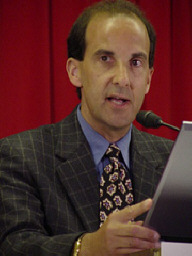
David
Greco addresses the 2002 convention of the National Federation of the
Blind.
The Braille Monitor October 2002
Accessible Web Applications and the Implications of Technology in the Years Ahead
by David Greco
From the Editor: David Greco is the CEO of SSB Technologies, Inc. On July 8 he made a presentation to the 2002 convention of the National Federation of the Blind. Not only did he announce an exciting new service that the NFB is now offering to Web site owners, but he asked for the assistance of everyone who cares about Web accessibility. This is what he said:
|
|
David
Greco addresses the 2002 convention of the National Federation of the
Blind.
|
Thank you, Dr. Maurer. This is the first time I have attended the annual convention, and it is truly an honor to be invited to speak with all of you today. When Dr. Maurer extended his invitation, my immediate reaction was, what topic should I speak about that would be most interesting and relevant to NFB members? Many weeks later that problem was solved when Dr. Maurer informed me that my presentation title was "Accessible Web Applications and the Implications of Technology in the Years Ahead." My question then became, how can I adequately address such a wide-ranging subject in just fifteen minutes? I thought to myself, answering this question is almost like answering the question, "Define the universe; give three examples."
So before I try to define the Web-accessibility universe, let me first tell you a little about SSB Technologies. SSB develops software that helps make Web sites or Web applications accessible to persons who use screen readers and other assistive technologies. By "accessible" I mean that, to the greatest extent possible, a blind person's Web experience is equivalent to that of a sighted person.
SSB was founded in November 1999 by two Stanford University students named Tim Springer and Doug Aley. Tim and Doug had a passion for what they call "making the Web a better place to live." Their passion was so strong they left Stanford to start SSB. Early in their entrepreneurial pursuits Tim and Doug met Ray Kurzweil, whom most of you in this room know or have heard of. Ray Kurzweil is a prolific inventor, value-added angel investor, and what we lovingly call a serial entrepreneur. Ray invented the first text-to-speech reader for the blind, enabling fast access to written material for millions of blind persons worldwide. Ray admired Tim and Doug's passion and provided the initial seed capital to help get SSB started.
Originally Tim, Doug, and Ray's concept was to create a Web site where people who are blind or disabled could visit to learn more about how technology like screen readers could enable or enhance their Web experience. What they quickly discovered was that Web sites were often not designed with screen readers in mind in the first place. The trio recognized that, while screen readers were potentially powerful tools for viewing the Web, using one was like trying to cross the information superhighway in a wheelchair, but without a wheelchair ramp on each curb--not a very successful experience.
So with Ray's money and mentoring, Tim and Doug began developing what was to become the world's first commercially available software product for helping Web-site publishers create accessible Web sites. This software product is called InFocus®. Today, InFocus is a market leader and is used by over 160 organizations worldwide, including forty-five U.S. federal agencies. SSB's customers include leading technology companies such as Adobe and Hewlett-Packard; large financial institutions like Wells Fargo Bank; and federal agencies like the Social Security Administration, the Census Bureau, and even NASA. And while accessibility remains an ongoing challenge for all Web-site publishers, the diverse organizations I just mentioned have one thing in common: a commitment to make their Web sites accessible to anyone, regardless of ability.
Recently one of SSB's investors asked me, "David, how is SSB's bottom line?" to which I replied, "which one?" Now as CEO I wasn't alluding to any accounting shenanigans, and I can assure you there are none going on at SSB. I said this because everyone at SSB is pursuing a double bottom line--namely profits and Web accessibility for everyone. Like our customers SSB is absolutely committed to making Web sites accessible so that each blind person in this room can some day have the equivalent experience on the Web as a sighted person. SSB is doing very well on both bottom lines. And, for the record, Deloitte and Touche is our audit firm.
Since my topic today has to do with technology, I thought I would briefly tell you generally what InFocus does--not because I expect each of you to run out and buy a copy to make your own Web site accessible, although that would be fine with me--but so that everyone here can get a better appreciation for the challenges Web-site publishers face in trying to make their sites accessible to blind or disabled persons.
So what are some of these problems, and how can technology help solve them? One perhaps overused example stems from the fact that the Web is getting ever more visual. Nowadays Web sites are starting to look more like photography shows or video rental stores than places to find information and conduct business easily and quickly. But as we know, these graphical images are of no use without a text description or caption that can be read aloud by screen readers. InFocus finds these missing descriptions and guides the Web publisher in the creation of not just any description but one that is truly useful to a blind person. That means the right length, the information value equivalent to that contained in the image itself, and the ability to skip around the description easily if desired.
Now, though we're here at a convention of the blind, Web-site publishers are concerned about accessibility issues for people who face other challenges as well, such as motor-skill impairments, cognitive disorders, and hearing problems. For example, if you only have the use of one hand, it's pretty hard to hit the "Control, Alt, Delete" keys all at the same time, as many Web sites or software programs often require you to do. So InFocus finds these sorts of problems too and provides a sample fix to the Web site computer code. This enables a Web publisher to correct the problem everywhere it occurs in the Web site so that the user can evoke the same command with just one simple keystroke.
Basically, you can think of InFocus or other Web site accessibility tools like it on the market as kind of a specialized spell checker for a Web site. Only instead of spelling and grammar errors, it looks for accessibility errors and, where possible, proposes ways to fix them. SSB and our competitors have only recently made this type of powerful Web-accessibility technology commercially available. And the Web-accessibility industry itself is still very young. I might be dating myself here, but I equate this to the time when we bought word processors for our PCs, but still had to rely on paper dictionaries or expensive add-on software programs to handle spell checking and grammar checking. Ultimately it was consumer demand that caused publishers of word-processing programs to offer spell checking as an integral part of their software.
So this leads me to the first of my two main messages today: accessibility is finally becoming an important issue for organizations that are required by law to have accessible Web sites and also for organizations that are developing accessible sites simply because its the right thing to do. U.S. federal agencies are in the first category. They are required to comply with Section 508 of the 1973 Rehabilitation Act. Section 508 mandates, in part, that all federal agencies' Web sites be accessible to blind or disabled persons. Section 508 went into effect on June 25, 2001, just over one year ago but is just now starting to get the attention of all federal agencies.
The writer of an article published exactly two weeks ago in Federal Computer Week, in which I am quoted, stated that, so far, compliance with the Section 508 law has been "inconsistent." But inconsistent is not good enough. More work needs to be done, and more work will be done. But potentially the most significant but sometimes overlooked part of Section 508 is that it also requires all information technology (IT) suppliers to the U.S. federal government to make their software products and Web applications accessible. Ultimately this affects virtually every IT supplier in the U.S., so Web accessibility is quickly becoming a mainstream issue for all of them.
At a minimum Section 508 has served to raise awareness of the need to make Web sites accessible. In fact, every federal agency is required to designate a Section 508 coordinator whose job it is to ensure that the agency develops and implements a plan for complying with Section 508 requirements. So right now a law is on the books that says in effect that there must be a wheelchair ramp to every federal agency's Web site. Ultimately, if Section 508 language were to be incorporated into the Americans with Disabilities Act, it would instead mean that there must be a wheelchair ramp to every Web site--not just those published by federal agencies. Again, the majority of Section 508 accessibility requirements have to do with access by the blind or sight-impaired, but it also contains requirements relevant to people who face other challenges. Together over 54 million Americans are blind or disabled, and this population is growing.
I just said that Web accessibility has now become an important issue for organizations required by the Section 508 law to have accessible Web sites. But what about those who are not so required? I'm pleased to say that the trend here is up and to the right as well. Members of the National Federation of the Blind are certainly aware of the action NFB took against America Online (AOL). That action helped compel AOL to make its Web site and e-mail service more accessible. Clearly even more needs to be done, and I predict more will be done as AOL's competitors begin adopting accessibility into their designs simply because it's the right thing to do. It also makes terrific business sense since the 54 million people who are blind or disabled control over $175 billion in purchasing power. That is a significant and loyal market for anyone who wants to transact business on the Web.
To prove my point, by show of hands, how many of you access the Web for information at least once per week? Almost everybody. How many would use the Web more frequently if Web sites were easier to navigate using screen readers? [Cheer] I can tell you that this message is finally starting to get heard, especially by certain Web-site publishers such as those in the financial services industry.
The accessibility message is also starting to get heard by software companies who make tools for creating Web sites such as Adobe with their GoLive software product, Macromedia's Dreamweaver, and Microsoft's FrontPage. And Microsoft continues to make strides to improve the accessibility of its Windows operating system and Microsoft Network online service. But ultimately it's up to every person in this room to continue to fight to raise awareness of the need for Web accessibility.
Soon I predict we will move from retrofitting existing Web sites for accessibility to integrating accessibility into the Web development process itself. A metaphor for this transformation is that, nowadays no competent architect would design a building without wheelchair access. In the future no competent Web site designer would design a Web site without it being accessible to blind users.
So my first message is that accessibility for blind and disabled users is finally becoming an important issue for Web-site publishers. But no matter if we're living in the present, where there are still a lot of static Web sites that need to be retrofitted for better access by the blind, or living in the future, where blind access is one of several personalization attributes all Web sites offer, a Web-site publisher will still need some way of validating that its Web site is accessible and, more important, truly useful to blind persons. This brings me to my second and final point: Web-site publishers need a reliable way of knowing if they have achieved accessibility. As the rabbit said to Alice in Alice in Wonderland: "If you don't know where you're going, any path will take you there." Web-site publishers need to know what path will lead them to accessibility.
Right now, if a federal agency wants to know if it is compliant with the Section 508 accessibility law, there is no government agency or other trusted third party that can state that it is or isn't compliant. If a bank wants to know if its online banking application is accessible according to international Web Content Accessibility Guidelines as published by the World Wide Web Consortium, it has nowhere to turn. Even if that same bank uses InFocus to retrofit its Web site for accessibility, it has no way to be sure that blind users can actually have an experience on its Web site equivalent to that of sighted users. Yes, you heard me correctly. Even if a Web site complies with every single accessibility design guideline, there is no way to know if it is truly usable without first having a blind person actually test the site using a screen reader. For example, an image may have text description, in compliance with accessibility guidelines, but this description may not be sufficiently meaningful. The situation for Web publishers who want to make their sites accessible is not unlike a four-year-old driving to Disneyland with his parents, constantly asking, "Are we there yet?"
Fortunately I am pleased to announce that the National Federation of the Blind is working to solve that problem. Today the NFB is launching its Nonvisual Web Accessibility Certification Program. This program is intended to provide any Web publisher with a reliable indication that its Web site is in fact accessible to blind users. This program entails having blind screen-reader users employed by the NFB test a Web site that was previously audited for accessibility by an authorized Web Accessibility Consultant to determine if it passes certain test criteria as defined by the NFB. I am also pleased to announce that SSB Technologies is the first Web Accessibility Consultant to be authorized by the NFB. The details of the NFB's Nonvisual Web Accessibility Certification Program are available in your choice of text or Braille fliers located at the back of this room. I encourage you to pick up a copy.
So my two main messages today were: first, Web accessibility is finally becoming an important issue for Web-site publishers, and they now have the technology necessary to do something about it; and second, the NFB's Nonvisual Web Accessibility Certification Program should provide further impetus for Web-site publishers to make their sites accessible to blind users.
Now in closing I want to ask for your help. No one can make Web sites accessible on their own-�not a commercial enterprise like SSB, a government mandate like Section 508, or even the NFB itself operating on its own. We need help from every person in this room.
First I want you to go to the following Web site: <www.ssbtechnologies.com/AskAlice>. You'll see when you get there that I'm talking about SSB's company mascot, Alice the Accessibility Advocate®, not Alice in Wonderland. Anyway, just follow the instructions to receive an e-mail that will contain a link to a free report that shows you how accessible your organization's Web site is. The report will contain an accessibility score on a scale of 0 to 100, with 100 being a perfect score. If your site scores less than ninety, I want you to forward that e-mail to the CEO or head of your organization and ask what he or she plans to do to improve the Web site's accessibility for blind users. Again that link is <www.ssbtechnologies.com/AskAlice>.
Now, before I make my second plea for your help, let me ask you how many people here work at a company or government agency that employs a full-time chief accessibility officer? Anyone? SSB, with only fourteen people, is probably the only company in the U.S. today that employs such a person. Surely those of you who work for larger companies can afford one too. So the second thing I am asking you to do is to ask the head of your organization to consider establishing the position of chief accessibility officer. At a minimum, ask at least that the responsibility to ensure your organization's Web site is accessible be added to a senior manager's job description. This might be something you want to put in the e-mail with the free accessibility report I just mentioned.
Finally, while taking legal action against Web-site publishers for not having accessible sites can be an effective strategy to compel action, I think it's time to catch Web-site publishers doing something right, instead of doing something wrong. That is, if there are Web sites you use frequently and receive a lot of value from specifically because they are easy to access with a screen reader, please recommend that they consider becoming certified by the NFB. You can recommend a Web-site publisher for certification or have them inquire themselves by sending an e-mail to either <[email protected]> or <[email protected]>.
Thank you all for your help and for the opportunity to be with you today. Working together we can and will make the Web a better place to live.